Languages of antiquity
Ancient Rome
Latium and the Roman Empire · from the first inscriptions to the Romance languages
Latin began as the speech of a small district around Rome. With Roman power it spread across Italy and the western half of the empire, became the language of law, the army and later of the Church and of scholars, and its spoken form gave rise to French, Spanish, Italian, Portuguese, Romanian and the other Romance languages. The alphabet the Romans took over from the Etruscans is now used for more than three thousand languages.
The language of one district
Latin was originally the language of the Latins, the people of Latium on the lower Tiber, where by tradition Rome was founded in 753 BCE. It belongs to the Italic branch of the Indo-European languages. Its closest relative was Faliscan, the language of neighbouring Falerii; more distant kin were Oscan, spoken in southern Italy (it was written, for example, at Pompeii), and Umbrian, known mainly from the bronze Iguvine Tables of Gubbio.
Italy at that time was multilingual. North of Rome lived the Etruscans, whose language was not Indo-European; in the south and on Sicily there were Greek cities. Latin spread together with Roman power: first across Italy, then across the western provinces of the empire. In the east it remained the language of the army and parts of the administration, but everyday speech and writing there stayed Greek.
The earliest inscriptions
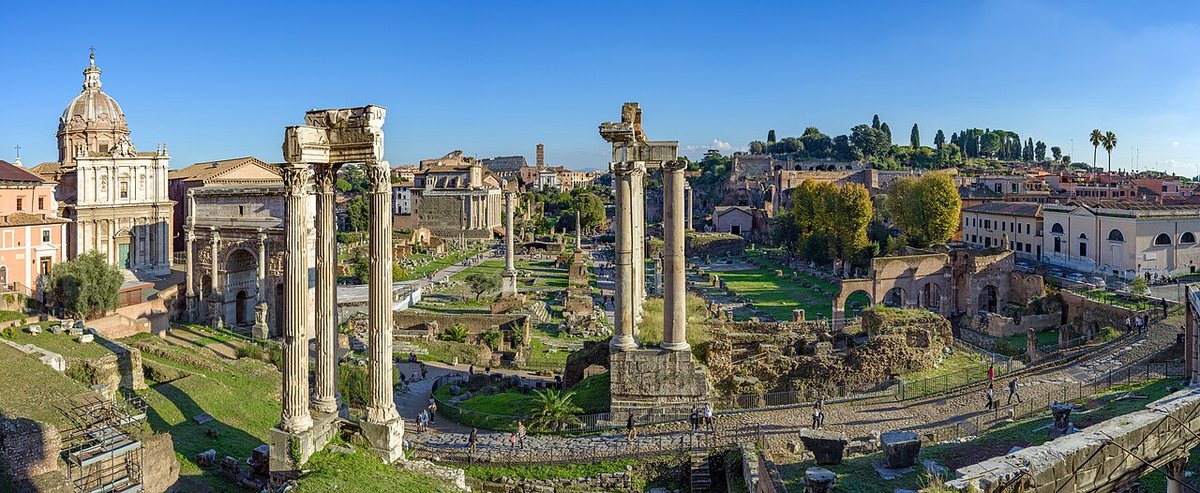
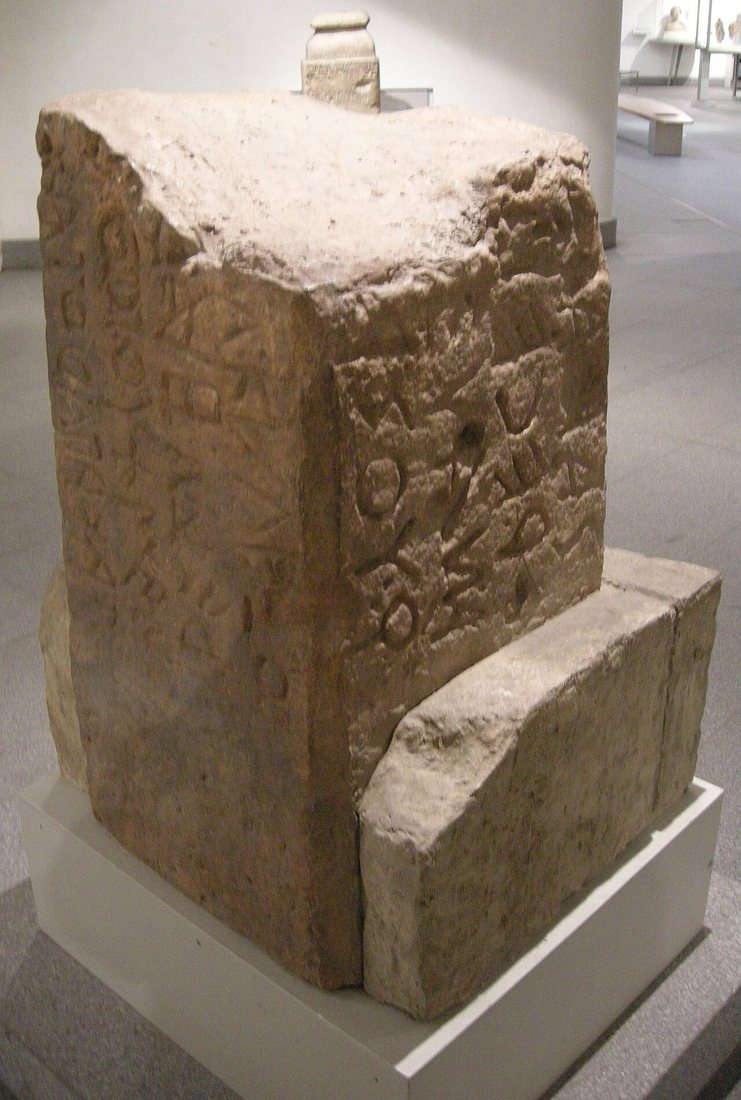
Only a handful of the earliest Latin texts exist, all short and hard to understand. Beneath the black marble paving called the Lapis Niger (“black stone”) in the Roman Forum lay an inscribed stone block, excavated by Giacomo Boni in 1899–1905. It is usually dated c. 570–550 BCE, is written boustrophedon, and only a third to a half of each line survives. It seems to forbid disturbing a ritual under threat of a curse, and it mentions a king: recei is the dative of rex.
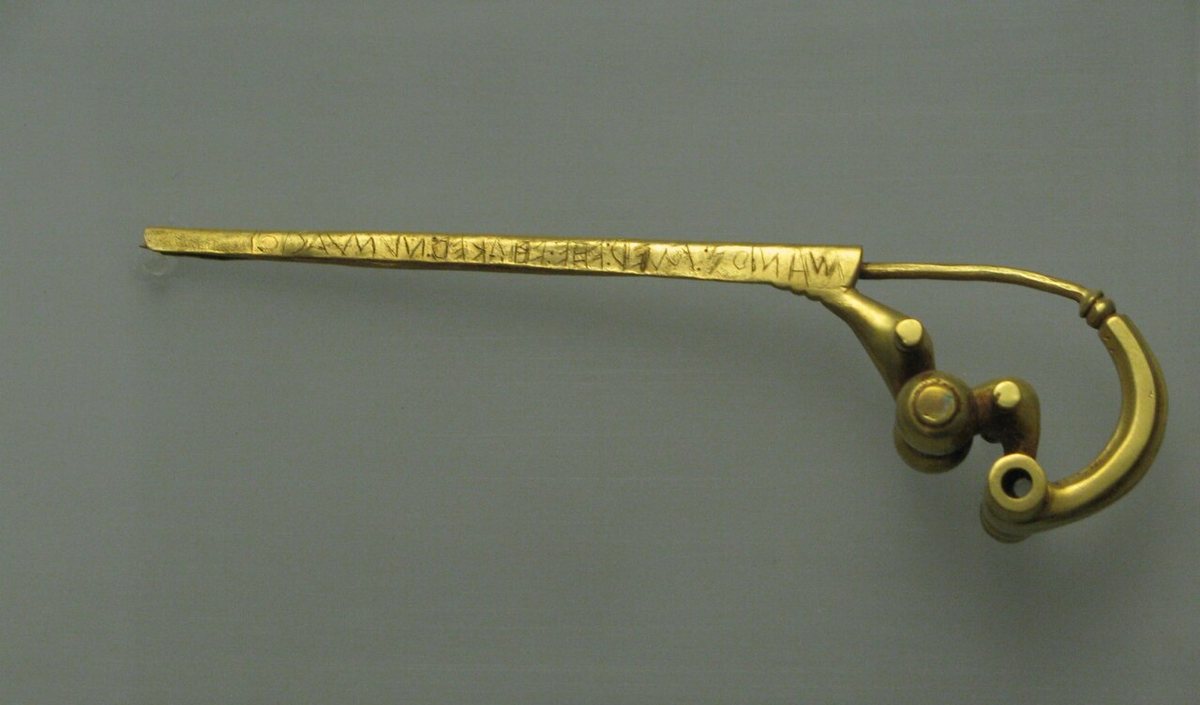
The Duenos inscription on a triple clay vessel, found in Rome in 1880, is dated variously between the 7th and the 5th century BCE. It is written from right to left without word spaces, and by 1983 more than fifty different interpretations had been proposed. The opening of its last section is clear: DVENOS MED FECED, “a good (man) made me”. Duenos is the older form of Classical bonus, “good”. Like the Praeneste fibula, the vessel carries a so-called speaking inscription, in which the object talks about itself.
Objects that speak
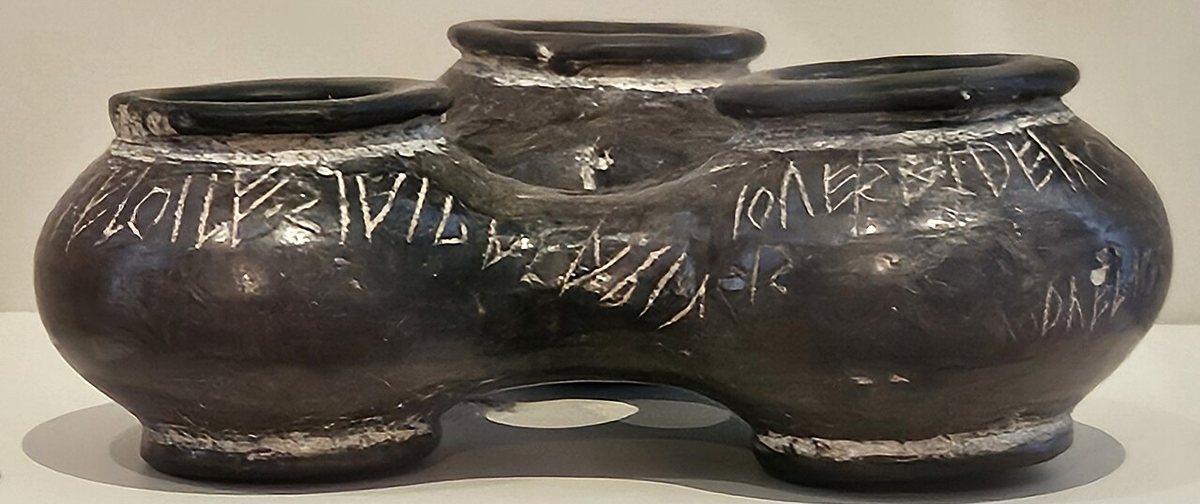
An alphabet from the Etruscans
According to the prevailing view, the Latin alphabet came from the Etruscan alphabet, which derived from the Greek script used at the Greek colony of Cumae in southern Italy; the Greek script itself came from Phoenician. Etruscan had no voiced consonants b, d, g, so the letters that stood for them in Greek either went unused in Etruscan or changed their value. Latin restored b and d, but at first wrote both k and g with C. Besides C it had K and Q for k; in early inscriptions the choice often depended on the following vowel (KA, CE, QO/QV).
Probably in the 3rd century BCE a new letter G was made from C by adding a stroke. It took the place of the unneeded Z, which dropped out of the alphabet; ancient authors (Plutarch) connect its introduction with the name of Spurius Carvilius. The Etruscans at first wrote the sound f as the pair FH, and so does the Praeneste fibula; Latin later kept only F. In the 1st century BCE, Y and Z were added at the end of the alphabet for words borrowed from Greek. The letters I and V stood for both a vowel and a consonant (i/j, u/w); J, U and W became separate letters only in the Middle Ages and the early modern period. The Romans did not yet distinguish capital and lowercase letters in the modern sense; lowercase forms (minuscules) developed from handwriting in late antiquity and became established as separate letters in the Middle Ages.
From the Etruscan alphabet to the Latin
- Afrom Greek alpha
- BEtruscan had no b sound and the letter fell out of use there; Latin kept it
- CGreek gamma; Latin at first used it for both k and g
- DEtruscan had no d sound and the letter fell out of use there; Latin kept it
- FGreek digamma (w); f was first written as the pair FH
- Zdropped from Old Latin; returned at the end of the alphabet in the 1st c. BCE
- Hfrom Greek eta, with the value h
- Iboth i and consonantal j
- Kin early inscriptions mainly before a, later only in a few words (Kalendae)
- Mthe old five-stroke form
- QGreek qoppa; in early inscriptions before o and u, in Classical Latin only before u
- VGreek upsilon; both u and consonantal w
- XGreek chi, read ks in the western Greek alphabets
MANIOS MED FHEFHAKED NVMASIOI“Manius made me for Numasios (Classical Numerius)” (the Praeneste fibula, authenticity disputed). On the brooch it reads from right to left, the sound f is written with the pair FH, and m has the old five-stroke form; the object itself reads FHE:FHAKED with an interpunct in the middle.
The first column shows the Etruscan (Old Italic) letter forms, rendered in Noto Sans Old Italic; the earliest Latin inscriptions wrote them very similarly, usually from right to left. Here they run left to right, as Unicode encodes them. The table is a selection; the Classical Latin alphabet had 21 native letters plus Y and Z.
Old and Classical Latin
Latin before about 75 BCE is called Old (Archaic) Latin. It had forms that later changed: genitive quoius for cuius, dative virtutei for virtuti, an ablative ending in -d (Gnaivod for Gnaeo), diphthongs as in aidilis for aedilis. The oldest texts were obscure even to the Romans themselves: the Greek historian Polybius wrote in the 2nd century BCE that the first treaty between Rome and Carthage, concluded around 508 BCE, could be read by the Romans of his day only with great difficulty.
Latin literature begins in 240 BCE with the first play of Livius Andronicus; around 200 BCE Plautus wrote his comedies. Classical Latin (c. 75 BCE – 200 CE) is the language of Cicero, Caesar, Virgil, Horace, Ovid and Livy, fixed in the schools of rhetoric and grammar. Today’s textbooks are based on it. The letter c was then always pronounced k, so Cicero sounded like Kikero.
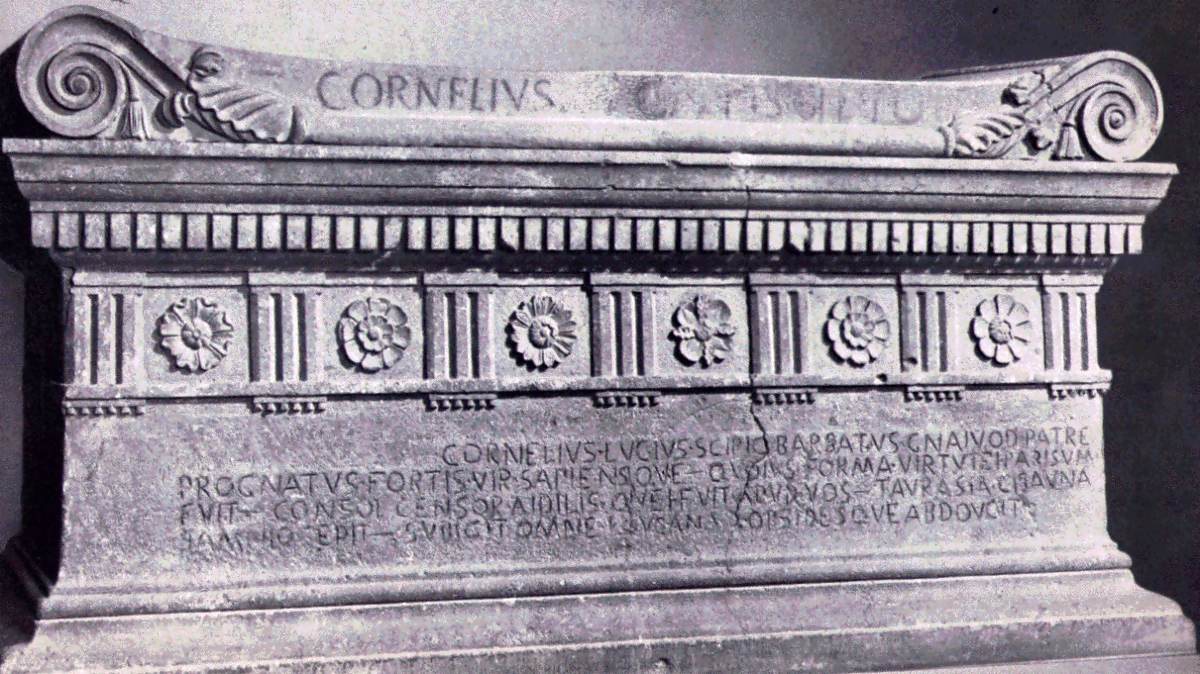
Cornelius Lucius Scipio Barbatus, Gnaeo patre prognatus, fortis vir sapiensque, cuius forma virtuti parissima fuit
- GNAIVOD PATRE
- from his father Gnaeus (ablative; Classical Gnaeo)
- PROGNATVS
- born
- FORTIS VIR SAPIENSQVE
- a brave and wise man (-que = and)
- QVOIVS FORMA
- whose appearance (Classical cuius)
- VIRTVTEI PARISVMA FVIT
- fully matched his valour (Classical virtuti parissima)
Cornelius Lucius Scipio Barbatus, born of his father Gnaeus, a brave and wise man, whose appearance fully matched his valour…The opening of the verse epitaph of Scipio Barbatus, probably from the 3rd century BCE. It goes on to say that he was consul, censor and aedile, captured towns in Samnium and subdued Lucania. The Old Latin forms GNAIVOD, QVOIVS, VIRTVTEI, CONSOL and AIDILIS give its age away; a dot separates the words.
The language of empire
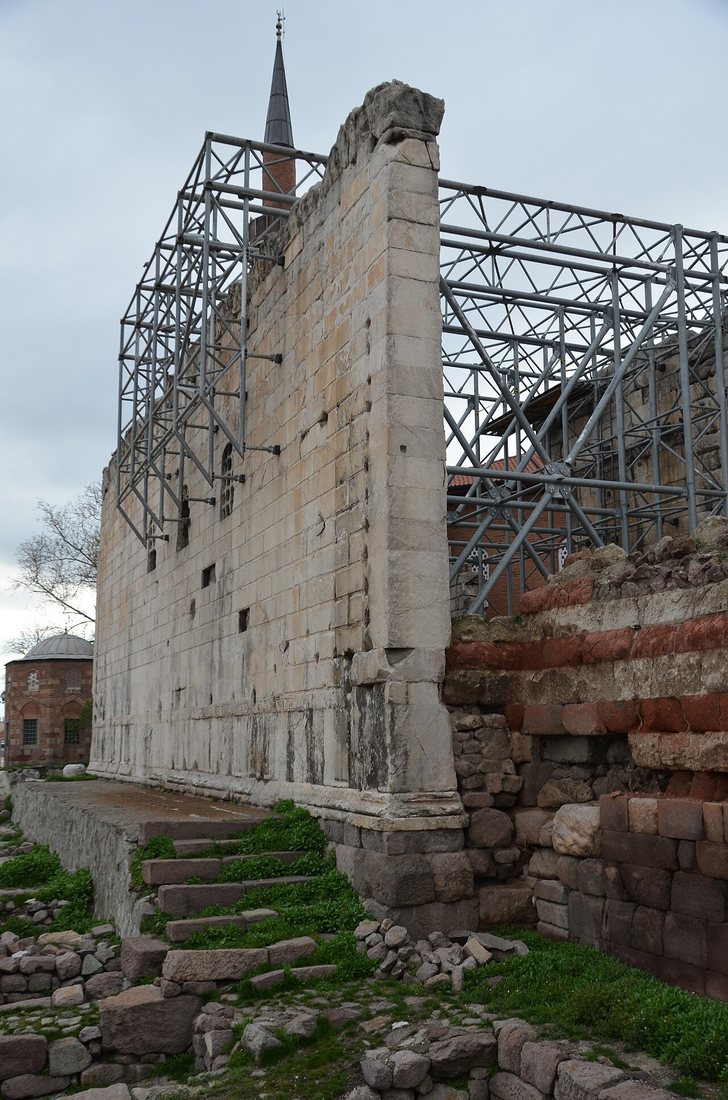
Latin was the language of Roman law, the army and the central administration throughout the empire; in the east, however, officials routinely dealt with the population in Greek. The best-known official text in Latin is the first emperor Augustus’ account of his own achievements, the Res Gestae Divi Augusti, completed, according to the usual account, a month before his death on 19 August 14 CE. The original was engraved on two bronze pillars in front of his mausoleum in Rome and has not survived. Copies, however, were carved in stone in the provinces: at Ancyra (modern Ankara) in Latin and in a Greek translation, at Pisidian Antioch in Latin, at Apollonia in Greek only. In the eastern empire the Latin text was translated for local readers.
After the Western Roman Empire ended in 476, the Germanic kingdoms that replaced it kept Latin as the language of law and official documents. In the Eastern Roman Empire Latin remained for a time the language of government and legislation; under Justinian I most of the Corpus Iuris Civilis was compiled in it. Then Greek replaced it in administration, and Latin survived only in a fossilized form on coins and in ceremonies until the 11th century.
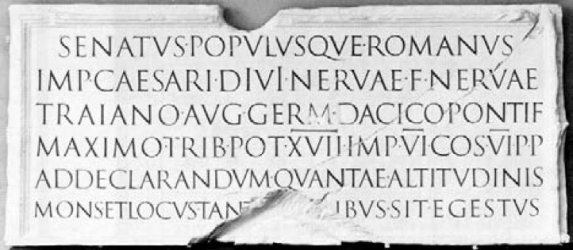
Capitals, rustic capitals and cursive
Stone inscriptions were cut in square capitals (capitalis monumentalis), with sharp straight lines, thick and thin strokes and serifs. The most famous example is the inscription on the base of Trajan’s Column, dedicated on 12 May 113; because it was read from below, the letters of the lower lines are slightly smaller. According to Edward Catich, the letters were first painted with a flat brush and only then cut by the stonemason, but this view is not universally accepted. The capital letters of today’s book typefaces go back to Roman capitals; the Trajan typeface of 1989 is a direct adaptation.
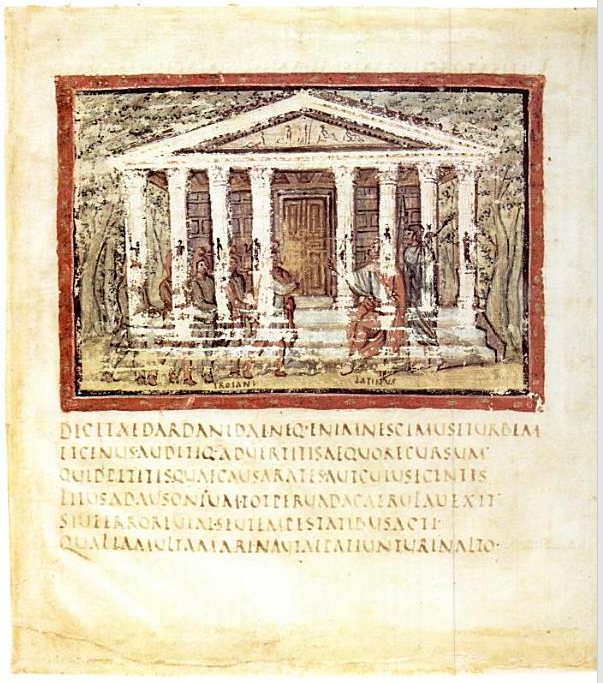
Books were written in the narrower rustic capitals; an example is the Vergilius Vaticanus, a manuscript of Virgil’s poems made in Rome around 400, the oldest of the three surviving illustrated manuscripts of classical literature. Everyday writing – letters, accounts, school exercises and writing on walls – was faster and joined: Old Roman cursive (mainly 1st c. BCE – 3rd c. CE), followed by New Roman cursive (c. 3rd–7th c.), whose a, b, d and e already approach modern lowercase letters.
Letters from Vindolanda
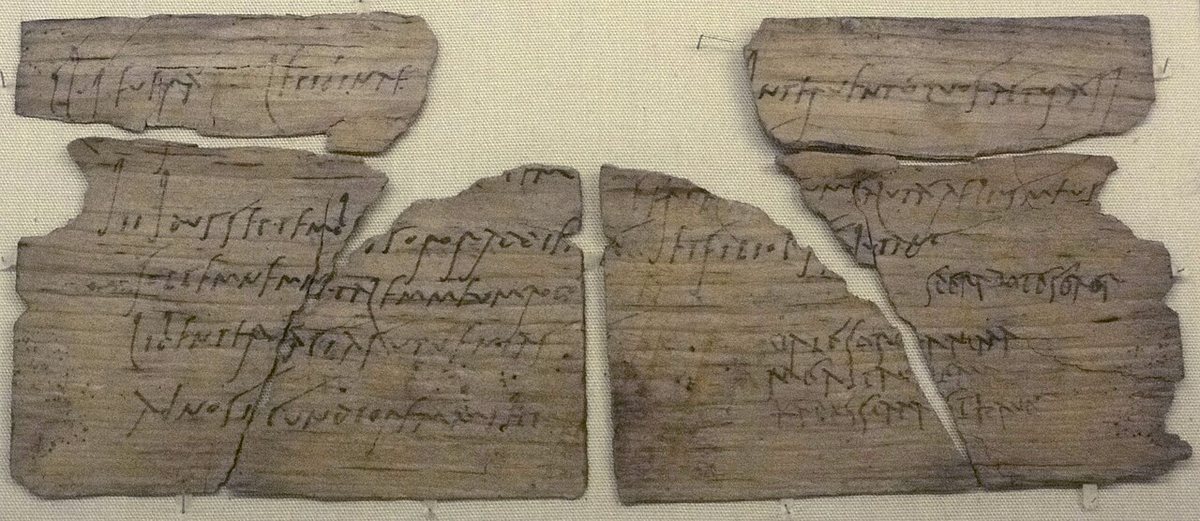
Most everyday writing has been lost. An exception are the wooden tablets from the fort of Vindolanda in northern Roman Britain, which the archaeologist Robin Birley began finding in March 1973. They are thin, postcard-sized leaves of birch, alder and oak written in ink made from carbon, gum arabic and water; most date from about 95–105, slightly before Hadrian’s Wall. By 2023 more than 1,700 had been found.
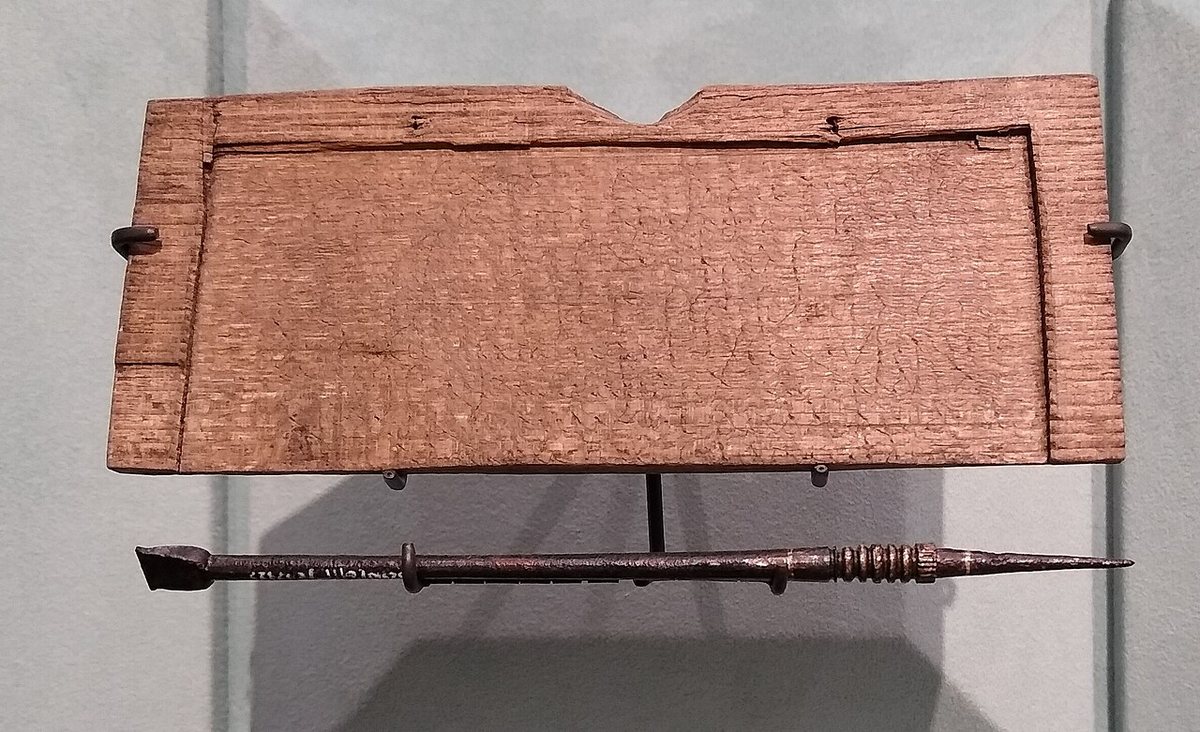
The tablets contain the garrison’s official records as well as private letters. In one, the decurion Masculus asks the commander for orders for the next day and for more beer, because the garrison has drunk the last of it. The best known is the invitation that Claudia Severa, wife of the commander of a nearby fort, sent around 100 to Sulpicia Lepidina for her birthday celebration; it is one of the earliest known Latin texts written by a woman. Besides ink tablets, people wrote with a stylus in wax on wooden tablets that could be wiped and reused; hence the phrase tabula rasa, “a clean (scraped) tablet”.
Wax and stylus

The Latin of the street
Written Latin changed slowly, spoken Latin faster. Since the Renaissance, colloquial Latin has been called Vulgar Latin (from vulgus, “the people”); scholars today stress that it was not a separate language but a continuous range from the written standard to everyday speech. The evidence is scattered: errors in inscriptions, curses on lead tablets, private letters, technical writings careless of style, and the later Romance languages.
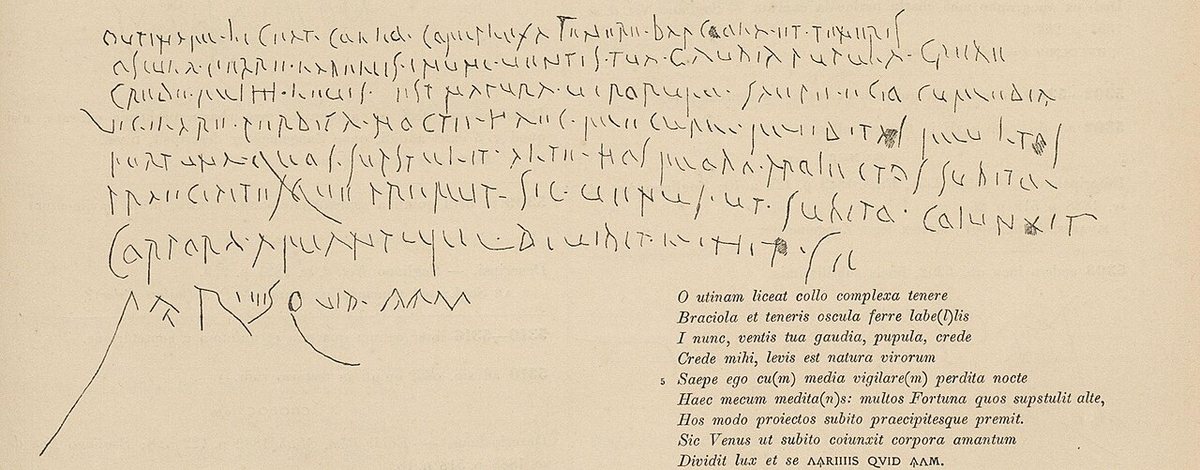
Especially valuable are the inscriptions on the walls of Pompeii, buried by the eruption of Vesuvius in 79; the scratched graffiti are mostly in Old Roman cursive. Already here the neuter merges with the masculine (hoc locum for hunc locum, “this place”). In speech, irregular and bookish words disappeared: ferre, “to carry”, gave way to portare, ignis, “fire”, to focus, originally “hearth”, and edere, “to eat”, to manducare, originally “to chew”.
From Latin to the Romance languages
Romance words continue spoken Latin, and mostly the accusative form without its final -m (aquam, manum, focum). Order: Italian · French · Spanish · Portuguese · Romanian.
| Latin | Romance languages | meaning |
|---|---|---|
| aqua | acqua · eau · agua · água · apă | water |
| manus | mano · main · mano · mão · mână | hand |
| lingua | lingua · langue · lengua · língua · limbă | tongue, language |
| filius | figlio · fils · hijo · filho · fiu | son |
| lac (colloquial accusative lactem) | latte · lait · leche · leite · lapte | milk |
| octo | otto · huit · ocho · oito · opt | eight |
| terra | terra · terre · tierra · terra · țară | land (Romanian “country”) |
| focus | fuoco · feu · fuego · fogo · foc | hearth; in spoken Latin “fire”, replacing ignis |
| caballus | cavallo · cheval · caballo · cavalo · cal | colloquially “horse”; the literary word was equus |
The birth of the Romance languages
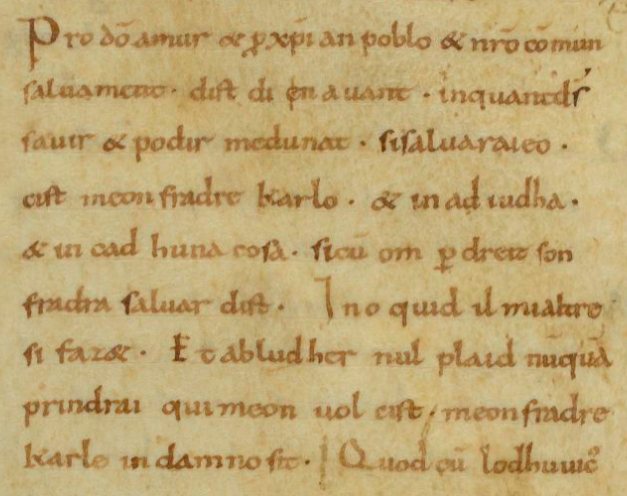
Between the 6th and 9th centuries, spoken Latin in the different regions of the former empire diverged so far that separate languages emerged. Writing, however, continued in Latin, so the Romance languages appear in writing only later. Speaking “in Roman” (romanice loqui) was then distinguished from speaking Latin (latine loqui).
The oldest continuous text deliberately written in an early Romance language of France is the Oaths of Strasbourg of 14 February 842. In them Charlemagne’s grandsons Louis the German and Charles the Bald made an alliance against their brother Lothair I. Louis swore in Romance so that Charles’s soldiers would understand him, and Charles in Old High German for Louis’s soldiers. The text was preserved by their cousin, the historian Nithard. Of the more than 900 million native speakers of Romance languages today, about half speak Spanish, followed by Portuguese, French, Italian and Romanian.
Latin after Rome
When Latin was no longer anyone’s mother tongue, it remained the language of the Church, schools, administration and learning, even in lands where Latin had never been spoken, among Germanic and Slavic peoples. In the Czech lands charters and chronicles were written in Latin, such as Cosmas’ Chronicle of the Czechs from the early 12th century, and Latin was the language of teaching at the University of Prague, founded in 1348. Many Latin words passed into Czech, the oldest of them by way of Old High German: kostel “church” (castellum, “small fort”), klášter “monastery” (claustrum, “enclosed place”), oltář “altar” (altare) and mše “mass” (missa); tabule “board” (tabula), for example, came directly from Latin.
Most books printed in the 15th century were in Latin, and Latin remained the language of scholars until the early 19th century. It is still the official language of the Holy See and the basis of technical terminology in medicine, biology and law. English, a Germanic language, took more than a quarter of its vocabulary directly from Latin, according to one frequently cited study, and about as much again from French, itself a descendant of Latin. The Latin script is used today for more than 3,000 languages and by about 70% of the world’s population; it is the most widely used writing system.
Timeline
- 753 BCETraditional date of the founding of Rome.
- 7th c. BCEThe Praeneste fibula, if genuine, one of the earliest Latin inscriptions.
- c. 570–550 BCEThe inscribed block beneath the later Lapis Niger paving in the Roman Forum.
- 3rd c. BCEThe letter G enters the alphabet; the verse epitaph of Scipio Barbatus.
- 240 BCEFirst play of Livius Andronicus, the beginning of Latin literature.
- 1st c. BCEClassical Latin: Cicero, Caesar, Virgil; Y and Z are added for Greek words.
- 14 CEDeath of Augustus; his Res Gestae is inscribed in the provinces.
- 79The eruption of Vesuvius buries Pompeii and the writing on its walls.
- c. 95–105Letters and records from the fort of Vindolanda in Britain.
- 113Dedication of Trajan’s Column with its inscription in square capitals.
- c. 400The Vergilius Vaticanus manuscript is made in Rome.
- 476End of the Western Roman Empire.
- 14 Feb 842The Oaths of Strasbourg, the oldest continuous text in an early Romance language of France.
- 1899–1905Giacomo Boni excavates the inscribed block beneath the Lapis Niger.
- 1973The first ink-written wooden tablets are found at Vindolanda.
- 2011Surface analyses of the Praeneste fibula support its authenticity.
Italic languages on the globe
Tap a language to show it on the globe:
Sources and further reading
- James Clackson, Geoffrey Horrocks: The Blackwell History of the Latin Language. Blackwell, 2007.
- Tore Janson: A Natural History of Latin. Oxford University Press, 2004.
- József Herman: Vulgar Latin. Trans. Roger Wright. Pennsylvania State University Press, 2000.
- Arthur E. Gordon: Illustrated Introduction to Latin Epigraphy. University of California Press, 1983.
- Alan K. Bowman: Life and Letters on the Roman Frontier: Vindolanda and its People. British Museum Press, 1994.
- Glottolog 5 (languages and their classification).