Languages of antiquity
The Etruscans
Etruria · from the first inscriptions around 700 BCE to the language's extinction around the turn of the era
Before the rise of Rome the Etruscan cities were among the most powerful in Italy, and on the prevailing view it was from them that the Romans took the alphabet that became the Latin script. Etruscan is not an Indo-European language; its only attested relatives are now held to be Raetic in the Alps and Lemnian on the island of Lemnos. Its roughly 13,000 inscriptions can be read aloud, because the script comes from the Greek alphabet, but they are understood only in part. The longest surviving text outlasted the Etruscans as the wrappings of an Egyptian mummy.
The twelve cities of Etruria
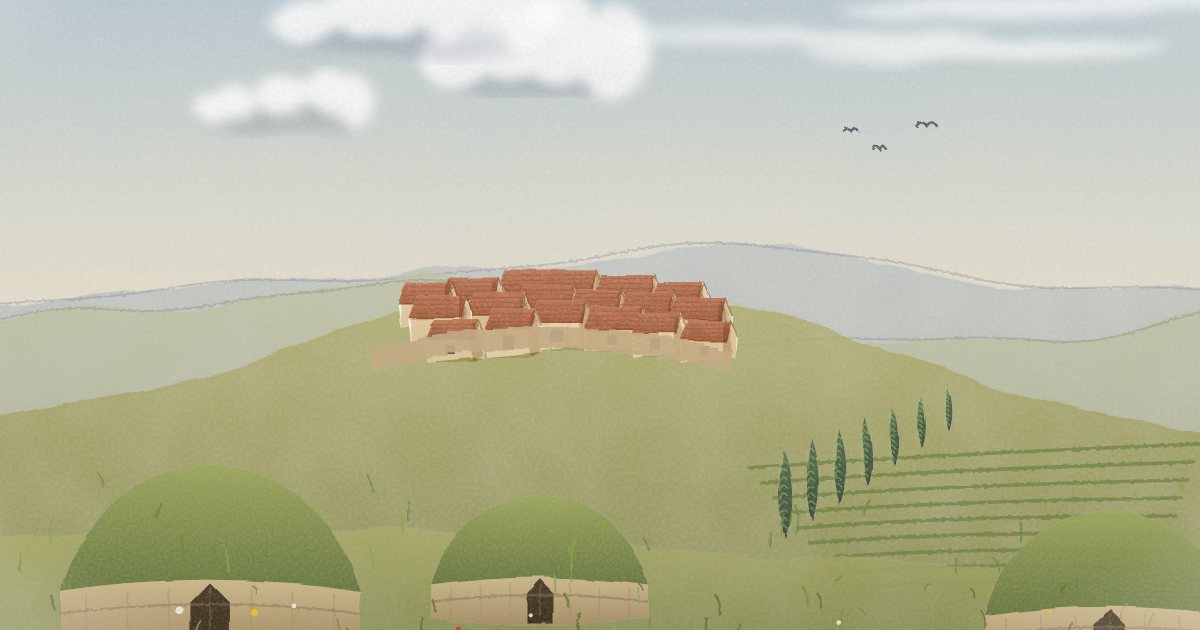
The Etruscans lived in central Italy between the rivers Arno and Tiber, in the region the Romans called Etruria, whose modern name, Tuscany, comes from the Latin Tusci, “Etruscans”. Their civilisation grew out of the earlier Villanovan culture in the same area (from about 900 BCE). Archaeologists and geneticists now mostly regard the Etruscans as a local population rather than immigrants from Asia Minor, as Herodotus claimed. Their wealth came from mining and trading metals, above all copper and iron, and Etruscan settlements spread into the Po Valley and Campania.
The Etruscans never formed a single state. According to ancient tradition, twelve cities formed a loose league and met once a year at the sanctuary of Fanum Voltumnae near Volsinii; they are usually taken to include Tarquinia, Caere (modern Cerveteri), Veii, Vulci, Volterra, Perugia, Cortona, Chiusi and Arezzo. According to Roman tradition, kings of Etruscan origin ruled Rome in the 6th century BCE (by the traditional dates 616–509 BCE), and the Romans expelled the last of them, Tarquin the Proud. From the 5th century BCE Etruscan power waned: in 474 BCE Hiero, tyrant of Syracuse, defeated the Etruscans at Cumae, in 396 BCE the Romans took and destroyed Veii, and in the 3rd century BCE they subdued all of Etruria.
A language without Indo-European relatives
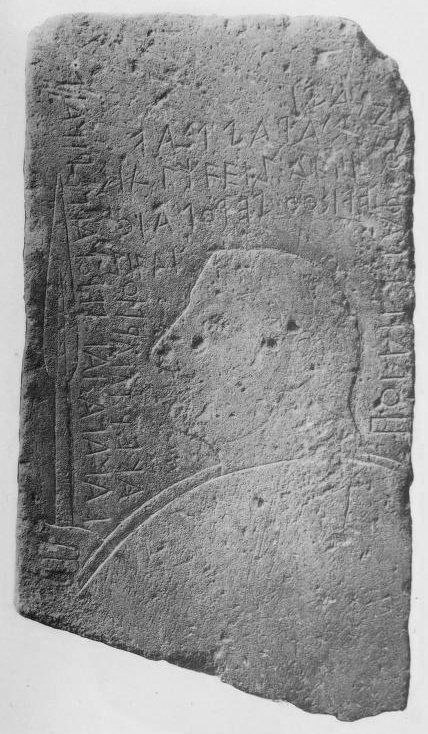
Etruscan is not an Indo-European language, unlike Latin, Oscan or Umbrian, which were spoken next door. For a long time it was treated as an isolate. Since the German linguist Helmut Rix's work of 1998, the prevailing view has been that it forms a small Tyrsenian (Tyrrhenian) family together with Raetic, attested in inscriptions from the eastern Alps, and Lemnian from the island of Lemnos in the Aegean. The correspondences lie mainly in morphology: Lemnian and Etruscan share, for example, the case endings -si and -ale, and Lemnian aviś matches Etruscan avils, the genitive of avil “year”. Proposed links with Hungarian, Albanian, Armenian, the Semitic, Caucasian or Anatolian languages have not been borne out.
According to the Greek historian Dionysius of Halicarnassus, the Etruscans called themselves Rasenna. The inscriptions have the form rasna, usually interpreted as “people, community”, as in tular rasnal, “boundaries of the people”. Some 13,000 Etruscan inscriptions are known today, dating from about 700 BCE to the early 1st century CE, mostly from Italy but also from Corsica, Sardinia, southern Gaul and Carthage. Most are short: epitaphs, owners' names, dedications to gods. Only a handful of longer texts exist.
An alphabet from Greek settlers
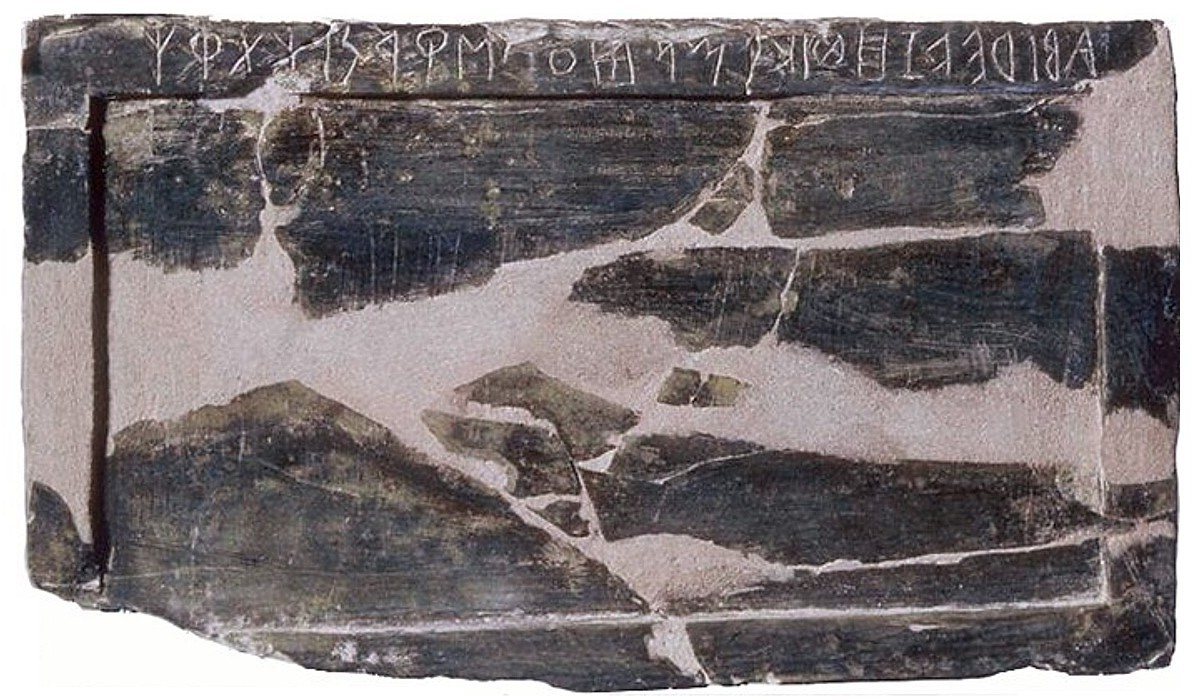
The Etruscans took their script from Greeks of the island of Euboea, who in the 8th century BCE founded the first settlements in Italy, Pithekoussai on the island of Ischia and Cumae in Campania. The earliest known Etruscan alphabet is incised on the frame of a small ivory wax tablet from Marsiliana d'Albegna near Grosseto, dating from about 700 BCE. It has 26 letters in Greek order, including digamma, san and qoppa; it also contains letters the Etruscans did not need, such as B, D and O.
Etruscan had no voiced consonants b, d, g and no vowel o. The letters B, D and O therefore fell out of use, while Greek gamma (C) came to stand for k and displaced K and Q. For the sound f a new letter shaped like the figure 8 appeared around 600–550 BCE; an early Sabellian inscription suggests that the Etruscans took it from neighbours speaking Sabellian languages. By about 400 BCE all of Etruria was using the classical alphabet of 20 letters. Writing ran from right to left, and in the earliest inscriptions occasionally in alternate directions (boustrophedon). The earliest inscriptions do not separate words; from the 6th century BCE they are divided by a dot or a colon.
A strong stress on the first syllable weakened the vowels of the following syllables, which then went unwritten: Greek Alexandros is Etruscan Alcsntre, Herakles is Hercle. This explains the consonant clusters that look so unusual in Etruscan words.
The Etruscan alphabet
- a
- c[k]; from Greek gamma, hence Latin C
- e
- v[w]; Greek digamma, hence Latin F
- z[ts]
- h
- θ[tʰ], aspirated t
- i
- l
- m
- n
- p
- śa sibilant, probably [ʃ]; Greek san
- r
- s
- t
- ualso for Greek o
- φ[pʰ], aspirated p
- χ[kʰ], aspirated k
- f[f]; only from the 6th c. BCE
- k[k]; archaic only, mainly before a
- q[k]; archaic only, before u
tular rasnal“boundaries of the people”, i.e. public boundaries – an inscription on boundary stones; -l is the genitive ending
The classical Etruscan alphabet (from about 400 BCE) had 20 letters; k and q belong to archaic inscriptions. The letters b, d and o, present in the model alphabet, were not used by the Etruscans. The signs for s and ś were used the other way round in different cities, and letter shapes varied by place and period. Unicode encodes the Old Italic scripts left to right, so the letters and words here are drawn as mirror images of most inscriptions, which run right to left. The signs are rendered in the Noto Sans Old Italic font.
Readable, but only partly understood
The Etruscan script never needed deciphering: the sound values of the letters are known from their Greek origin, so the texts can be roughly pronounced. What is missing is a key to their meaning. Etruscan has no well-known relatives to help, and the surviving texts are short and repetitive. Scholars therefore use the so-called combinatory method: they observe the contexts in which a word recurs and infer its function and meaning from the patterns. In this way word classes, case and verb endings and the meanings of frequent words have been established. Today the meaning of only a few hundred words is known with reasonable certainty.
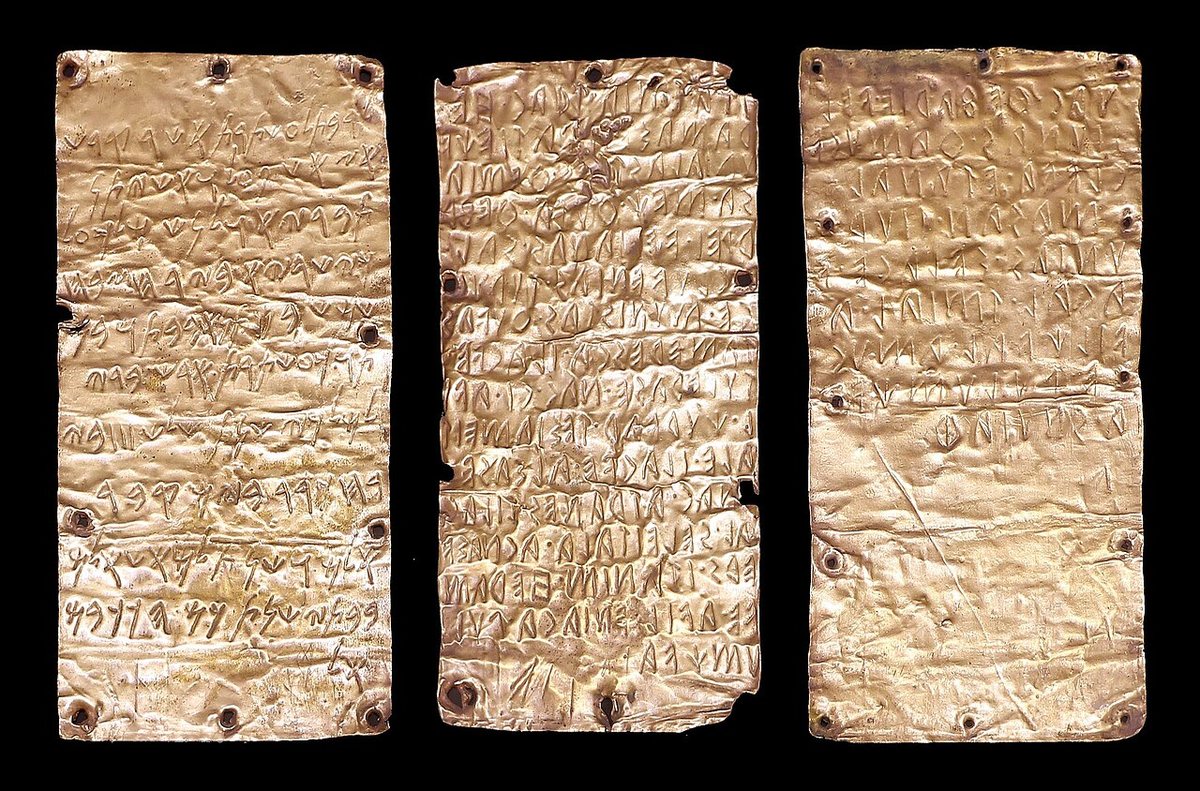
Other help comes from bilingual inscriptions with Latin, Greek or Phoenician, from scenes on mirrors and vases in which figures from Greek myth are labelled in Etruscan (Hercle, Menrva, Aplu), and from remarks by ancient authors. The most valuable bilingual text is the set of gold tablets from Pyrgi, the port of Caere, found in 1964 in Massimo Pallottino's excavations. Dating from about 500 BCE, they record the dedication of a sanctuary to a goddess whom the Phoenician text calls Astarte and the Etruscan text Uni. The Phoenician and the longer Etruscan text correspond in content but are not word-for-word translations. The only new word that could be extracted from them is ci, “three”: the donor, Thefarie Velianas, ruler of Caere, dedicated the sanctuary in the third year of his reign.
tite cale : atial : turce malstria : cver
- tite cale
- Tite Cale (a man's name)
- atial
- to (his) mother (genitive of ati “mother”)
- turce
- gave
- malstria
- mirror
- cver
- gift (?)
Tite Cale gave (this) mirror to (his) mother as a gift.An inscription on an Etruscan bronze mirror with a scene showing the goddess Turan (Venus), Atunis and Menrva (Minerva). On the mirror it runs from right to left, with colons between the words. The genitive atial here marks the recipient, as is usual in Etruscan dedications; turce is the past form of the verb tur- “give”, with the suffix -ce, which does not mark person. The meaning of cver is inferred from similar dedications and is less certain. About 2,300 Etruscan mirrors are known, and many name the figures shown on them.
Speaking objects and epitaphs
Many Etruscan inscriptions speak for the object in the first person: mi … “I (am) …”. Vessels carry the name of their owner or donor. An inscription on a 5th-century BCE cup (kylix) even warns off thieves: mi χuliχna cupes alθrnas … ei minipi capi, “I (am) the cup (kylix) of Cupe Althrna … do not steal me”.
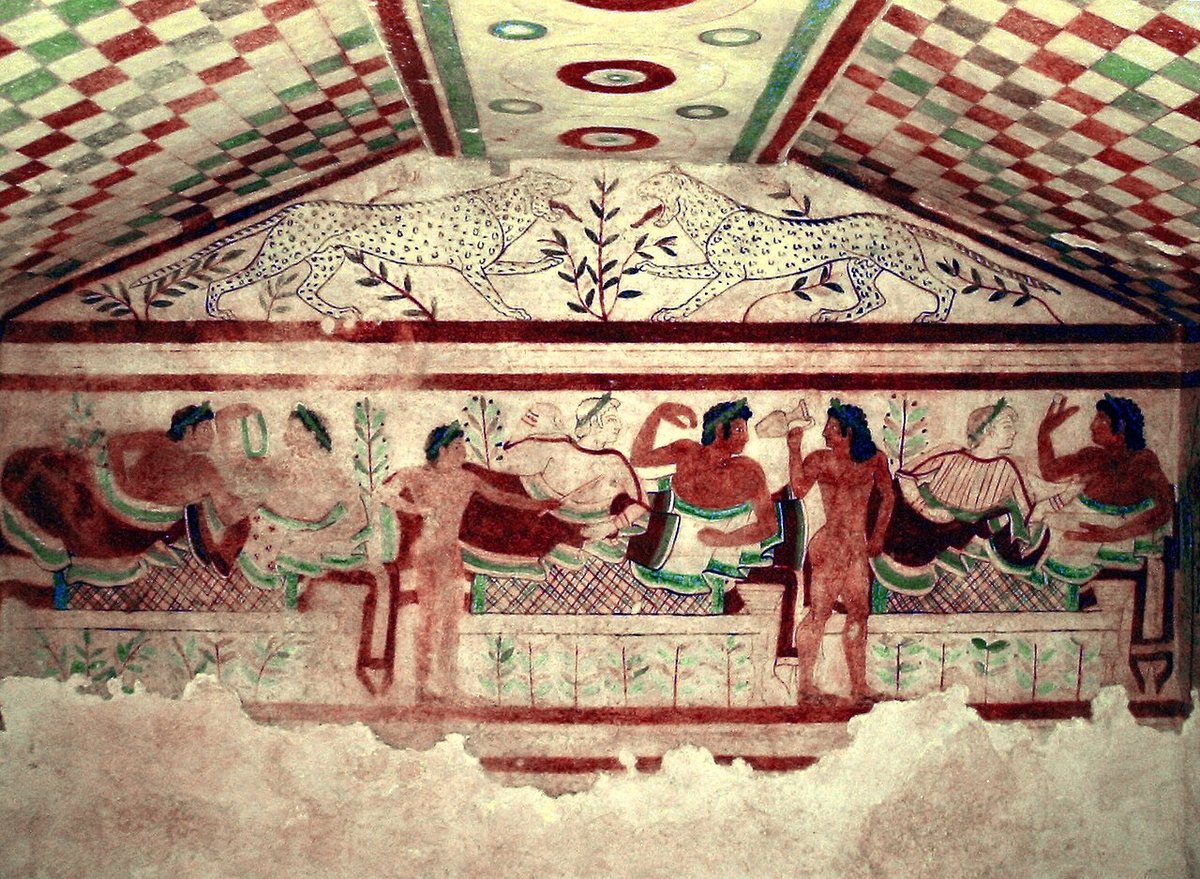
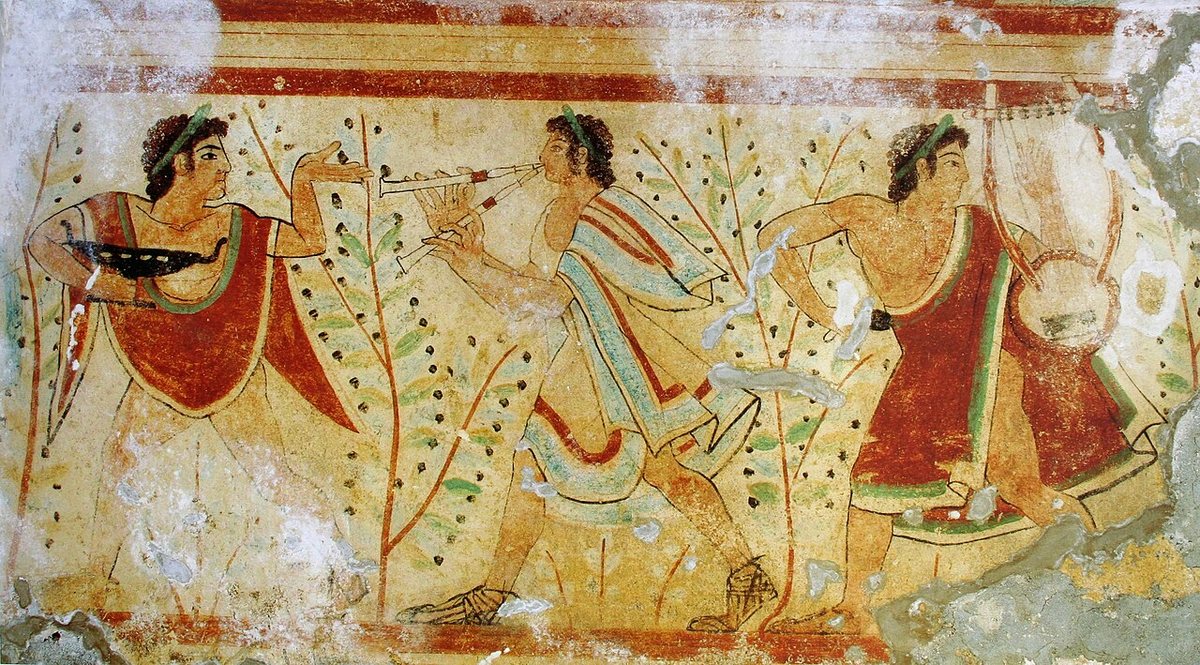
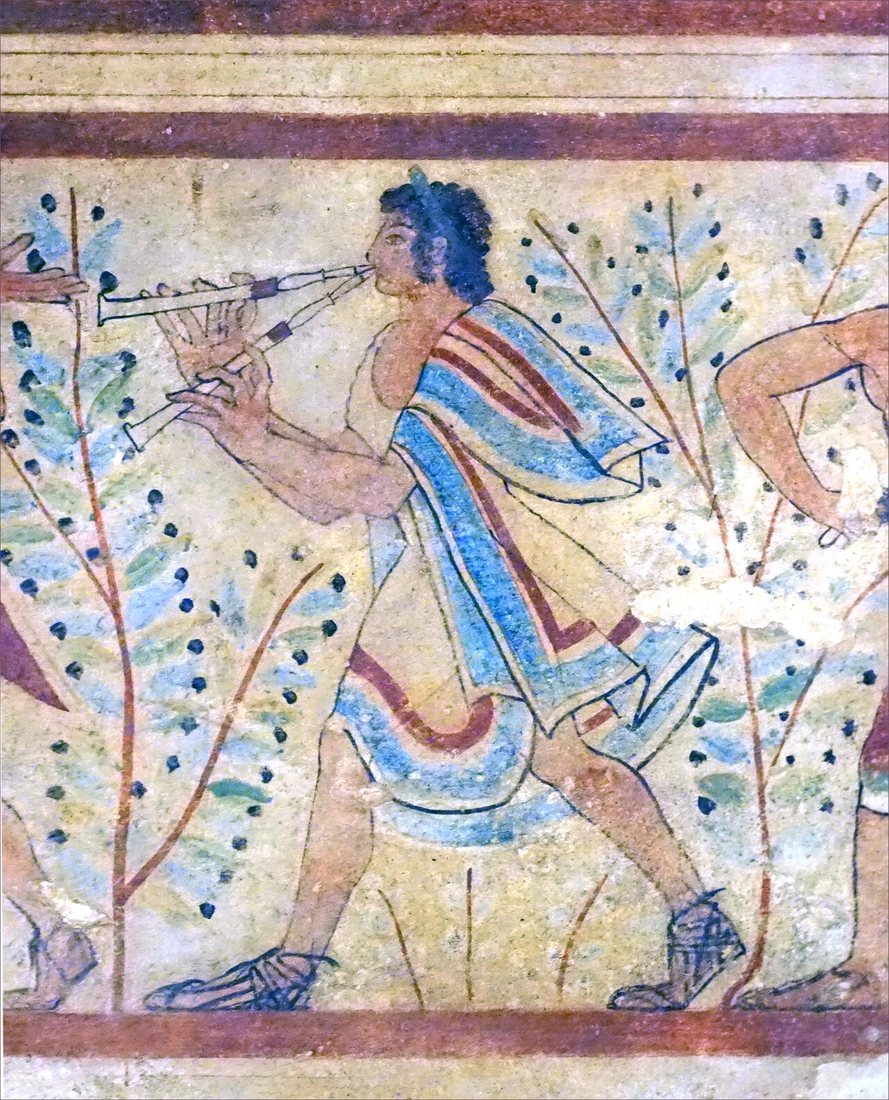
Most inscriptions come from graves. The Etruscan necropolises of Cerveteri and Tarquinia are UNESCO World Heritage Sites: the Banditaccia necropolis at Cerveteri has more than a thousand burial mounds, and Tarquinia some 6,000 graves and about 200 painted tombs, where figures are often labelled with Etruscan names. Epitaphs follow set formulas: name, father's name (clan “son”, seχ “daughter”), offices held and age, for example lupu avils … “died aged … years”. Thanks to these formulas, words for kinship, offices and numbers are among the best known.
Etruscan is an agglutinative language: it expresses grammatical meanings by stringing suffixes together. “Son” is clan, “sons” clenar and “to the sons” clenaraśi. By the usual description nouns have five cases and two numbers, with the same form for nominative and accusative. The past tense is formed with the suffix -ce, which does not mark person: tur “gives”, turce “gave”. The verb usually comes at the end of the clause.
Etruscan words
Words whose meaning is well established. The letters are shown here in Unicode, left to right; on the monuments they usually ran right to left:
| inscription | transliteration | meaning |
|---|---|---|
| 𐌌𐌉 | mi | I; accusative mini “me” |
| 𐌂𐌋𐌀𐌍 | clan | son; plural clenar |
| 𐌔𐌄𐌙 | seχ | daughter |
| 𐌀𐌕𐌉 | ati | mother |
| 𐌀𐌐𐌀 | apa | father |
| 𐌐𐌖𐌉𐌀 | puia | wife |
| 𐌀𐌅𐌉𐌋 | avil | year; in epitaphs the age of the deceased |
| 𐌋𐌖𐌐𐌖 | lupu | died |
| 𐌔𐌅𐌀𐌋𐌂𐌄 | svalce | lived |
| 𐌕𐌖𐌓𐌂𐌄 | turce | gave, dedicated |
| 𐌆𐌉𐌋𐌀𐌈 | zilaθ | a high magistrate, comparable to a Roman praetor |
| 𐌕𐌖𐌋𐌀𐌓 | tular | boundary, boundaries |
| 𐌀𐌉𐌔, 𐌀𐌉𐌔𐌀𐌓 | ais, aisar | god, gods |
| 𐌖𐌔𐌉𐌋 | usil | sun; also the sun god |
| 𐌕𐌉𐌖𐌓 | tiur | moon; month |
The Tomb of the Leopards at Tarquinia
Counting
Etruscan numerals are known from epitaphs giving the age of the deceased and from a pair of dice from Tuscania on which the numbers are written out as words. There is agreement on θu 1, zal 2, ci 3 and maχ 5; śa and huθ are 4 and 6, but which is which is disputed; the prevailing view now is śa 4, huθ 6 (see the box). Tens are formed with the suffix -alχ (cealχ 30, muvalχ 50), and twenty is zaθrum. The numbers 17 to 19 were expressed by subtraction from twenty: ciem zaθrum, “three from twenty”, is 17. The Romans formed duodeviginti and undeviginti (18 and 19) in the same way, which is attributed to Etruscan influence.
The Etruscan numeral signs 𐌠 (1), 𐌡 (5), 𐌢 (10) and 𐌣 (50) are generally regarded as the forerunners of Roman numerals. Numbers were written additively from higher values to lower, so 87 is 𐌣𐌢𐌢𐌢𐌡𐌠𐌠 (usually right to left in inscriptions). Only 17 to 19 were also written subtractively in figures, 17 as 𐌠𐌠𐌠𐌢𐌢 (“three from twenty”). Four, however, the Etruscans wrote as 𐌠𐌠𐌠𐌠, not by subtraction like the later Roman IV.
The linen book of Zagreb
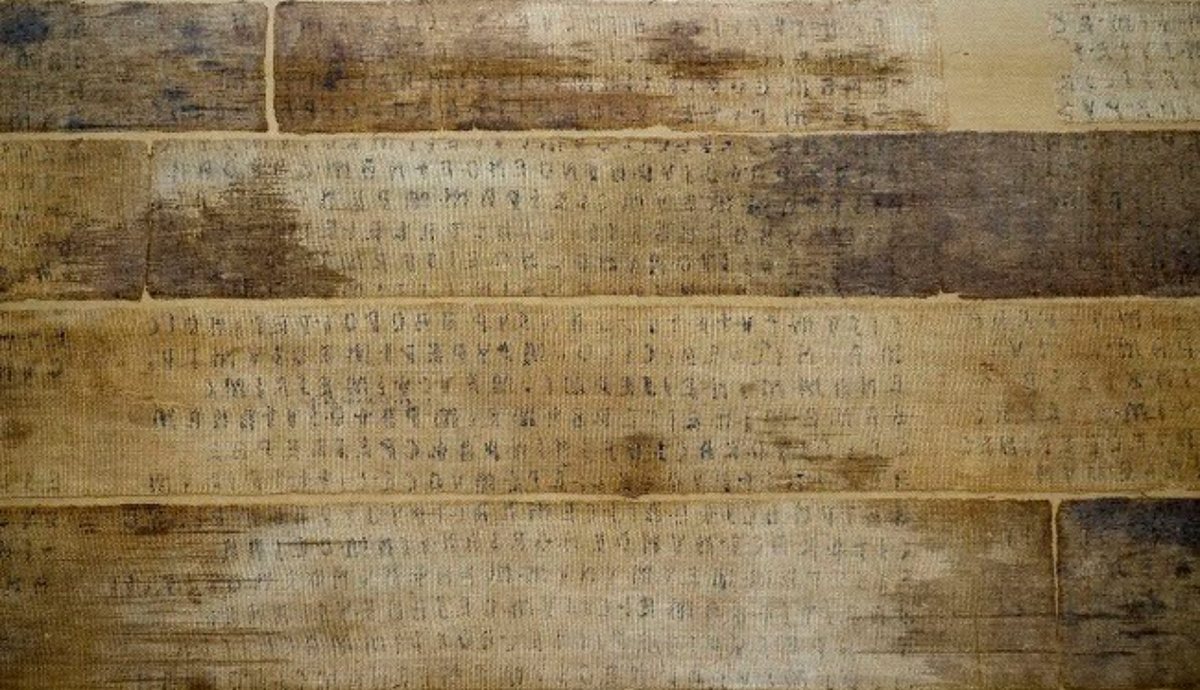
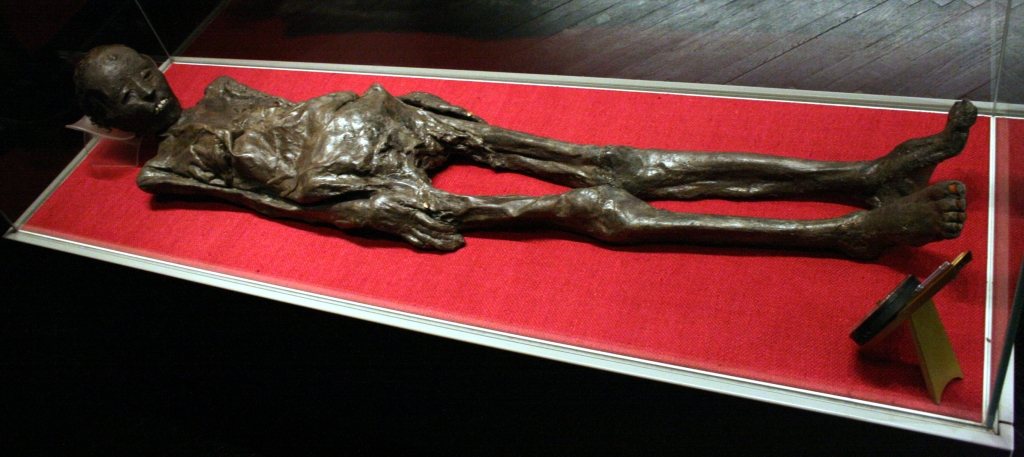
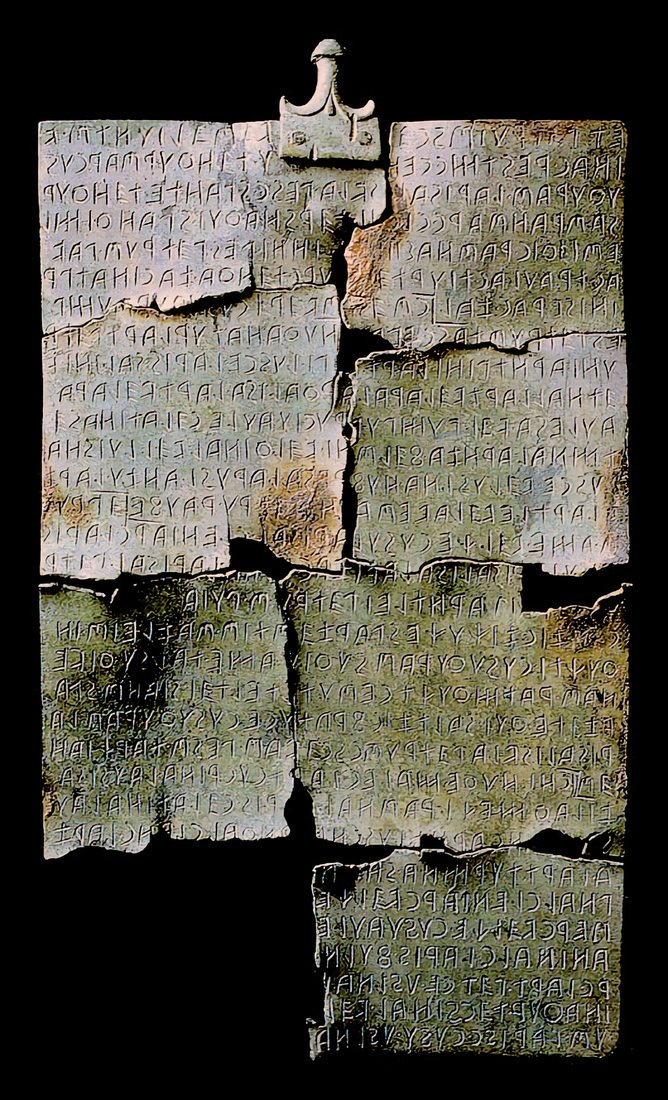
According to Roman authors the Etruscans had a rich religious literature, known collectively as the Etrusca disciplina: books on divination from the entrails of sacrificed animals, from lightning, and on rituals. None of it survives. The only Etruscan book to have come down to us is the Liber Linteus (“linen book”), and only by chance: the linen it was written on was used in Ptolemaic Egypt to wrap a mummy.
The mummy of a woman was bought in Alexandria in 1848 by the Croatian official Mihajlo Barić, and since 1867 it has been in Zagreb together with its wrappings, now in the Archaeological Museum. The Egyptologist Heinrich Brugsch noticed the writing but took it for Egyptian. Only in 1892 did Jakob Krall in Vienna recognise the language as Etruscan and put the strips back in their original order.
The book had twelve columns written from right to left, in black ink with red rulings. About 230 lines survive with some 1,300 legible words, but only some 500 distinct words or roots; only about 60% of the original text is thought to survive. On palaeographic grounds it dates from about 250 BCE, while radiocarbon dating points to an older cloth. Its content is most probably a religious calendar with dates, names of gods and instructions for offerings, for example vacl, on the prevailing interpretation “libation”. The names of local gods place its origin around Lake Trasimeno, on the border of modern Tuscany and Umbria (Perugia, Chiusi, Cortona, Arezzo).
A calendar, contracts and boundary stones
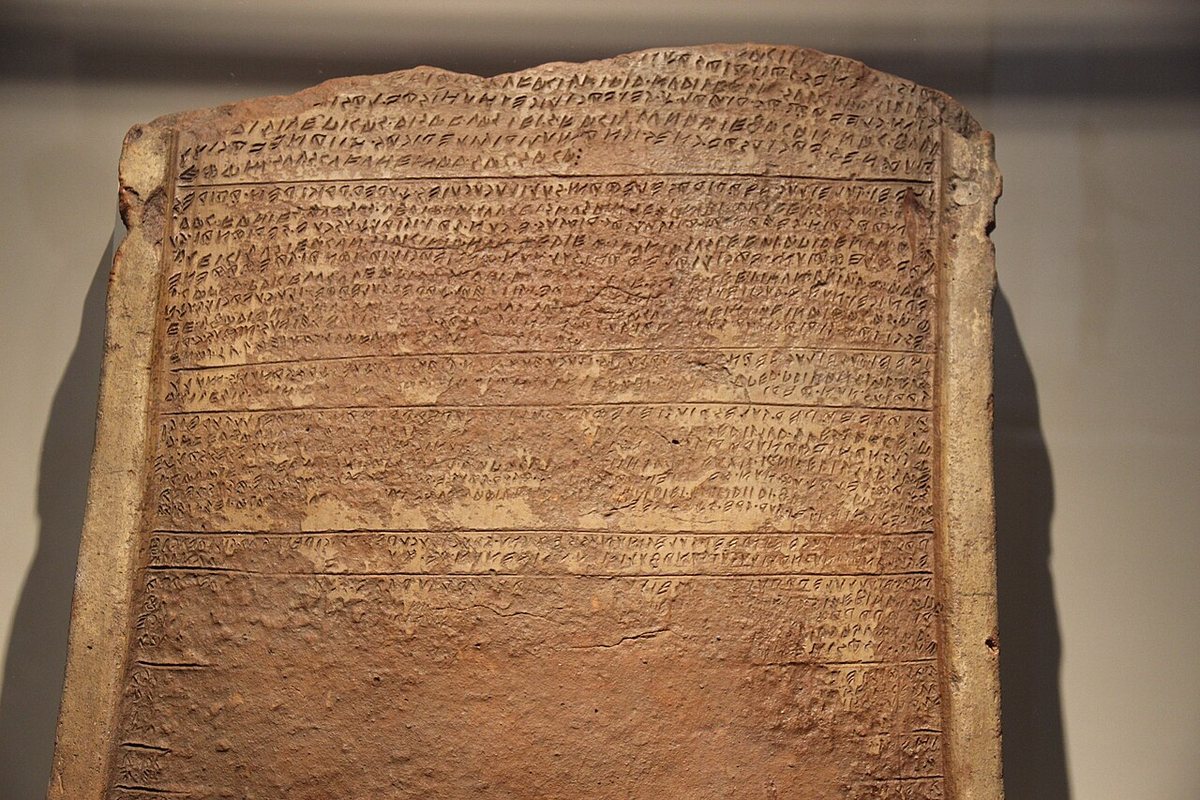
The second-longest Etruscan text is the Tabula Capuana, a terracotta slab about 60 × 50 cm found in 1898 at Santa Maria Capua Vetere in Campania and now in the Altes Museum in Berlin. It dates from about 470 BCE and has more than 300 legible words in 62 lines. Horizontal lines divide it into ten sections, apparently by month from March to December; this text, too, is a ritual calendar. Its lines alternate between left-to-right and right-to-left.
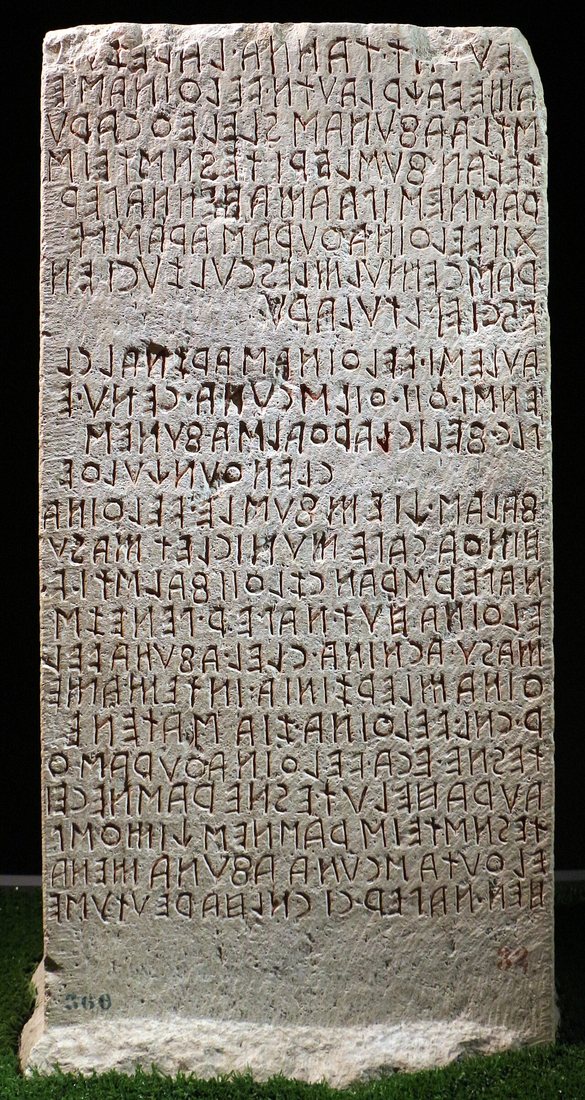
Secular texts are mainly legal. The Cippus Perusinus, a stone block found in 1822 on the hill of San Marco near Perugia, bears 46 lines and about 130 words from the 3rd or 2nd century BCE. On the usual interpretation it records an agreement between the Velthina family of Perugia and the Afuna family of Chiusi about a plot of land with a tomb on it. The bronze Tabula Cortonensis was brought to the police in Cortona in 1992 by a finder who did not tell the truth about where it had been found. It has about 200 words and apparently concerns the sale or division of land near Lake Trasimeno; it probably gave the word tisś, “lake”.
Contracts in stone and bronze
The Liver of Piacenza
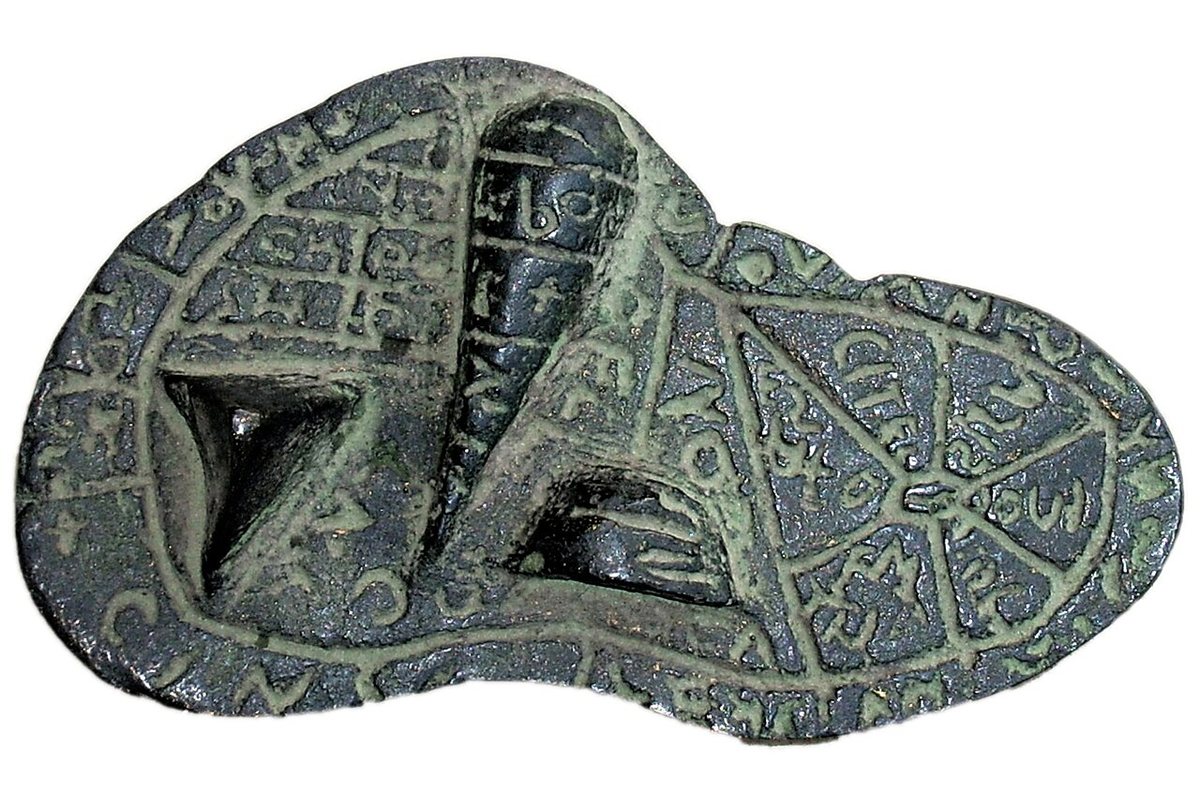
Etruscan priests called haruspices read the will of the gods from the livers of sacrificed animals and from lightning. The Romans valued their art, and in the 1st century CE the emperor Claudius revived their standing. A bronze liver found on 26 September 1877 in a field near Gossolengo in the province of Piacenza is usually interpreted as showing how the Etruscans divided the heavens among the gods. This life-sized model of a sheep's liver (126 × 76 × 60 mm) dates from the late 2nd century BCE and is divided into fields bearing the names of gods; its rim has 16 sections.
The names are abbreviated and many readings are disputed. Among the legible ones are tin (Tinia, the counterpart of Jupiter), uni (Juno), neθ(uns) (Neptune) and fufluns (Bacchus); the underside bears usils, the genitive of usil “sun”.
The end of the language and what remained
Under Roman rule Etruscan gradually gave way to Latin, earlier in southern Etruria than in the north. Veii was Latinised after its destruction in 396 BCE, Caere in the late 2nd century BCE. At Chiusi, Perugia, Arezzo and Volterra Etruscan and bilingual inscriptions were still being made in the 1st century BCE; the last dated (bilingual) inscription comes from Volterra, from about 10–20 CE. Most scholars place the extinction of the language in the late 1st century BCE or the early 1st century CE; limited knowledge may have lasted longer in religious ritual.
The emperor Claudius (reigned 41–54 CE), whose first wife Plautia Urgulanilla was of Etruscan descent, wrote a history of the Etruscans in twenty books, the Tyrrhenika. The work is lost, and whether Claudius could still read Etruscan is uncertain.
The Etruscans' main legacy is their alphabet. On the prevailing view the Latin alphabet derives from it, as do the alphabets of other languages of Italy such as Oscan, Umbrian and Venetic. The Latin alphabet bears a trace of Etruscan transmission in the letter C: the Romans at first used it for both k and g, until they introduced a separate letter G. A few dozen Etruscan words and names also passed into Latin. The derivation of persona “mask” from Etruscan phersu is considered probable; for others, such as satelles “bodyguard” or populus “people”, an Etruscan origin is possible but disputed.
Timeline
- c. 900 BCEVillanovan culture, the earliest phase of Etruscan civilisation.
- 8th c. BCEGreeks from Euboea found Pithekoussai and Cumae; the Etruscans take over their alphabet.
- c. 700 BCEThe earliest Etruscan inscriptions; the alphabet on the Marsiliana tablet.
- 2nd half of 6th c. BCEThe Lemnos stele, the main record of Lemnian.
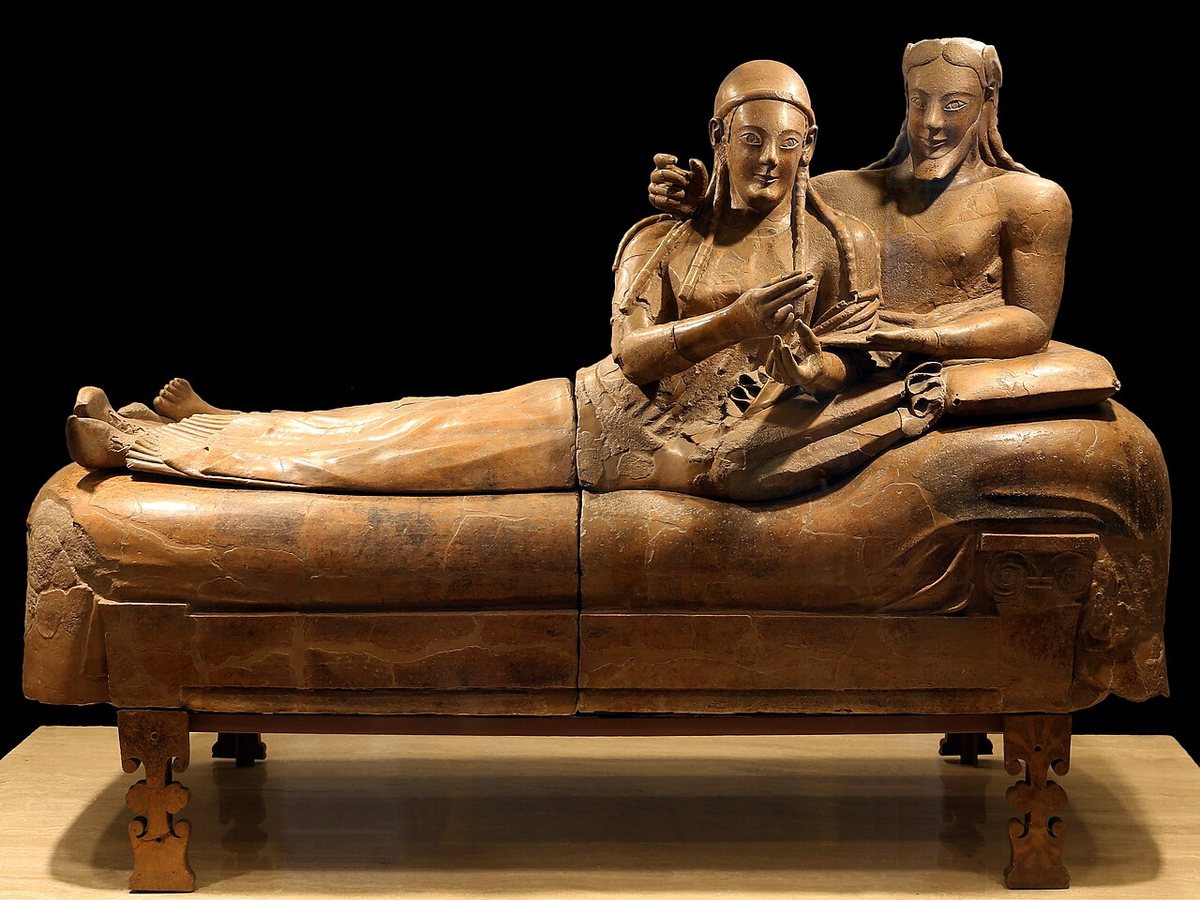
- c. 530–510 BCEThe Sarcophagus of the Spouses from Caere.
- c. 510 BCEAccording to Roman tradition, Tarquin the Proud, the last king of Etruscan origin, is expelled from Rome.
- c. 500 BCEThe gold tablets from Pyrgi with an Etruscan and a Phoenician dedication.
- 474 BCESyracuse defeats the Etruscans at Cumae.
- c. 470 BCEThe Tabula Capuana.
- 396 BCEThe Romans take and destroy Veii.
- 3rd c. BCERome subdues Etruria; around 250 BCE the Liber Linteus is written.
- c. 10–20 CEThe last dated (bilingual) Etruscan inscription (Volterra).
- 41–54 CEReign of the emperor Claudius, author of the lost Tyrrhenika.
- 1892Jakob Krall recognises Etruscan on the wrappings of the Zagreb mummy.
- 1964The gold tablets from Pyrgi are found.
- 1992The Tabula Cortonensis surfaces in Cortona.
Etruscan on the globe
Alongside Etruscan is Venetic, an Indo-European language of north-eastern Italy written in an alphabet derived from the Etruscan one. Raetic and Lemnian have no dot on the globe. Tap a language to show it on the globe:
Sources and further reading
- Giuliano Bonfante, Larissa Bonfante: The Etruscan Language: An Introduction. Manchester University Press, 2nd ed. 2002.
- Larissa Bonfante: Etruscan. University of California Press, 1990 (Reading the Past series).
- Rex E. Wallace: Zikh Rasna: A Manual of the Etruscan Language and Inscriptions. Beech Stave Press, 2008.
- Helmut Rix: Etruscan. In: Roger D. Woodard (ed.), The Cambridge Encyclopedia of the World's Ancient Languages. Cambridge University Press, 2004, pp. 943–966.
- L. Bouke van der Meer: Liber linteus zagrabiensis. The Linen Book of Zagreb. A Comment on the Longest Etruscan Text. Peeters, 2007.
- Glottolog 5 (languages and their classification).