Languages of antiquity
Korea: Chinese characters and Hangul
The Korean peninsula · from King Gwanggaeto's stele (414) to the rise of Hangul as the national script in the late 19th century
For more than a thousand years Koreans wrote in Chinese characters, both in Classical Chinese and in their own language, which they squeezed into the characters through the ingenious systems of idu, hyangchal and gugyeol. Korea produced the oldest surviving book printed with movable metal type. In 1446 King Sejong promulgated a new script, now called Hangul: its consonants draw the shape of the speech organs, its vowels derive from heaven, earth and humankind, and its letters are grouped into syllables. Confucian scholars scorned it for four centuries; today it is a source of national pride.
Chinese writing on the peninsula
Writing reached the Korean peninsula from China. The earliest archaeological evidence of Chinese inscriptions in Korea dates from the 3rd century BC, when Chinese migrants were arriving to escape the wars in northern China; a sword with a Chinese inscription dated 222 BC was found in Pyongyang. From 108 BC to AD 313 the north of the peninsula was under the Chinese administration of the Han dynasty and its successors. Korean remained the spoken language; Chinese was only written.
In the Three Kingdoms period, with Goguryeo in the north, Baekje in the southwest and Silla in the southeast, Classical Chinese became the language of letters and government. The chronicle Samguk sagi of 1145 dates the first written records to 375 in Baekje and to 545 in Silla. Buddhism spread along with reading, traditionally adopted in Goguryeo in 372, in Baekje in 384 and in Silla in 527. Scholars from Baekje were sought after in Japan as teachers of Chinese writing.
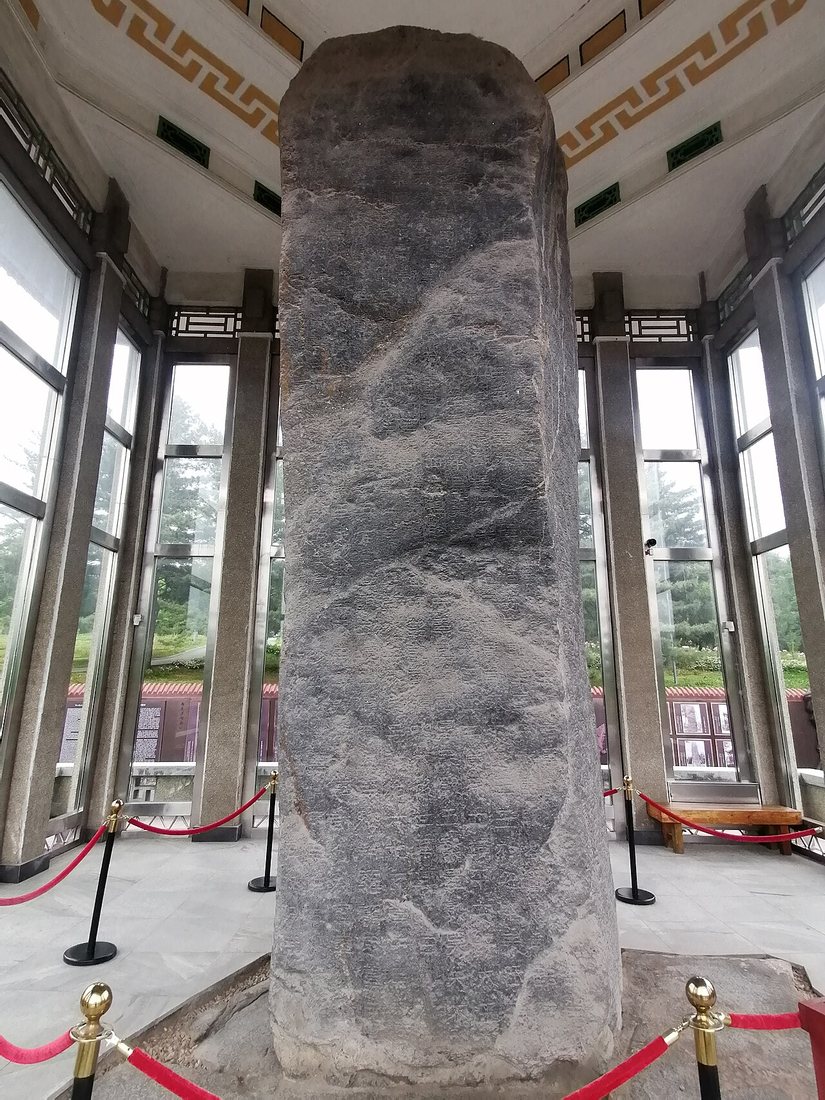
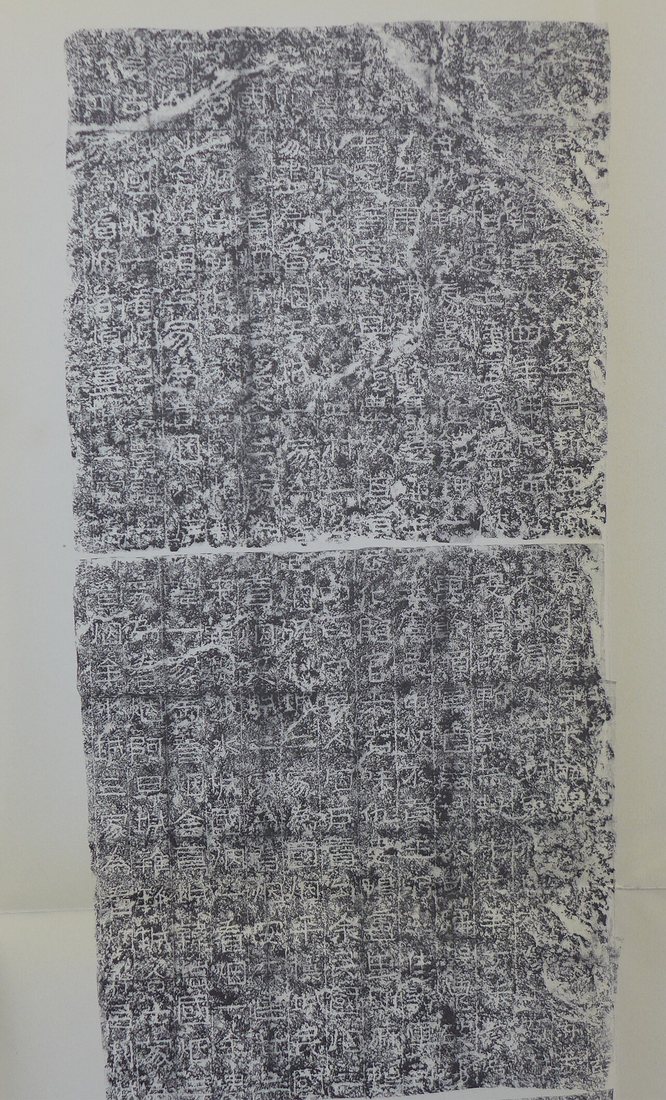
The earliest securely dated Korean text in Classical Chinese (hanmun) is the stele of King Gwanggaeto the Great (r. 391–413), set up in 414. His son, King Jangsu, erected it by his father's tomb near the Goguryeo capital of the time, today near the city of Ji'an in China. Its 1,775 characters tell of the origin of the dynasty and the late king's campaigns. The stele was rediscovered in the late 19th century, and part of the inscription is now illegible.
Chinese characters are called hanja in Korean, “Han characters”. Classical Chinese remained the language of Korean scholarship until the end of the 19th century: from 958 to 1894 the civil service examinations (gwageo) were written in it, as were Korean chronicles and the official annals of the Joseon dynasty.
Korean in Chinese characters
Classical Chinese differs fundamentally from Korean. Chinese words are short and uninflected, and the word order is subject–verb–object; Korean is agglutinative, attaching strings of suffixes for case, tense and politeness to its stems, and the verb comes at the end of the sentence. To write their own language, Koreans had to use the characters differently: either for their meaning, reading them as a Korean word, or purely for their sound.
The oldest of these systems is called idu (吏讀, “clerks' reading”). The text followed Korean word order; content words were written in Chinese, and Korean endings and particles with characters chosen for their sound or their Korean reading. The pair 不冬, literally “not winter”, was thus not read in Chinese but in Korean as andʌl (spelled with the obsolete vowel ㆍ), “does not”, corresponding to modern 않는다 anneunda. Tradition credits idu to the 7th-century scholar Seol Chong, but similar spellings are attested earlier. Idu served mainly clerks and scribes for administrative documents; it was officially abolished only in 1894.
Poetry used hyangchal (鄕札, “local letters”), in which whole Korean verses were written in Chinese characters, partly for meaning and partly for sound. Twenty-five songs written this way, called hyangga, survive: fourteen in the chronicle Samguk yusa, compiled by the monk Iryeon in the 13th century, and eleven in the 1075 biography of the monk Gyunyeo (923–973). In the song Seodongyo, for example, a princess is written 善化公主主隱: the first four characters are read in Sino-Korean as Seonhwa gongju, “Princess Seonhwa”, while 主 (“lord”) is read by its Korean gloss as the honorific suffix -nim, and 隱 is used purely for its sound as the topic particle -eun.
The third system, gugyeol (口訣), was a reading aid for Chinese texts: Korean grammatical endings were inserted between the phrases of the classical text, often in simplified forms of the characters. The pair 爲尼, for instance, was read not in Chinese but in Korean as hani, “does, and so”: the first character for its Korean meaning “to do”, the second for its sound. Gugyeol resembles the Japanese way of reading Chinese texts (kanbun) and remained in use into the early 20th century. All three systems, however, required a good command of Chinese characters and so remained the preserve of the educated.
Eighty thousand blocks and metal type
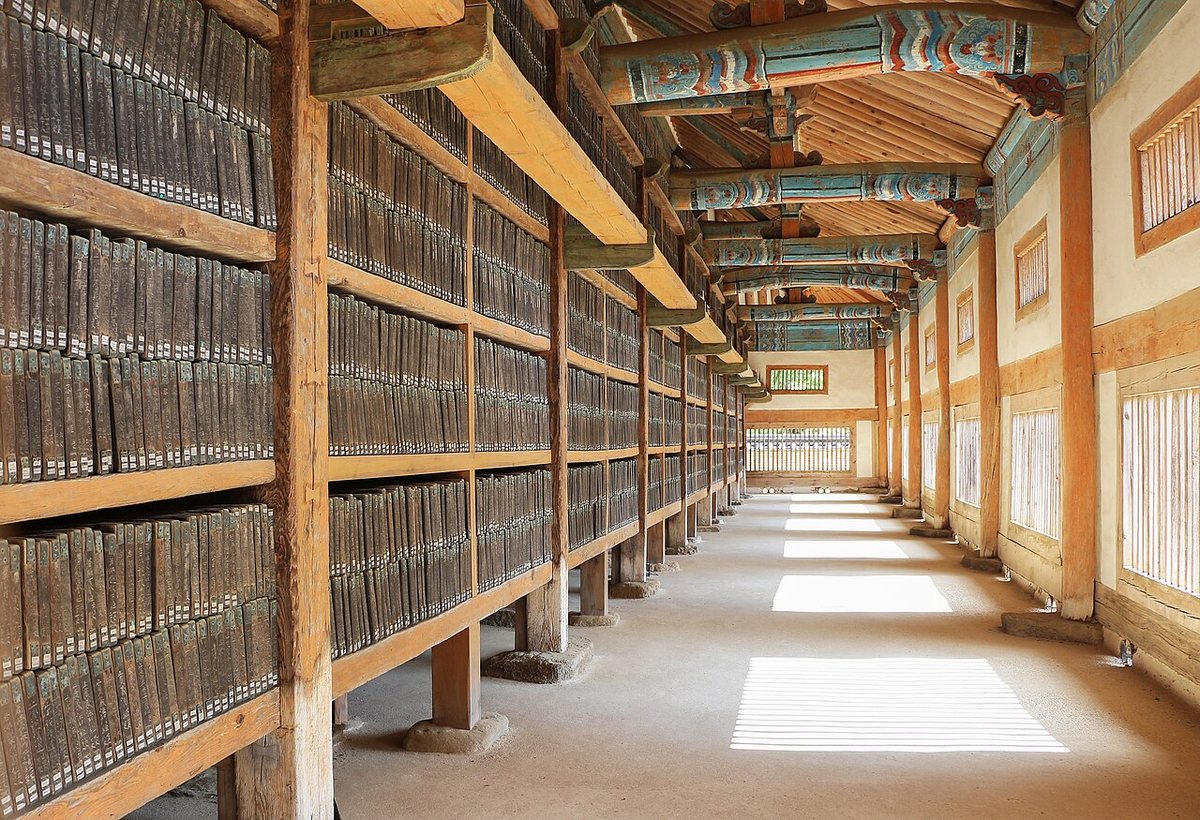
Korea was a pioneer of printing. Under the Goryeo dynasty (918–1392) the Tripitaka Koreana was produced, in Korean Palman Daejanggyeong, “the Tripitaka in eighty thousand blocks”: the Buddhist canon in Chinese, carved in mirror image into wooden printing blocks. After the Mongols destroyed the first edition of the canon, the court had a new one carved during the Mongol invasions of the 13th century, according to the usual dating in 1237–1248. Since 1398 the blocks, 81,258 of them, have been kept at the mountain temple of Haeinsa. Their depositories are a UNESCO World Heritage Site, and the blocks themselves are on the Memory of the World Register.
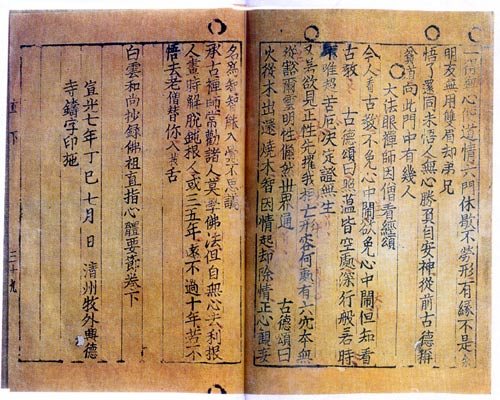
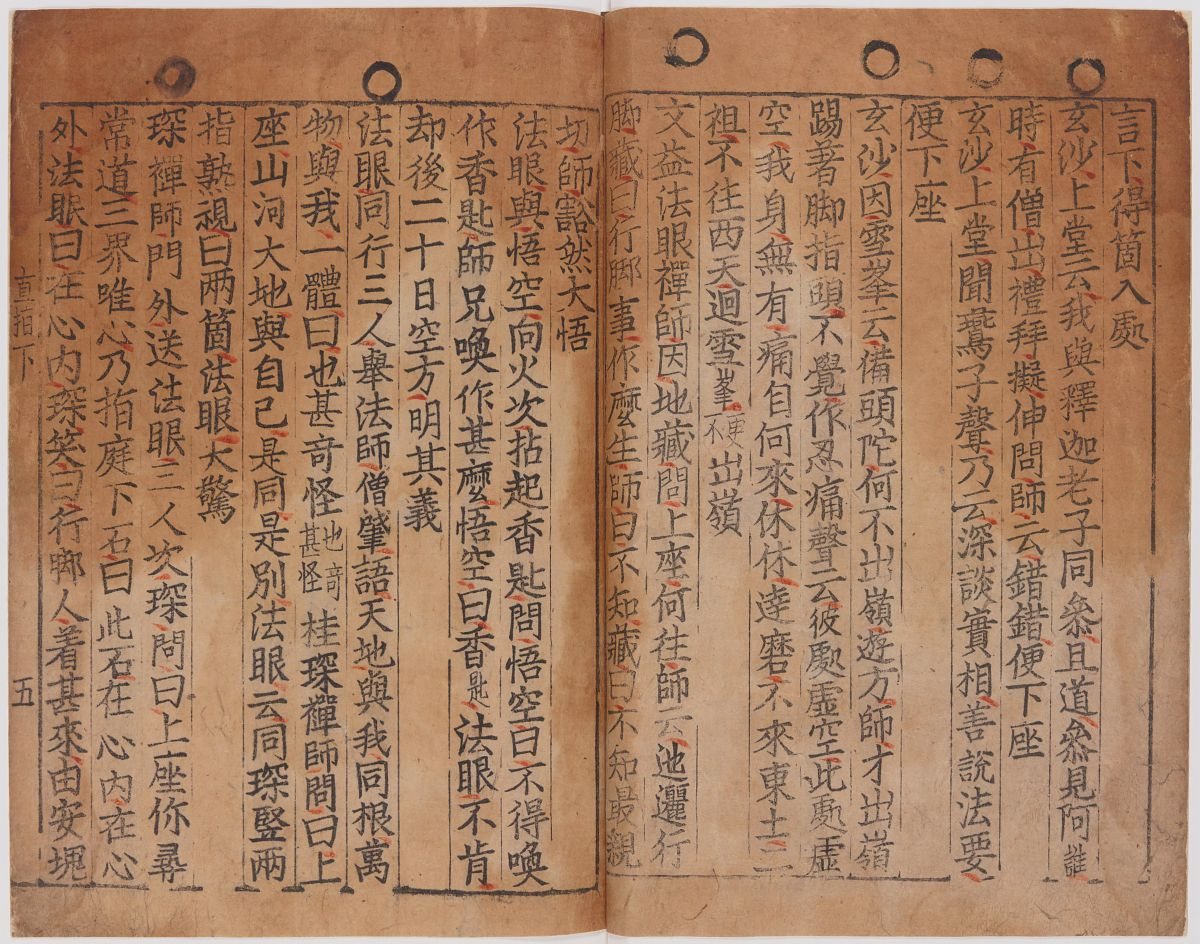
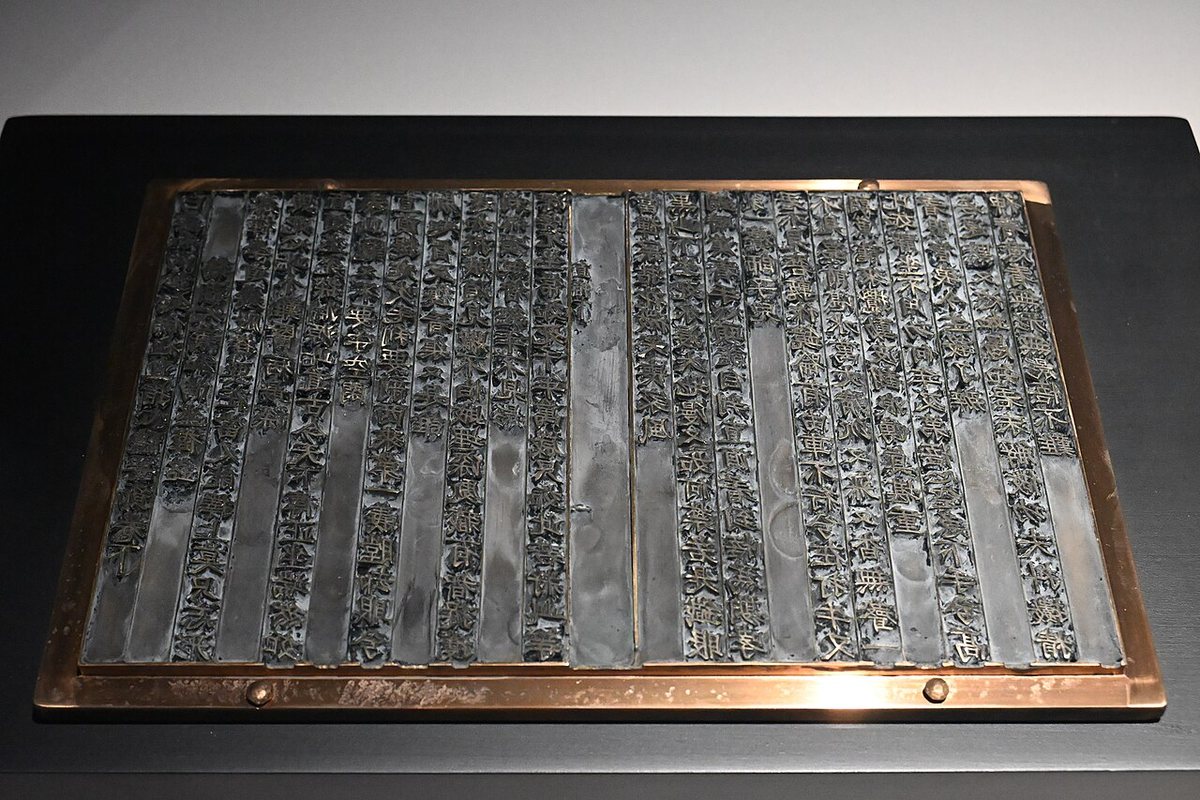
More remarkable still is printing with movable metal type. According to written sources, metal type was already in use in Korea in the first half of the 13th century, but those prints have not survived. The oldest surviving book printed with movable metal type is the Jikji, in full Baegun hwasang chorok buljo jikji simche yojeol, an anthology of sayings of Zen (Korean Seon) masters compiled by the monk Baegun. According to its colophon it was printed by his disciples in 1377 at Heungdeoksa Temple near Cheongju, roughly three quarters of a century before Johannes Gutenberg completed his Bible.
Of the original two volumes only the second survives, and without its first leaf. In the late 19th century the French diplomat Victor Collin de Plancy took it from Korea; today it belongs to the National Library of France in Paris, and in 2001 it was inscribed on the Memory of the World Register. Unlike in Europe, however, metal type did not become the basis of mass printing in Korea: Chinese writing required thousands of different pieces of type, and printing served mainly the court and the monasteries.
Jikji
King Sejong
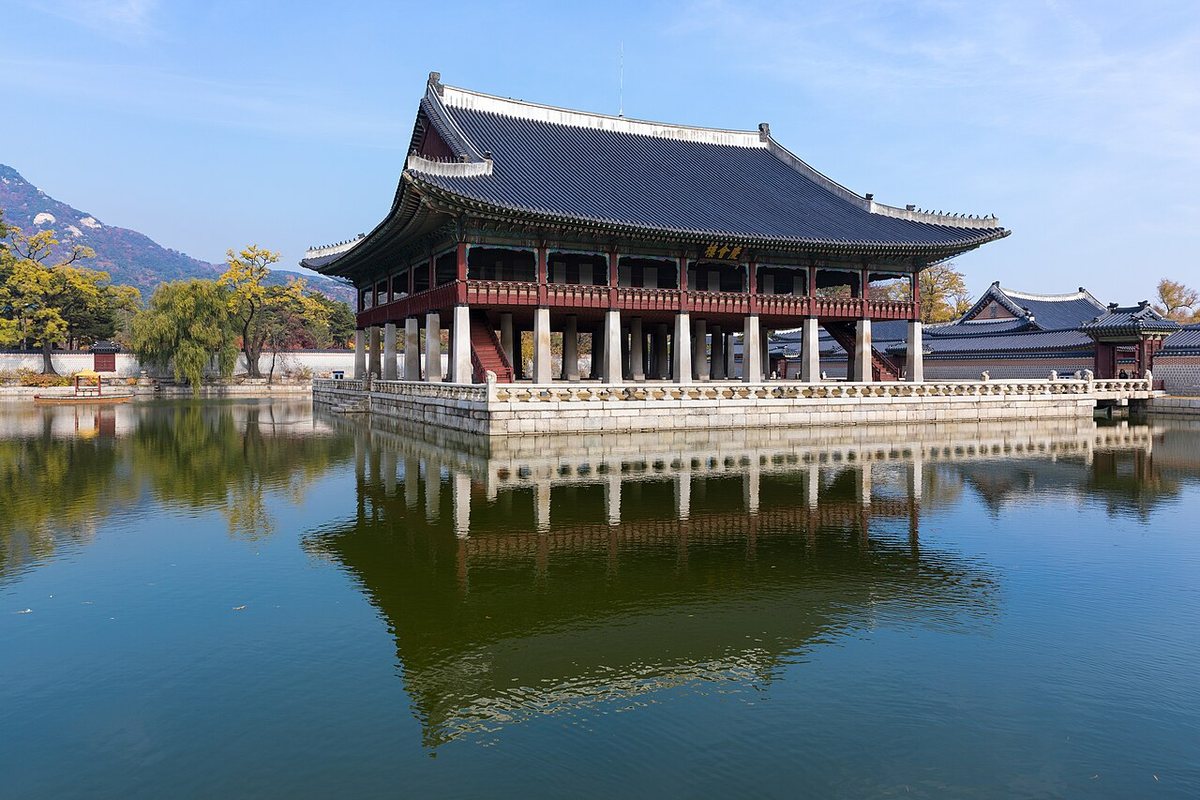
Sejong (1397–1450), the fourth king of the Joseon dynasty, reigned from 1418 to 1450 and is still regarded in Korea as the greatest ruler in its history. In 1420 he re-established the Hall of Worthies (Jiphyeonjeon), a royal institution of scholars that modern historians liken to a think tank. His reign saw the first native Korean calendar, large medical and agricultural compendia and new astronomical instruments.
The sources do not say when work on the new script began. In the 12th month of 1443 by the Korean calendar (between late December 1443 and late January 1444) the script, probably already almost complete, was presented to the court. Most scholars believe that Sejong was significantly and personally involved in creating it; whether he was its sole author, as the records of the time claim, is debated. The king was himself interested in languages, took lessons in spoken Chinese and followed the work of the Bureau of Interpreters.
As early as the 2nd month of 1444 a group of scholars from the Hall of Worthies led by Choe Mal-li submitted a sharp protest to the king. In their view the new script led Korea away from Chinese civilisation, to which Confucian principles said it should defer, and only barbarians wrote with their own phonetic letters. Historians add concerns about social standing: knowledge of Chinese characters was a privilege and a badge of the elite. Sejong rejected the objections, saying the script had been created out of care for his subjects and so in a Confucian spirit, and had Choe Mal-li and the other signatories imprisoned for a day.
In the 9th month of 1446 the script was formally promulgated in the text Hunminjeongeum (訓民正音), “The Correct Sounds for the Instruction of the People”, which was at first also the name of the script itself. The short base text was traditionally written by Sejong himself; an extensive commentary (Haerye) explaining the shapes of the letters and the rules for their use was added by a group of scholars led by Jeong In-ji. The edition with the commentary was later lost and reappeared only in 1940; it is now a National Treasure of South Korea and has been on the Memory of the World Register since 1997.
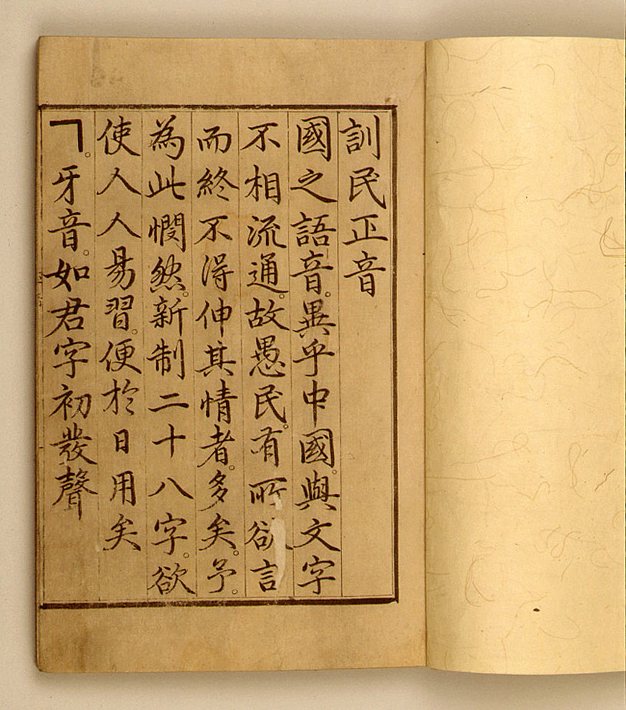
gukji eoeum iho jungguk, yeo munja bulsang yutong
- 國之語音 gukji eoeum
- the sounds of the speech of (our) country
- 異乎中國 iho jungguk
- differ from the Middle Kingdom (China)
- 與文字 yeo munja
- with the (Chinese) characters
- 不相流通 bulsang yutong
- do not correspond to each other
The sounds of our country's language differ from those of China and do not correspond to the characters.The opening sentence of Sejong's preface, shown in the photograph of the first page of the Hunminjeongeum. It is written in Classical Chinese; the transcription gives the modern Korean (Sino-Korean) reading of the characters. The preface goes on: many common people therefore cannot express what they wish to say; “I have been distressed because of this, and have newly designed twenty-eight letters, which I wish to have everyone practise at their ease and make convenient for their daily use.” In the 15th century the text was read with Korean endings inserted; the oldest known Korean translation (Eonhae) is found in the Worin seokbo of 1459.
Speech organs, heaven, earth and humankind
The Hunminjeongeum Haerye explains in detail how the shapes of the letters were derived. The five basic consonants depict the speech organs as the sound is made: ㄱ the root of the tongue closing the throat, ㄴ the tongue touching the upper palate, ㅁ the mouth, ㅅ a tooth and ㅇ the throat. The other consonants are derived from them by adding a stroke for a “stronger” sound: ㄱ g gives aspirated ㅋ k, ㄴ n gives ㄷ d and then ㅌ t, ㅁ m gives ㅂ b and ㅍ p, ㅅ s gives ㅈ j and ㅊ ch. Sounds made at the same place in the mouth thus have letters of similar shape.
The vowels derive from three elements of Chinese cosmology: the dot ㆍ is round like heaven, the horizontal line ㅡ flat like the earth, and the vertical ㅣ stands upright like a human being. The other vowels are combinations of these: ㅏ a is ㅣ with a dot on the right, ㅓ eo with a dot on the left, ㅗ o is ㅡ with a dot above, ㅜ u with a dot below. The division of vowels into “bright” and “dark” ones reflects the vowel harmony of the Korean of the time. Modern scholars attach little weight to further philosophical explanations, such as links between the sounds and the five elements.
The letters are not written in a row as in the Latin alphabet but grouped into roughly square syllable blocks, like Chinese characters: an initial consonant, a vowel to its right or below it, and possibly a final consonant at the bottom. When a syllable begins with a vowel, a silent ㅇ fills the consonant slot. Today's 19 initial consonants, 21 vowels and 27 final consonants can form 11,172 syllables, of which only about two thousand are in common use. In Middle Korean, dots to the left of a syllable also marked pitch: no dot for a low tone, one dot for a high tone, two dots for a rising tone. This marking fell out of use in the 16th century.
In 1985 the British linguist Geoffrey Sampson called Hangul a “featural script”, whose shapes systematically encode phonological features; Hangul is the best-known example of the category. Others object that only some of the letters are built this way and that readers do not use the logic of the shapes when reading. Whether another script inspired Sejong's scholars is debated; the hypothesis that attracted most attention, put forward by Gari Ledyard, is an influence of the ʼPhags-pa script used by the Mongol administration. That Chinese characters inspired the shape of the syllable blocks is likely.
The basic letters and their shapes
- g / kthe root of the tongue closing the throat (a velar consonant)
- kㄱ with an extra stroke: a “stronger”, aspirated sound
- nthe tongue touching the upper palate
- d / tㄴ with an extra stroke
- tㄷ with another stroke: aspiration
- mthe mouth
- b / pㅁ with extra strokes
- pthe aspirated counterpart of ㅂ
- sa tooth (an incisor)
- jㅅ with an extra stroke
- chㅈ with another stroke: aspiration
- – / ngthe throat; silent today at the start of a syllable, ng at the end (originally ng had its own letter, ㆁ)
- hthe throat letter ㅇ with extra strokes
- r / lnot derived by adding strokes; the Haerye counts it among the letters of “different shape”
- ʌ (?)heaven, hence round; an obsolete vowel of disputed pronunciation, kept as a distinct sound only in Jeju
- euearth, hence flat
- ia human, hence upright
- aㅣ with a dot on the right (today a short stroke)
- eoㅣ with a dot on the left
- oㅡ with a dot above
- uㅡ with a dot below
- yaa second dot adds a preceding y
han + geul → hangeulThe word 한글 hangeul, “Han script”; han is one of the Korean names of Korea, and geul means “writing, script”. In the block 한 the consonant ㅎ stands at top left, the vertical vowel ㅏ to its right and the final ㄴ at the bottom; in the block 글 the horizontal vowel ㅡ sits below the initial ㄱ, with the final ㄹ beneath it.
The explanation of the shapes follows the Hunminjeongeum Haerye (1446). The letters are shown in their modern form, with values in Revised Romanization; for ㄱ, ㄷ and ㅂ the first value applies at the start of a syllable, the second at the end. Present-day spelling no longer uses the obsolete vowel ㆍ or the letter ㆁ, but Unicode encodes them. Modern Hangul has 24 basic letters, 14 consonants and 10 vowels; doubled consonants such as ㄲ kk and compound vowels such as ㅐ ae are built from them.
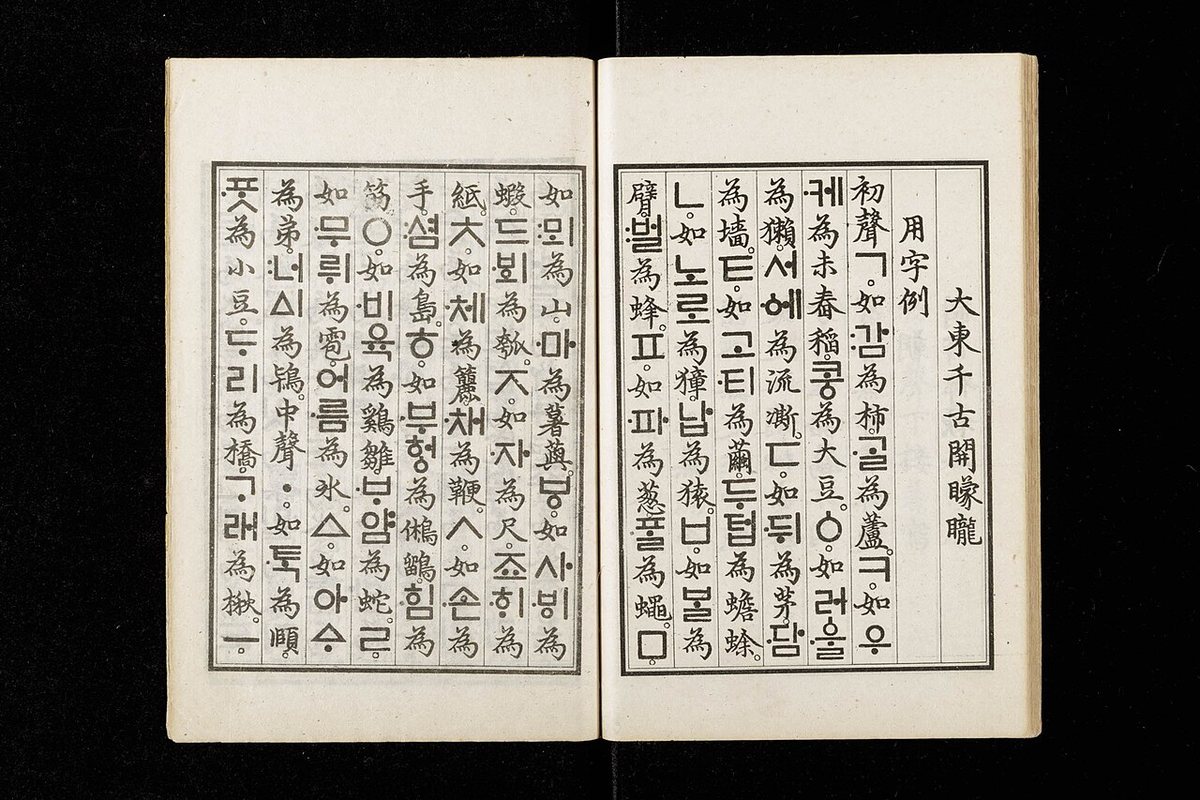
Eonmun: the script of women and monks
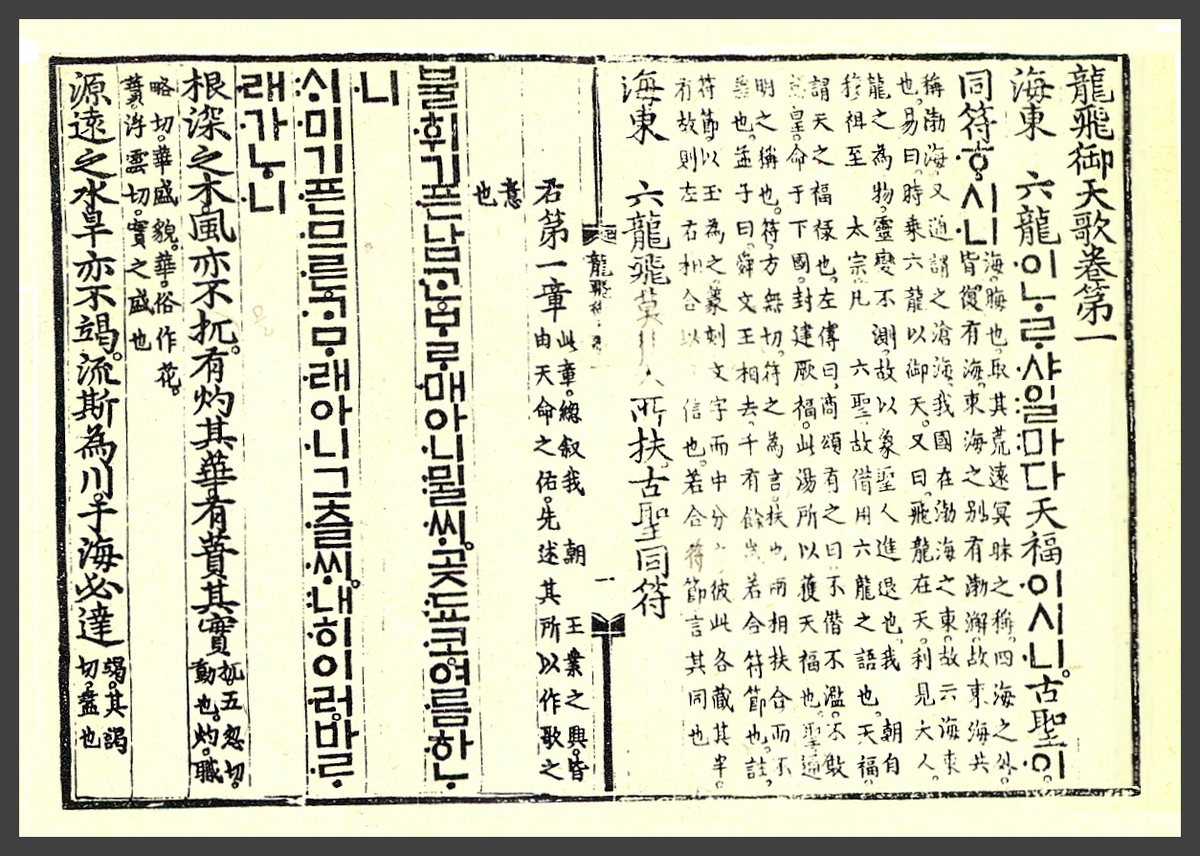
Sejong tried to introduce the new script into government, the examinations and the schools, but cautiously and with limited success. The first major work in Hangul was the Yongbieocheonga (Songs of the Dragons Flying to Heaven), 125 cantos in praise of the ancestors of the ruling dynasty, printed in 1447. Buddhist texts followed, among them hymns traditionally ascribed to Sejong himself. After the king's death Hangul was pushed out of many fields again.
The educated went on writing Classical Chinese and called the new script eonmun (諺文), “vernacular script”, a name that took on a disparaging tone. In the 15th century Hangul was used mainly in Seoul around the court; it spread beyond the capital only in the 16th century. Among its first users were women, who were denied a Confucian education and often learned the script at home, and Buddhist monasteries. In 1504 the tyrant Yeonsangun, on learning that criticism of his rule was circulating in Hangul, had its use persecuted.
Hangul nevertheless survived. In the 16th century scholars of the Bureau of Interpreters studied it, and in the 17th century popular literature in Hangul flourished, including sijo verse and the novel Hong Gildong jeon, traditionally attributed to Heo Gyun (the attribution is disputed). The spelling changed at the same time: some letters, such as ㅿ and ㆆ, fell out of use by the late 16th century, ㅇ and ㆁ merged, and tone marking disappeared. Hangul became the script of private letters, popular reading and women, while official and learned Korea wrote in Chinese.
A national script
The turning point came in the late 19th century. When Korea opened to the outside world in the 1870s, Hangul came to be seen as a national symbol and was also called gungmun (國文), “national script”. The Scottish missionary John Ross, in his primer of 1877, first separated words with spaces and wrote horizontally. On 21 November 1894, as part of the Gabo Reform, the government declared Hangul the preferred script for official documents; the same year saw the end of the examinations in Classical Chinese and of the official use of idu. In 1896 the newspaper Dongnip Sinmun (The Independent) began to appear, written in Hangul alone.
The name Hangul, “Han script”, came into use around 1910, by the prevailing account at the instigation of the linguist Ju Si-gyeong. Under Japanese rule (1910–1945) the Korean language and script were suppressed to varying degrees. The Korean Language Research Society established Hangul Day in 1926; renamed the Korean Language Society, it published the Unified Hangul Orthography in 1933, on which the spelling of both present-day Korean states is based; among other things it ended the use of the vowel ㆍ. In 1942 its members were arrested en masse and tortured.
In 1940 a copy of the Hunminjeongeum with its commentary, long believed lost, was found; it is now called the Gansong copy after its collector. After liberation and the division of the country in 1945, both states achieved general literacy in Hangul. In North Korea the script has been called Chosŏn'gŭl, “Korean script”, since 1949, after the North Korean name for Korea, Chosŏn; South Korea uses the name Hangul. Both versions have the same letters and differ mainly in alphabetical order and some spelling rules.
Hangul Day
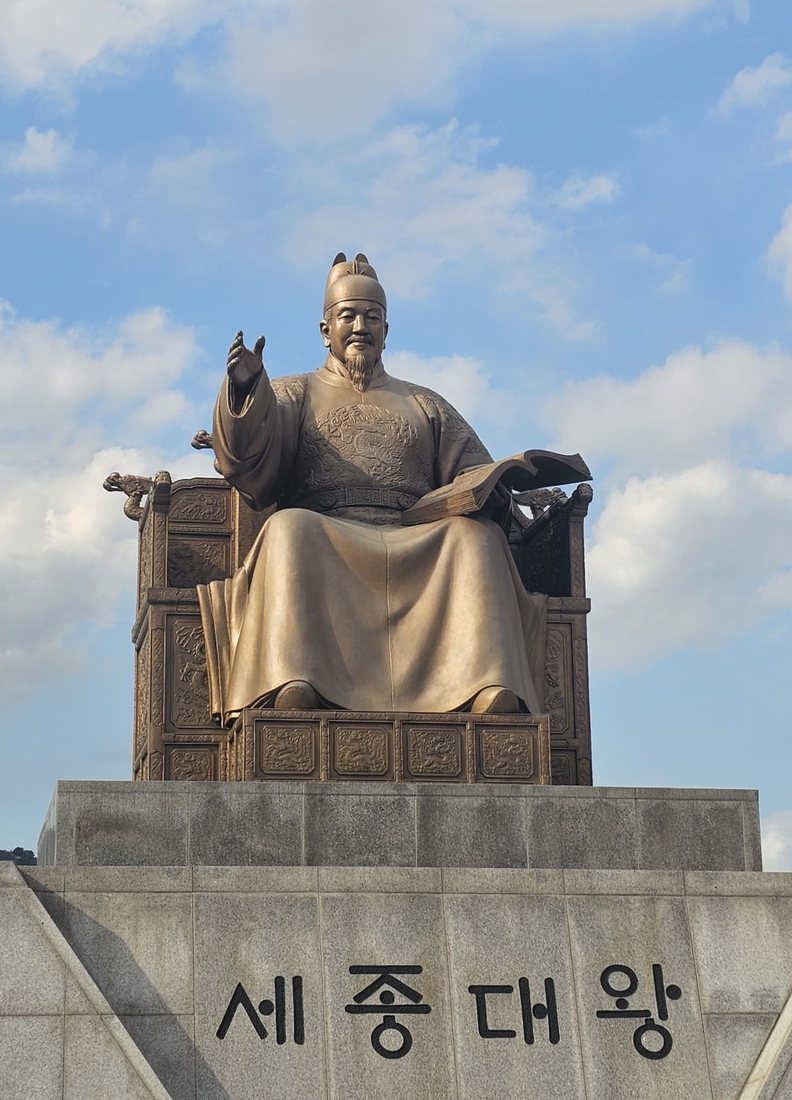
The exact date of the promulgation is not known. The postface to the Hunminjeongeum commentary is dated to “the first ten days” of the 9th month of 1446; taking the tenth day gives 9 October. Hangul Day was first celebrated on 4 November 1926; the date then changed, settling on 9 October in 1945, when it could be based on the rediscovered Haerye. In South Korea Hangul Day (Hangeullal) is a public holiday; it was not one from 1991 to 2012, and its restoration was celebrated in December 2012. North Korea marks Korean Alphabet Day on 15 January, referring to the presentation of the script to the court at the turn of 1443 and 1444. On Hangul Day 2009 a bronze statue of King Sejong was unveiled in Gwanghwamun Square in Seoul, which has since become the main venue of the celebrations.
Celebrating Hangul Day
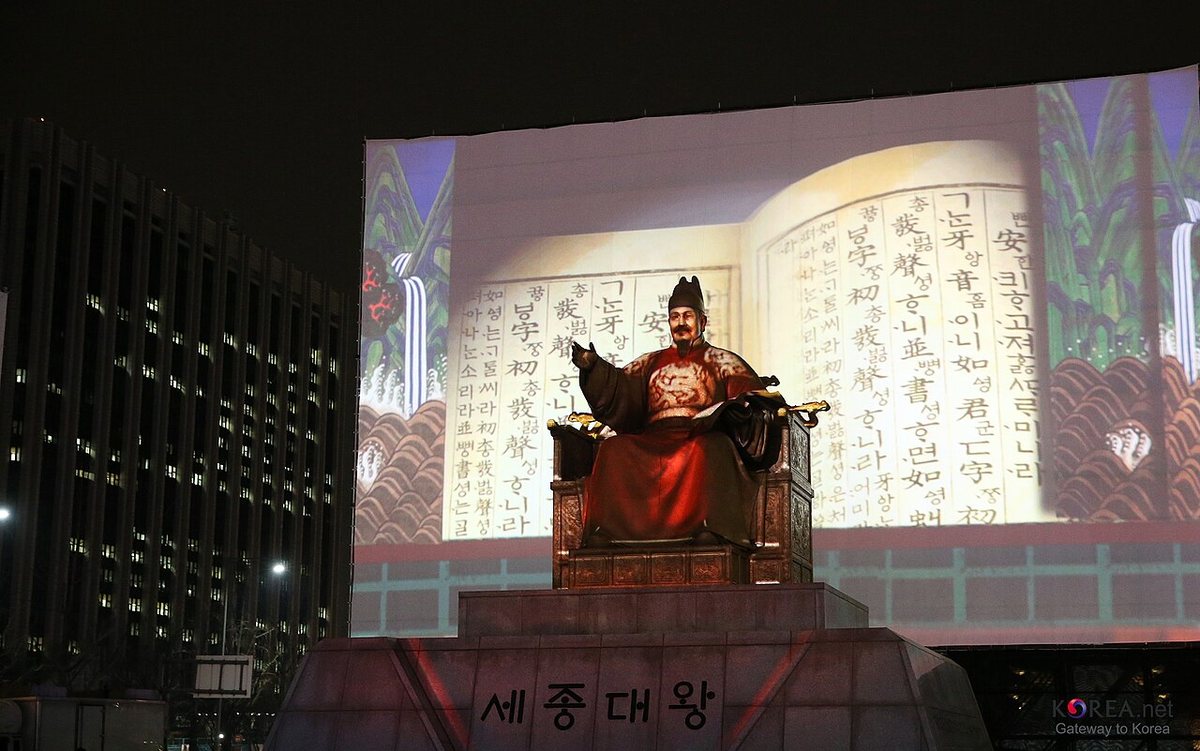
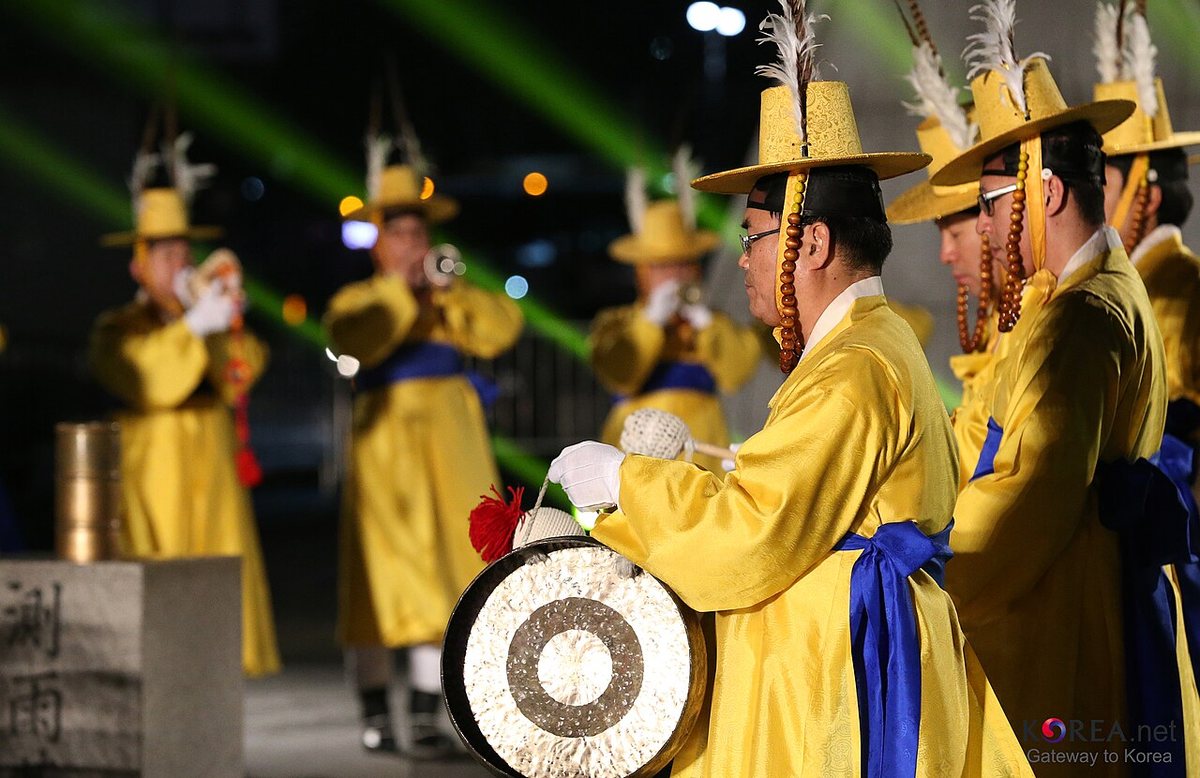
Hanja today
Hangul replaced Chinese characters only in the 20th century. For a long time mixed script was used: Sino-Korean words, that is words borrowed from Chinese or formed from Chinese roots, in characters, and Korean stems and endings in Hangul. By most estimates Sino-Korean words make up more than half of dictionary entries (50–65 per cent according to Ho-min Sohn); lexicographic estimates vary, however, and critics who point to the many unused words in older dictionaries put the figure at only around 30 per cent. They include mainly technical and abstract terms.
In North Korea Chinese characters have not been used in texts since 1949, though they are taught in schools. South Korea long wavered between abolishing and keeping them: in 1968 the government announced a five-year plan to remove them from schools and official use, and four years later teaching of the characters returned as an elective. Today 1,800 basic characters are taught in secondary schools as an elective subject. Newspapers switched mostly to Hangul in the 1990s; characters remain in headlines as abbreviations (中 China, 韓 Korea, 美 USA, 日 Japan), in personal names, in official documents and in dictionaries, where they distinguish words that sound alike.
One word, six meanings
Sino-Korean words that sound the same are easily confused in Hangul, because standard Korean, unlike Chinese, has no tones. Dictionaries therefore give the characters for each entry. All six of these words are read 수도 sudo:
| characters | composition | meaning |
|---|---|---|
| 首都 | 首 “head” + 都 “seat, city” | capital city |
| 水道 | 水 “water” + 道 “way” | waterworks, watercourse |
| 修道 | 修 “cultivate” + 道 “way, the Dao” | spiritual discipline, asceticism |
| 隧道 | 隧 “underground passage” + 道 “way” | tunnel |
| 水稻 | 水 “water” + 稻 “rice” | paddy rice |
| 囚徒 | 囚 “imprison” + 徒 “person, fellow” | prisoner |
Korean and Jeju
Korean is spoken by about 81 million people (Ethnologue, 2020). It is the official language of both Korean states and is also spoken by large communities in China, where Hangul is an official script of the Yanbian Korean Autonomous Prefecture, in Japan, the United States and Central Asia. It belongs to the small Koreanic language family. Most linguists now reject earlier attempts to class it as Altaic, and a relationship with Japanese, defended by some scholars, has not been demonstrated either. The homeland of its ancestors is usually sought in Manchuria.
Old Korean of the Three Kingdoms and Unified Silla is known only in fragments, from spellings in Chinese characters. Middle Korean is usually dated 918–1592; its early phase is likewise known only in fragments, but its late phase, from 1446, is documented in detail thanks to Hangul. It had a pitch accent, which Sejong's script recorded with dots. Modern Korean is an agglutinative language with subject–object–verb word order and an elaborate system of speech levels, in which the verb ending expresses the speaker's relation to the listener. The two standard languages differ in some features: the North, for example, keeps the initial r in Sino-Korean words, so “labour” is 로동 rodong in the North and 노동 nodong in the South.
On Jeju Island off the south coast people speak Jeju. It is closely related to Korean, but speakers of the two cannot understand each other, and Glottolog therefore lists it as a separate language of the Koreanic family. It alone keeps a distinct sound for the obsolete vowel ㆍ. It is spoken mainly by the older generation, and since 2010 UNESCO has classed it as critically endangered.
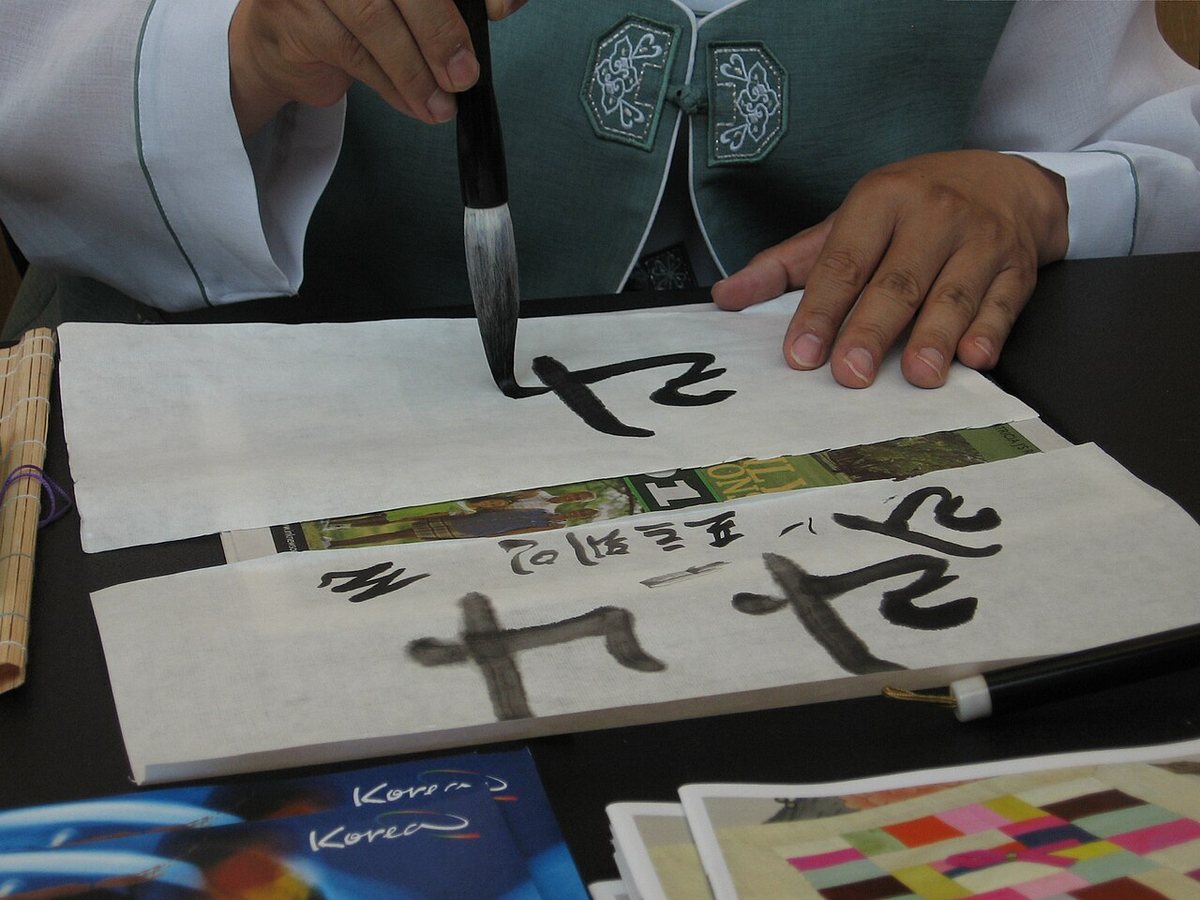
Korean words in the world
A few Korean words have spread into other languages, especially with the wave of interest in Korean culture around the turn of the 21st century:
| Korean | meaning | in English |
|---|---|---|
| 김치 gimchi | fermented vegetables, most often napa cabbage with chilli | kimchi |
| 태권도 taegwondo | 跆拳道, “the way of kick and fist”, a martial art | taekwondo |
| 한글 hangeul | the Korean script | Hangul |
| 불고기 bulgogi | “fire meat”, grilled marinated beef | bulgogi |
| 소주 soju | 燒酒, “burnt liquor”, a distilled spirit | soju |
| 재벌 jaebeol | 財閥, a large family-run business conglomerate | chaebol |
| 한복 hanbok | traditional Korean dress | hanbok |
| 한류 hallyu | 韓流, “Korean current”, the popularity of Korean pop culture abroad | hallyu |
| 만화 manhwa | 漫畫, comics; the same characters are read manga in Japanese | manhwa |
Timeline
- 414The stele of King Gwanggaeto is erected, the earliest securely dated Korean text in Classical Chinese.
- 958Goryeo introduces civil service examinations in Classical Chinese.
- 1237–1248The Tripitaka Koreana is carved (usual dating).
- 1377The Jikji is printed with metal type at Heungdeoksa Temple.
- 1392Founding of the Joseon dynasty.
- 1398The Tripitaka Koreana blocks are moved to Haeinsa Temple.
- 1418Sejong ascends the throne.
- 1443/1444The new script is presented to the court (12th month of 1443 by the Korean calendar).
- 1444Choe Mal-li and other scholars protest against the new script.
- 1446The script is promulgated in the Hunminjeongeum (9th month).
- 1447The Yongbieocheonga, the first major work in Hangul, is printed.
- 1504Yeonsangun persecutes the use of Hangul.
- 21 Nov 1894Gabo Reform: Hangul becomes the preferred script of official documents; the examinations and idu end.
- 1926The Korean Language Research Society establishes Hangul Day (then on 4 November).
- 1940A copy of the Hunminjeongeum with its commentary (Haerye) is found.
- 1949North Korea stops using Chinese characters in texts.
Korean and Jeju on the globe
Click a language to show it on the globe:
Sources and further reading
- Gari K. Ledyard: The Korean Language Reform of 1446. Singu munhwasa, Seoul 1998.
- Young-Key Kim-Renaud (ed.): The Korean Alphabet. Its History and Structure. University of Hawai‘i Press, 1997.
- Ki-Moon Lee, S. Robert Ramsey: A History of the Korean Language. Cambridge University Press, 2011.
- Sungdai Cho, John Whitman: Korean. A Linguistic Introduction. Cambridge University Press, 2019.
- Peter H. Lee (ed.): A History of Korean Literature. Cambridge University Press, 2003.
- Vladimír Glomb, Vladimír Pucek: Klasická korejština (Classical Korean). Charles University, Faculty of Arts, 2013.
- Glottolog 5 (languages and their classification).