Languages of antiquity
The Celts
Europe · from the Lepontic inscriptions to ogham
In antiquity Celtic languages were spoken from the Iberian Peninsula to Asia Minor, yet their speakers on the Continent never created a script of their own. They wrote with their neighbours' scripts: Etruscan in the Alps, Iberian in Spain, Greek and Latin in Gaul. What survives is mostly short inscriptions, names on coins, a calendar and a few lead curse tablets; in Ireland a script of strokes, ogham, was devised. The Latin name of Bohemia goes back to the Celtic Boii. Continental Celtic died out, but Irish, Welsh and Breton are still spoken today.
Who were the Celts
For linguists the Celts are above all the speakers of the Celtic languages. The Greeks knew them as Keltoi (they are mentioned already in the fragments of Hecataeus of Miletus around 500 BCE and by Herodotus in the 5th century BCE), the Romans as Celtae or Galli, and those who settled in Asia Minor as Galatae. They never formed a single state: they were many tribes and tribal confederations linked by related languages, religious ideas and a similar material culture.
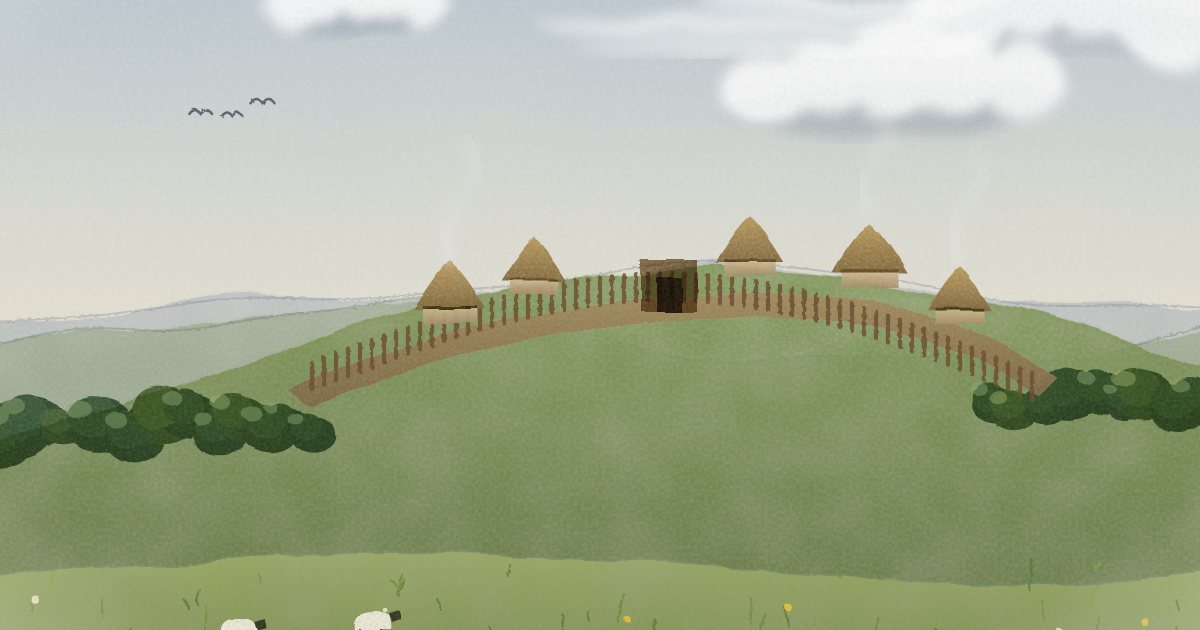
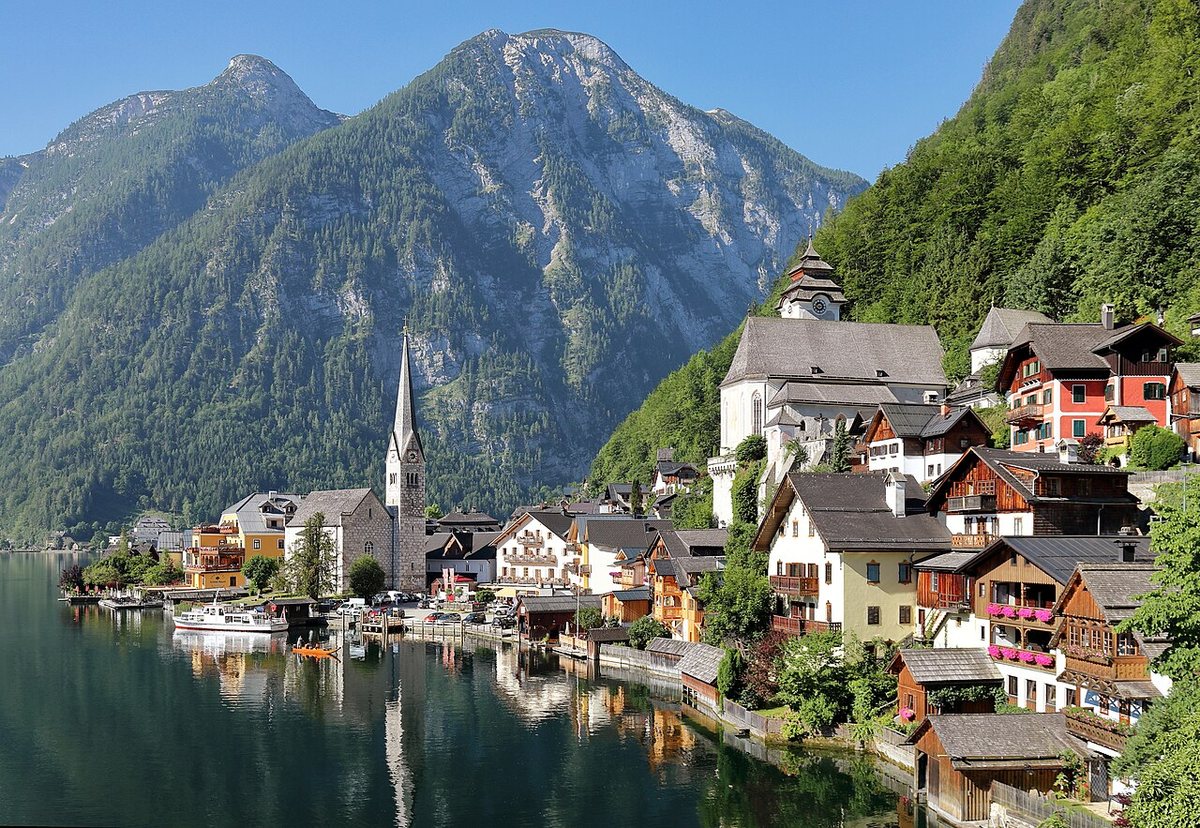
Archaeologists associate the Celts with the Early Iron Age Hallstatt culture (c. 800–450 BCE) and above all with the later La Tène culture (from c. 450 BCE to the Roman conquest), named after the site of La Tène on Lake Neuchâtel in Switzerland. Equating an archaeological culture with a language is always an interpretation, however, and where and when the Celtic languages arose is still disputed.
Around 400 BCE Gaulish tribes crossed the Alps into northern Italy (on the traditional view including the Boii, who settled around Bononia); in the 3rd century Celts pushed into the Balkans, and in 278/277 BCE they crossed into inner Asia Minor, to the region around modern Ankara that was named Galatia after them. As late as the 4th century CE the church father Jerome wrote that the Galatians had a language of their own, almost the same as that of the Treveri on the Moselle. The Celtiberians lived in the Iberian Peninsula, and the ancestors of today's Insular Celts in Britain and Ireland.
The Celtic languages
The Celtic languages form one branch of the Indo-European family, alongside Italic (Latin), Germanic or Slavic. The ancient Continental languages, Gaulish, Lepontic, Celtiberian and Galatian, are known only from inscriptions, names and words quoted by classical authors, and all of them died out. The Insular languages divide into Goidelic (Irish, Scottish Gaelic, Manx) and Brittonic (Welsh, Cornish, Breton).
A typical Celtic feature is the loss of Indo-European p: the Celtic prefix ro- corresponds to Latin pro-. Depending on what happened to Indo-European kʷ, the Celtic languages are traditionally divided into “Q-Celtic”, which kept it (Celtiberian, Irish), and “P-Celtic”, where it became p (Gaulish, Welsh). Hence “son” is mac in Irish but mab, earlier map, in Welsh, and the Celtiberian conjunction -kue “and” matches Latin -que. Whether this division reflects the family tree is disputed: other scholars stress the innovations shared by Irish and Welsh and group them together as an Insular branch.
The Continental Celts never created a script of their own. When they began to write, they borrowed their neighbours' scripts: Etruscan in the Alps, Iberian in Spain, Greek and later Latin in Gaul. In Ireland a distinctive script, ogham, arose in the first centuries CE.
Celtic words and their traces
Words from ancient inscriptions and names, and their descendants or relatives in modern languages:
| Celtic word | meaning | traces and relatives |
|---|---|---|
| Boii | the Boii (tribal name) | Boiohaemum → Bohemia, German Böhmen; on the usual reading also Bavaria |
| *dūnon, -dunum | enclosure, fort | Lugdunum (Lyon); on the prevailing view, via Germanic, also Czech týn and English town |
| -briga | hill, hillfort | Segobriga and other Celtiberian towns |
| nemeton | sacred place, sanctuary | Old Irish nemed |
| maqi (ogham), mapos | of the son; son | Irish mac (Mac- in surnames), Welsh mab, ap in surnames |
| samoni- (Samonios) | first month of the year | Irish Samhain, the feast of 1 November and the name of November |
| giamos | winter | Welsh gaeaf, Old Irish gam |
| gobedbi | to the smiths | Irish gabha, Welsh gof ‘smith’ |
| rīx | king | Old Irish rí; in the names Vercingetorix, Dumnorix |
| uindo- | white | Irish fionn, Welsh gwyn; on the usual reading Vindobona (Vienna) |
The oldest inscriptions: Lepontic
The earliest evidence for a Celtic language comes from the area around Lugano and Lakes Como and Maggiore. Lepontic, spoken there, is known from about 140 inscriptions in the alphabet of Lugano, one of the northern Italic alphabets derived from the Etruscan script. The oldest inscriptions, from Castelletto Ticino, date to the 6th century BCE, and some from Sesto Calende perhaps to the 7th. Their authors are associated with the Golasecca culture.
The Lugano alphabet did not distinguish voiced from voiceless stops: P stood for both p and b, T for t and d, K for k and g. Most inscriptions are names on gravestones and vessels, often with the word pala, “(grave)stone”. The longest is the stone block from Prestino near Como, of c. 480–450 BCE, written from right to left: uvamokozis plialeθu uvltiauiopos ariuonepos sitis tetu. It is a dedication: it opens with the donor's name, Uvamokozis, and ends with the verb tetu, “gave”; sitis is taken to mean “seats” (compare Latin sedes). The meaning of the other words is disputed, as is whether Lepontic was a separate language or an early form of Gaulish.
Celtiberian and syllables from Iberia
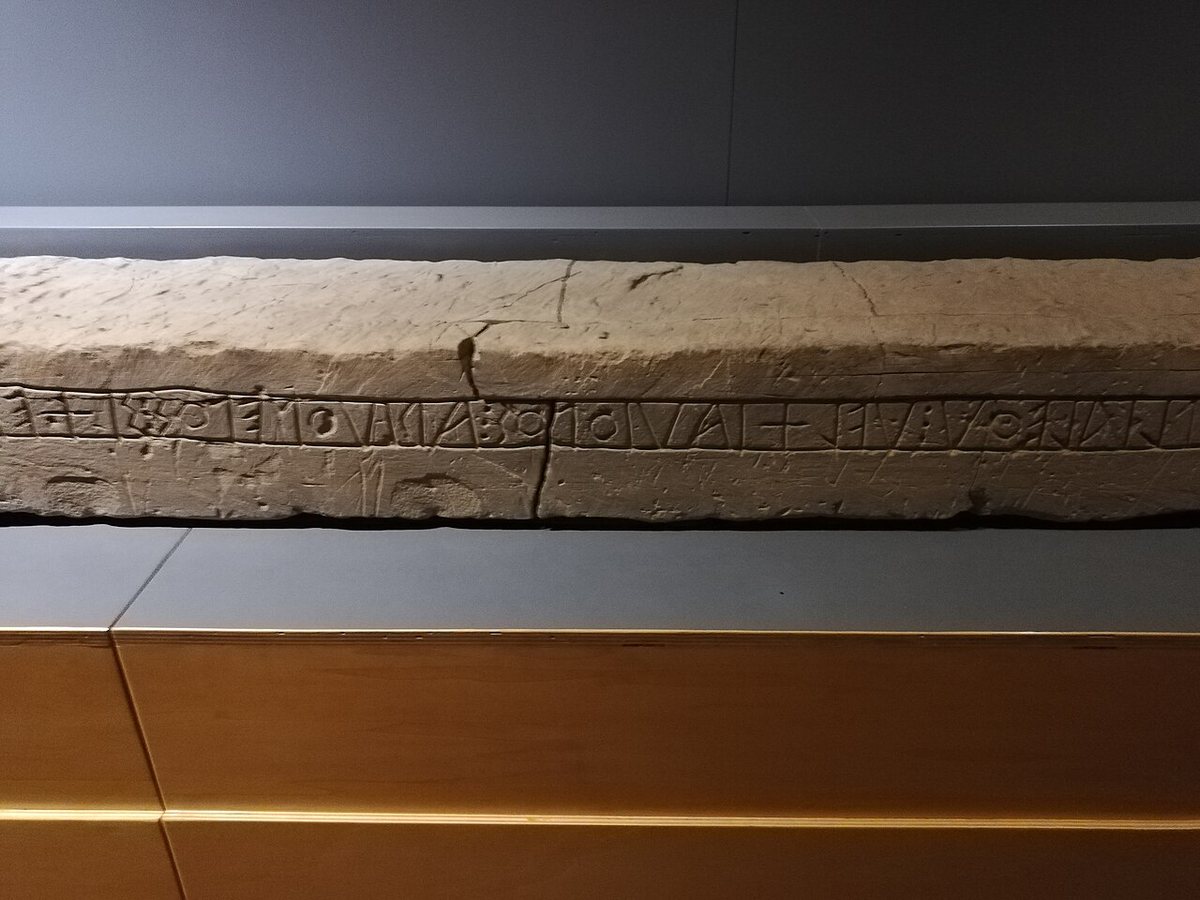
The Celtiberians lived in the interior of what is now Spain, between the upper Douro, Tagus and Ebro. Their language is attested in nearly 200 inscriptions and about 300 shorter records from the 2nd century BCE to the 1st century CE, mostly in the Celtiberian script, which the Celtiberians adapted from the Northeastern Iberian script, and partly in the Latin alphabet.
The Iberian script is a semi-syllabary: vowels and consonants such as l, n, r and s have letters of their own, but stops are written only with syllabic signs – one series of signs for ba, be, bi, bo, bu, another for ta, te, ti, to, tu, and so on. Celtiberian consonant clusters fitted such a script only awkwardly.
The longest Celtiberian texts are on the bronze plaques from Botorrita near Zaragoza, ancient Contrebia Belaisca, from the early 1st century BCE. Three of them (Botorrita I, III and IV) are in Celtiberian; Botorrita II is in Latin. Small bronze hospitality tokens (tessera hospitalis), which sealed bonds of friendship between people or communities, are also common. The last Celtiberian texts, such as the rock inscriptions in Latin letters at the sanctuary of Peñalba de Villastar, date from the 1st century CE; the language probably died out around 200.
The Gauls write in Greek
Gaulish is the best-attested ancient Celtic language. It is known from some 800 inscriptions, many of them fragmentary (dedications to gods, epitaphs, texts on pottery and coins), from personal and place names, and from words recorded by classical authors. In southern Gaul the Gauls began to write it in the Greek alphabet, which they learned from the Greeks of Massalia (modern Marseille, founded around 600 BCE). Gaulish names in Greek letters are known from the 3rd century BCE and true inscriptions from the 2nd. According to the corpus Recueil des inscriptions gauloises, nearly three quarters of Gaulish inscriptions (excluding coins) are in the Greek alphabet.
The Greek script travelled far north. Caesar writes in his Gallic War (I, 29) that in 58 BCE tablets written in Greek letters were found in the camp of the Helvetii, listing everyone who had set out: 368,000 people, among them 32,000 Boii. Greek legends prevailed on Gaulish coins until the middle of the 1st century BCE. After the Roman conquest of Gaul (58–50 BCE) the Gauls switched to the Latin alphabet, adding a barred D, the tau gallicum, for a sound similar to ts.
Gaulish gave way to Latin and probably died out in the 6th century. It left some 150–180 words in French, mostly to do with rural life, and around 400 if dialect words are included.
Segomaros Uilloneos toutius Namausatis eiōru Bēlēsami sosin nemēton
- Segomaros
- a man's name
- Uilloneos
- son of Villu (Uillū) (an adjective formed from the father's name)
- toutius Namausatis
- citizen of Nemausus (Nîmes); touta = people, community
- eiōru
- dedicated
- Bēlēsami
- to Belesama (dative), a goddess
- sosin nemēton
- this sacred enclosure (accusative)
Segomaros, son of Villu (Uillū), citizen of Nemausus, dedicated this sacred enclosure to Belesama.A Gaulish dedication in the Greek alphabet from Vaison-la-Romaine in Provence. The sigma has the crescent shape Ϲ usual in later Greek writing. The verb eiōru is spelled ieuru in inscriptions in Latin letters, for example on the stone from Alise-Sainte-Reine. The word nemeton, “sacred place”, has a counterpart in Old Irish nemed, and Gaulish touta in Old Irish túath, “people, tribe”.
![A column capital with a Gaulish dedication in the Greek alphabet, from Saint-Côme (Gard). Only the dedicator's patronymic ΑΔΡΕΣΣΙΚΝΟΣ, “son of Adressos”, and the closing formula ΒΡΑΤΟΥΔΕΚΑ[ΝΤΕΜ] survive; bratoude is usually taken to mean “in gratitude”, and the rest perhaps “a tithe”. Archaeological Museum, Nîmes.](/starovek/keltove/nimes.jpg)
The Coligny calendar
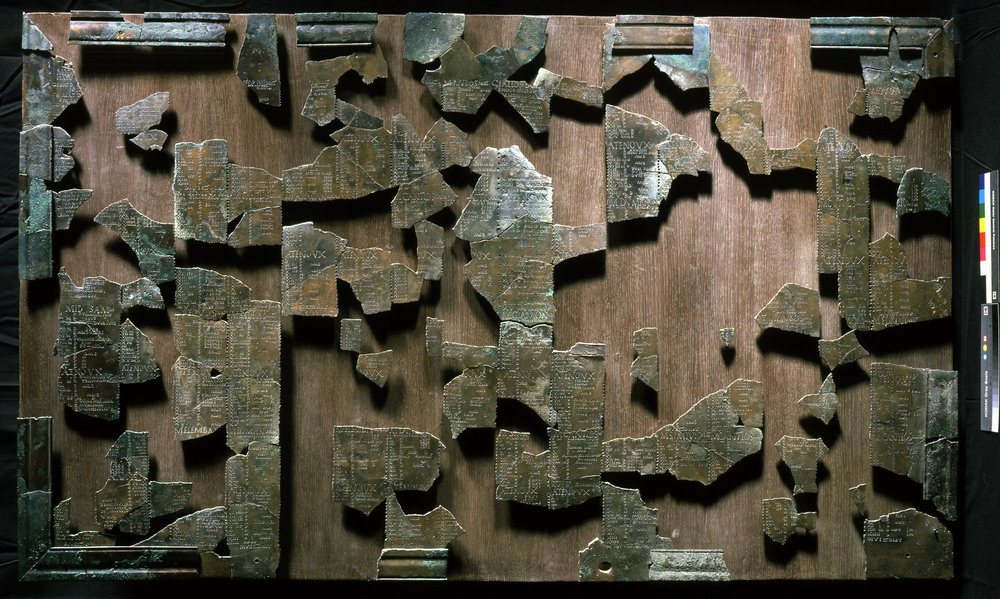
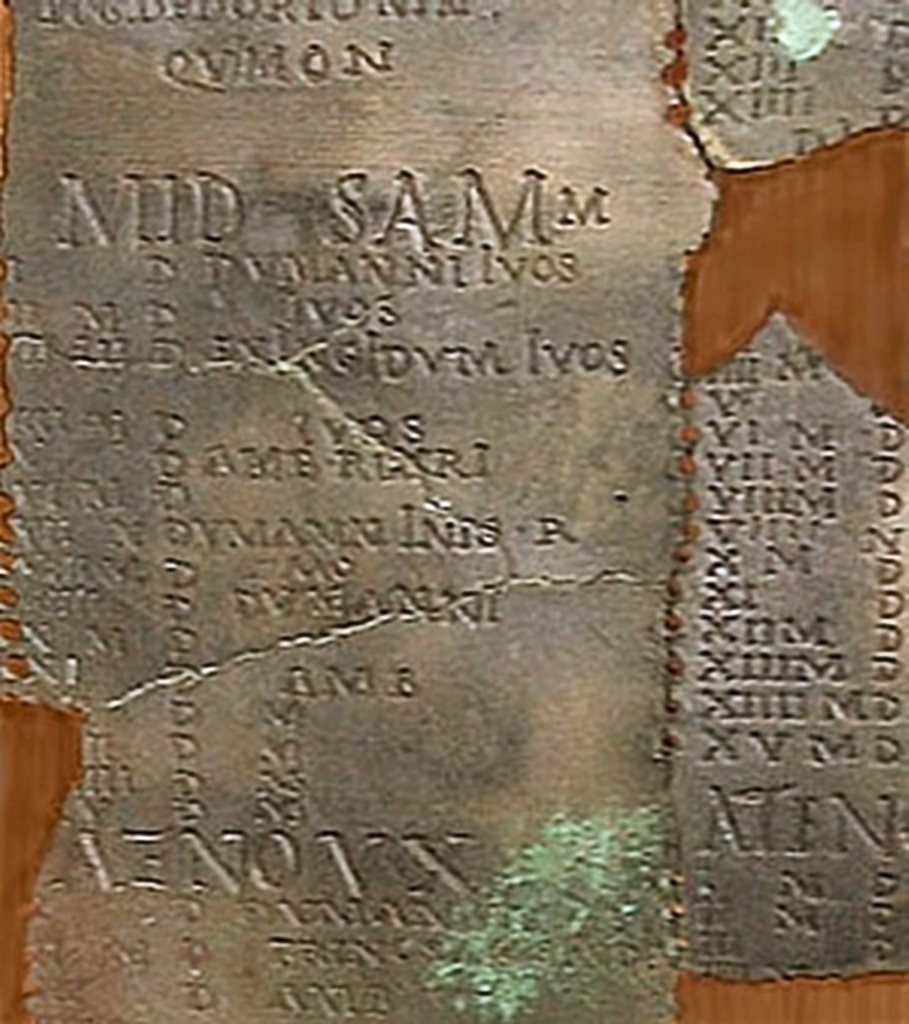
The best-known Gaulish text is the calendar found in 1897 at Coligny in the Ain department, about 80 km north-east of Lyon, together with fragments of a bronze statue, probably of the god Mars. The bronze plaque, originally 134.8 × 78 cm, survives in 73 fragments, roughly 40 per cent of the whole. It most likely dates from the late 2nd century CE, but copying errors show that the calendar itself is older. It is written in Gaulish in Latin capitals, with Roman numerals.
The calendar is lunisolar: its five-year cycle has 62 months, 60 ordinary ones and two intercalary months that make up the difference between the lunar and the solar year. The months have 30 or 29 days and are marked MAT or ANM(AT). By comparison with Middle Welsh mad, “good”, these are read as “auspicious” and “inauspicious”, but they may simply mean “complete” and “incomplete”. In the middle of each month stands the word ATENOVX, perhaps “renewal”, and each day has a hole for a peg.
The month names have counterparts in the Insular languages. The first month, Samonios, is related to Old Irish samain, the feast of 1 November, which is modern Irish Samhain; the seventh, Giamonios, to the word giamos, “winter”.
Curses on lead tablets
The longest Gaulish text is on a lead tablet from L'Hospitalet-du-Larzac in southern France, found in a grave in 1983 and dated to around 100 CE. Written in Roman cursive, it runs to more than 1,000 letters, about 160 words, and its end is lost. It cannot be translated with certainty, but it is evidently a curse cast by one group of women on another, led by a certain Severa Tertionicna; her name combines the Roman names Severa and Tertio with the Gaulish suffix -ikno-, which forms names from the father's name. The tablet is in the museum at Millau.
The third longest is the tablet from Chamalières, found in 1971 at a healing spring and dated between 50 BCE and 50 CE. It measures only about 6 × 4 cm and carries 396 letters in 47 words. It invokes the god Maponos and ends with the formula luge dessumiis, repeated three times and which some scholars connect with the god Lugus. Whether it is a curse or a plea for healing is disputed.
Gaulish also appears in small texts: on spindle whorls apparently given to girls by their suitors, on a gold ring from Thiaucourt, and in the tallies of the potters of La Graufesenque, which give the Gaulish ordinal numbers from cintus, “first”, to decametos, “tenth”.
Celtic art and coinage
The Boii and the name of Bohemia
The Latin name of Bohemia and the German Böhmen both come from the name Boiohaemum. It was first recorded in Greek around the turn of the era by Strabo (Βουίαιμον), then by Velleius Paterculus and by Tacitus, who is the only ancient author to link it explicitly with the Boii, noting that the name survived although the population had changed. It is usually explained as a Celto-Germanic compound, “home of the Boii”: Celtic Boio- and Germanic *haima-, “home, dwelling”. In medieval German it appears as Bêheim.
That the Boii lived in what is now Bohemia is the traditional view, but not an undisputed one. Some scholars (Miklós Szabó) place the Boian homeland rather in south-western Slovakia; others (Vladimír Salač) regard Boiohaemum as a Germanic name that proves nothing about the Boii's original homeland, though Salač himself still places it in the Bohemian basin. Other groups of Boii are attested in northern Italy around Bononia (Bologna) and along the Danube. In 58 BCE Boii joined the Helvetii on their march into Gaul, and after their defeat Caesar settled them among the Aedui.
Oppida, coins and a stone head
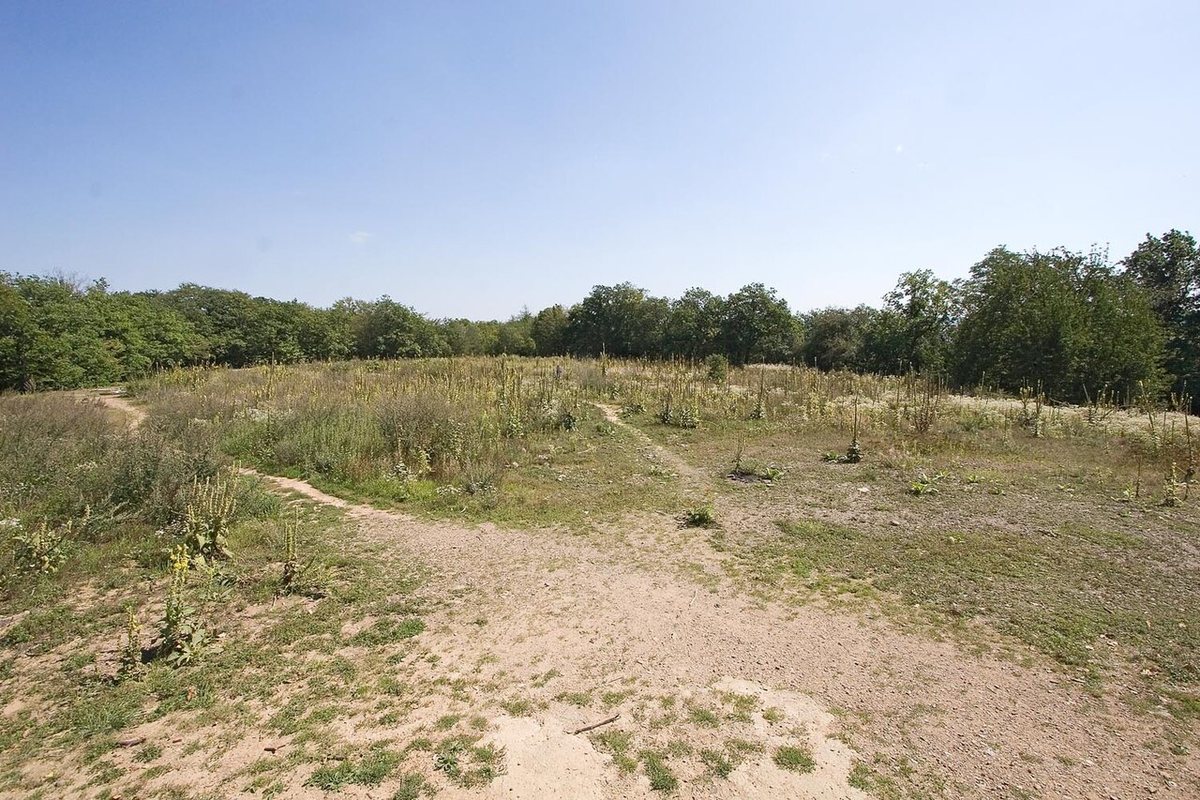
From the second quarter of the 2nd century BCE oppida were founded in Bohemia and Moravia: fortified settlements covering tens of hectares, with workshops and trade. The main ones were Závist on a spur above the Vltava opposite the mouth of the Berounka, Stradonice near Nižbor, Hrazany near Sedlčany, Nevězice, Třísov and České Lhotice, and in Moravia Staré Hradisko near Prostějov and Hostýn. Their economy rested on gold and graphite and on long-distance trade, amber among other goods. A Celtic origin is also assumed for some Czech river names, such as the Jizera, but such etymologies are uncertain.
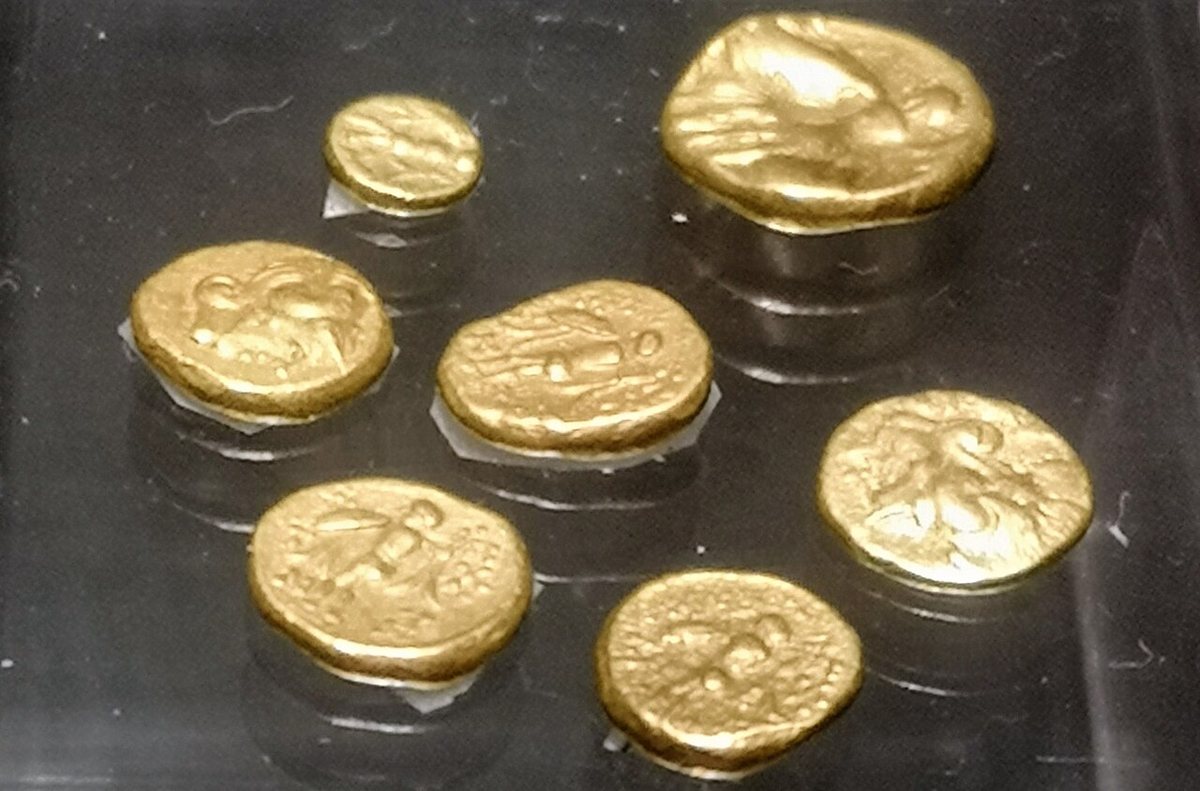
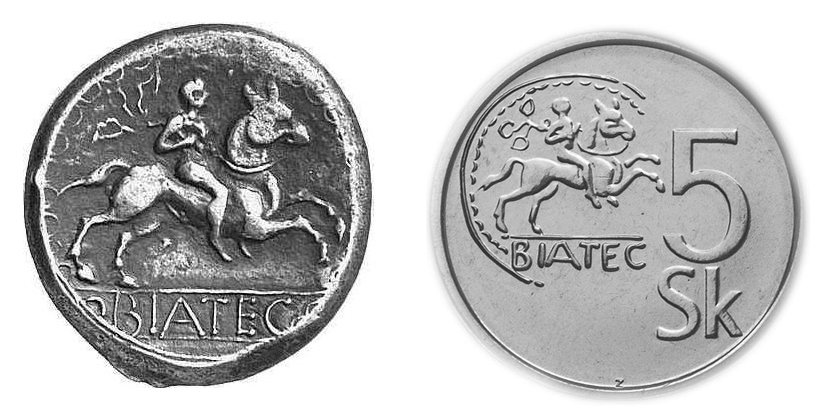
Coins were struck in the oppida. The earliest gold issues imitated Macedonian staters; later, cup-shaped gold coins prevailed, known in Czech as duhovky and in German as Regenbogenschüsselchen, “rainbow cups” (folk belief held that they were found where a rainbow touched the ground), along with the so-called shell staters. Attributing them to the Boii is a convention based on the equation of Boiohaemum with Bohemia. Writing appears on central European coins only in the 1st century BCE: large silver coins from Bratislava carry names in Latin letters, the best known being BIATEC.
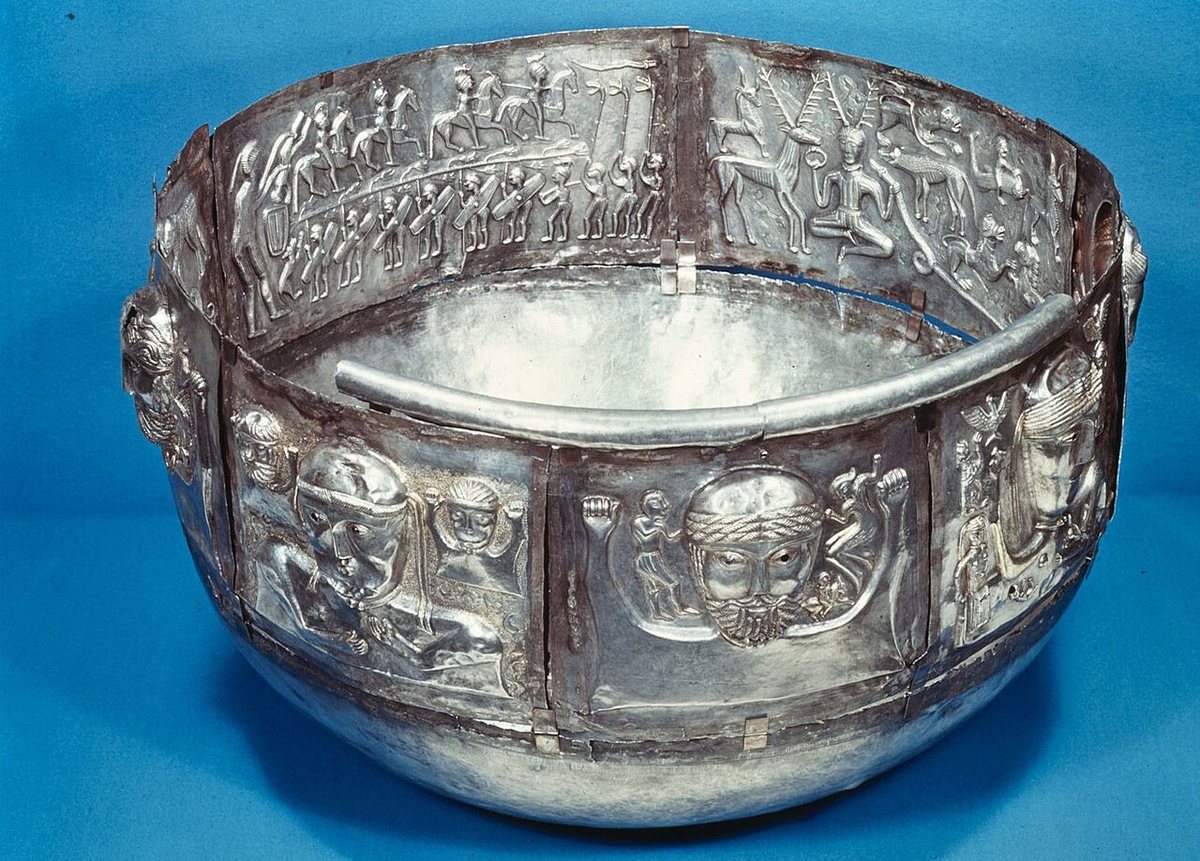
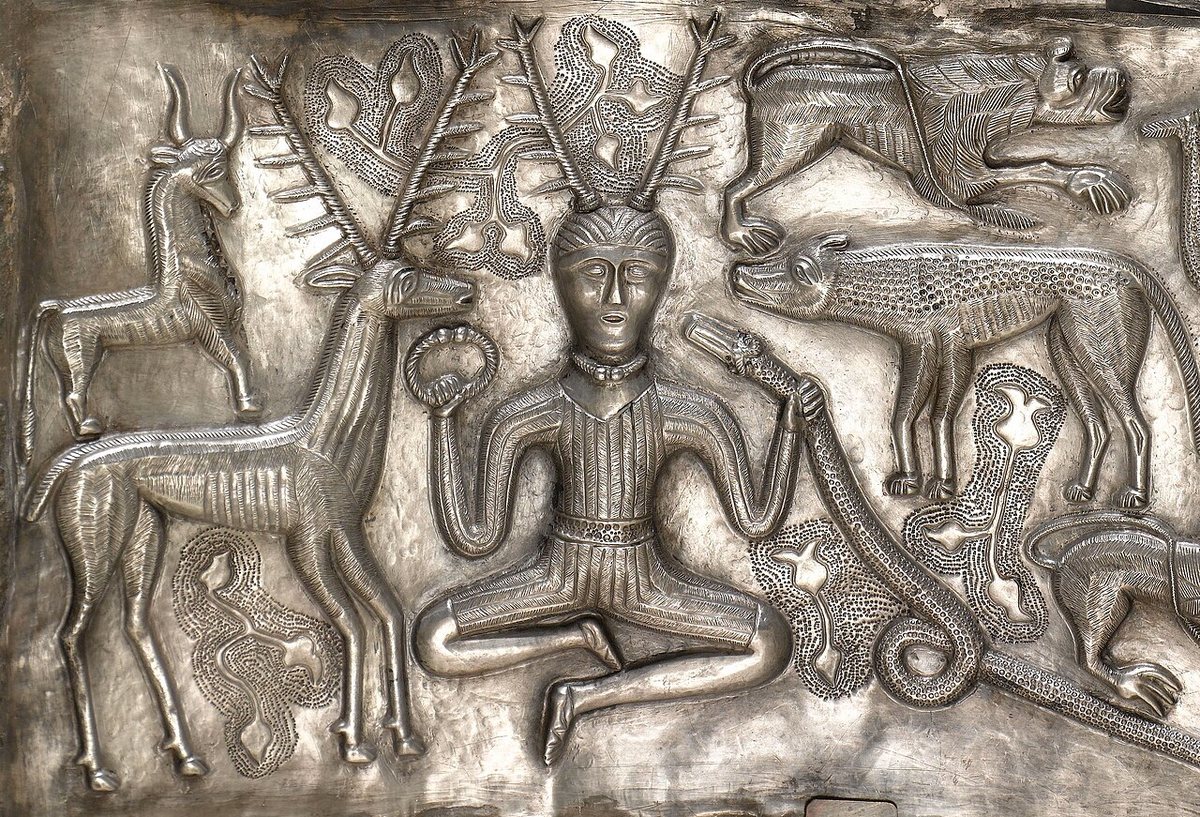
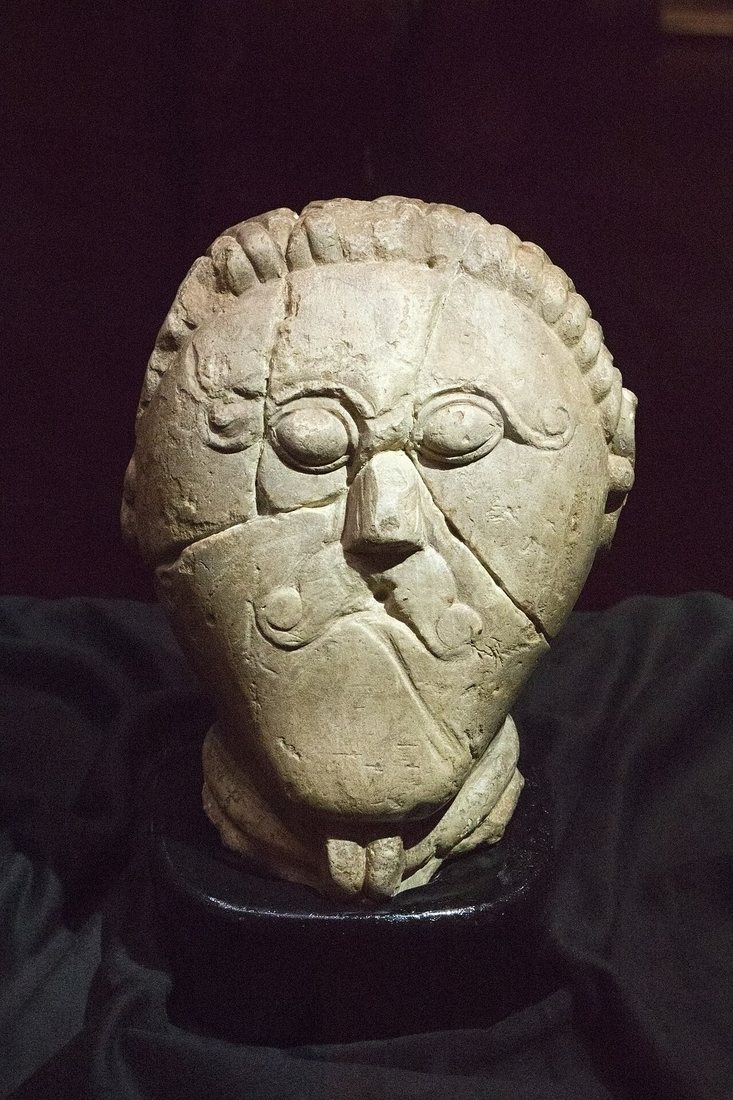
La Tène Bohemia also produced one of the best-known works of Celtic art, the stone head from Mšecké Žehrovice in the Rakovník district, found in 1943. The man with a torc, a moustache and curled eyebrows is variously interpreted as a druid, a hero or a revered ancestor; none of these is certain.
Ogham: a script of strokes
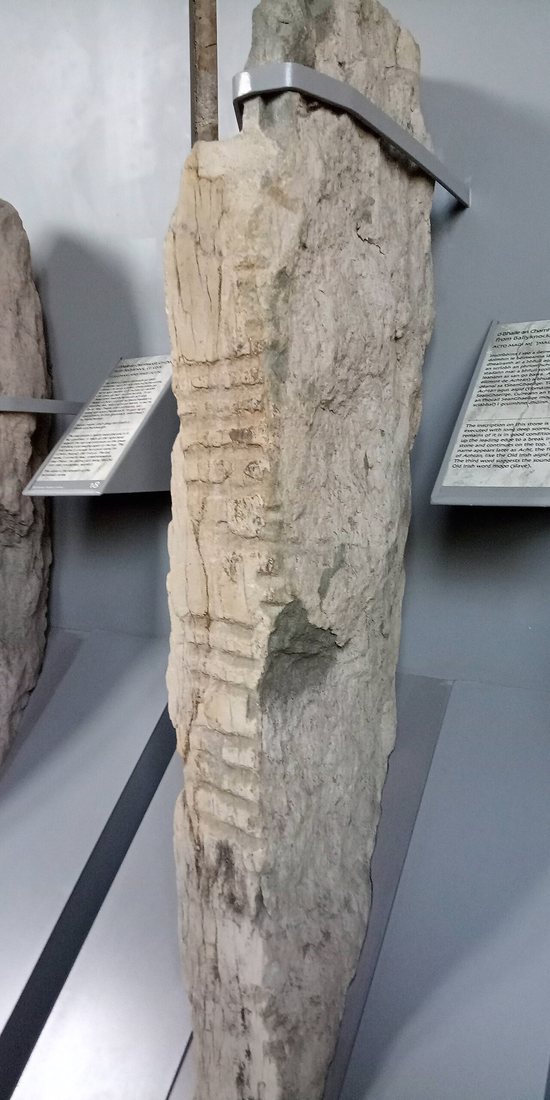
In Ireland, which Roman rule never reached, a script of its own arose: ogham. The earliest inscriptions date from around the 4th century CE and most from the 5th and 6th. There are some 380–400 of them, mainly in the south-western Irish province of Munster (Counties Cork and Kerry hold 60 per cent of the Irish stones), with others in Wales, the Isle of Man, Cornwall, Devon and Scotland. Their language is Primitive Irish, the earliest attested form of Irish, and in Scotland probably also Pictish.
The letters consist of one to five strokes or notches on a stemline, which on a stone is formed by its edge. The twenty basic letters fall into four groups (aicme) of five: strokes on one side of the line, strokes on the other side, slanting strokes across it, and notches for the vowels. The text is read upwards along the edge and, in longer inscriptions, over the top and down. The inscriptions are almost always just names in a fixed formula, X MAQI Y, “(the stone) of X, son of Y”, often with MUCOI, “of the kindred of”.
Most scholars believe that ogham was modelled on the Latin alphabet, perhaps through contacts with Roman Britain. Some letters stand for sounds no longer pronounced by the 5th century, so the script is probably older than the surviving stones and may first have been written on wood. Ogham continued to be taught after the Latin alphabet was adopted and appears in manuscripts as late as the 16th century.
Medieval Irish treatises such as the Auraicept na n-Éces explain the letter names as the names of trees, hence the modern label “tree alphabet”. According to Damian McManus this is a later interpretation: at most eight of the twenty names are really names of trees, certainly beith (birch), fern (alder), sail (willow), dair (oak), coll (hazel) and onn (ash). The idea of a druidic tree calendar was spread by Robert Graves in The White Goddess (1948) and does not stand up to scholarly scrutiny.
The ogham letters
- bbeith ‘birch’
- lluis ‘flame’ or ‘herb’ (tradition: rowan)
- vfern ‘alder’; originally w, later f
- ssail ‘willow’
- nnin ‘fork’ (tradition: ash)
- húath ‘horror’; value uncertain
- ddair ‘oak’
- ttinne ‘metal bar’ (tradition: holly)
- ccoll ‘hazel’; read k
- qcert ‘bush’; originally kʷ
- mmuin ‘neck’ (tradition: vine)
- ggort ‘field’ (tradition: ivy)
- nggétal ‘slaying’; originally gʷ
- zstraif ‘sulphur’; value uncertain
- rruis ‘red’ (tradition: elder)
- aailm, perhaps ‘pine’
- oonn ‘ash’
- uúr ‘clay, earth’
- eedad, meaning unknown
- iidad, perhaps ‘yew’
MAQI MUCOI“of the son of the kindred of …” – MAQI is the genitive of the word for “son”, the source of Irish mac. This is how the inscription from the Isle of Man continues: BIVAIDONAS MAQI MUCOI CUNAVA[LI], “(the stone) of Bivaidonas, son of the kindred of Cunavalos”.
The signs are rendered in the Noto Sans Ogham font. On the stones the letters run vertically along the edge; Unicode writes them horizontally on a shared stemline, and the marks ᚛ and ᚜ mark the beginning and end of an inscription. The letters úath, gétal and straif do not occur in the stone inscriptions. Meanings in quotation marks are the Old Irish senses according to McManus; “tradition” marks the later tree interpretation. Unicode does not yet include the Iberian and Celtiberian scripts, so they are given here only in transliteration.
The Insular languages to the present
Irish began to be written in the Latin alphabet with the arrival of Christianity. Old Irish (c. 600–900) survives mainly in glosses, notes in the margins and between the lines of Latin manuscripts that Irish monks took to monasteries on the Continent; the best known are the Würzburg glosses on the Pauline Epistles and the Milan glosses, both of the 8th–9th centuries. Irish literature is rich, but great sagas such as the Táin Bó Cúailnge (“The Cattle Raid of Cooley”) survive only in manuscripts of the 12th century and later.
Old Irish is the ancestor of Irish, Scottish Gaelic and Manx; Brittonic gave rise to Welsh, Cornish and Breton. On the prevailing view, Breton does not descend from Gaulish: it was brought to Armorica, today's Brittany, by settlers from Britain in the early Middle Ages. Cornish and Manx died out as mother tongues (the last native speakers are usually dated to 1777 and 1974) and are now being revived.
In the 2021 census, 538,000 people in Wales (17.8 per cent) said they could speak Welsh. In the Republic of Ireland 1.87 million people reported some ability in Irish in the 2022 census, about 790,000 of them saying they spoke it very well or well. According to a 2024 survey Breton is spoken by about 107,000 people (still around 200,000 in 2018), and Scottish Gaelic by about 70,000 according to the 2022 census.
Timeline
- c. 800–450 BCEThe Early Iron Age Hallstatt culture.
- 6th c. BCEThe earliest Lepontic inscriptions (Castelletto Ticino).
- c. 480–450 BCEThe Lepontic inscription from Prestino.
- from c. 450 BCEThe La Tène culture.
- c. 400 BCEGaulish tribes cross into northern Italy; Boii around Bononia (disputed).
- 278/277 BCEThe Galatians cross into Asia Minor.
- 3rd–2nd c. BCEThe first Gaulish names and inscriptions in the Greek alphabet in southern Gaul.
- 2nd c. BCEOppida are founded in Bohemia and Moravia.
- early 1st c. BCEThe bronze plaques of Botorrita.
- 58 BCECaesar finds Helvetian registers in Greek letters; the conquest of Gaul begins.
- 1st c. BCESilver coins inscribed BIATEC from Bratislava.
- c. 100 CEThe lead tablet from Larzac, the longest Gaulish text.
- late 2nd c. CEThe Coligny calendar.
- 4th–6th c. CEOgham inscriptions in Ireland and Britain.
- 6th c. CEGaulish probably dies out.
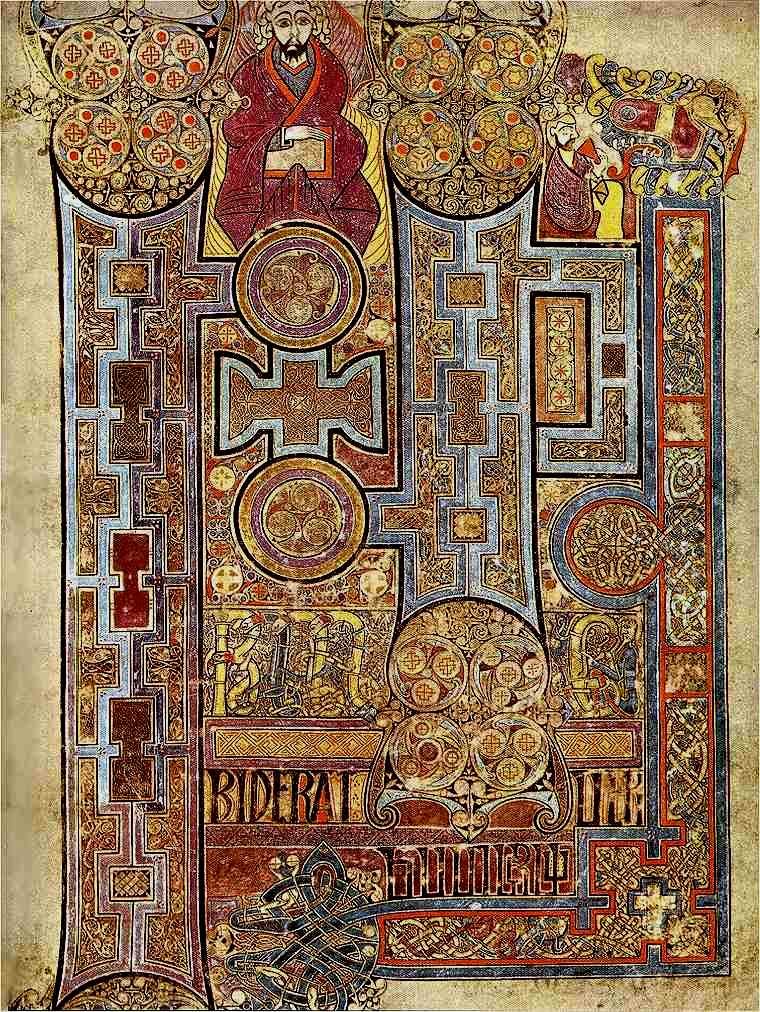
- 8th–9th c.Old Irish glosses; the Book of Kells (c. 800).
Celtic languages on the globe
Tap a language to show it on the globe:
Sources and further reading
- Martin J. Ball, Nicole Müller (eds.): The Celtic Languages. Routledge, 2nd ed. 2009.
- Pierre-Yves Lambert: La langue gauloise. Éditions Errance, 2018.
- Damian McManus: A Guide to Ogam. An Sagart, Maynooth 1991.
- John T. Koch (ed.): Celtic Culture: A Historical Encyclopedia. ABC-CLIO, 2006.
- Petr Drda, Alena Rybová: Keltové a Čechy. Academia, Prague 1998.
- Glottolog 5 (languages and their classification).