
Languages of antiquity
The Hebrews and the Arameans
The Levant · from the Gezer calendar to revived Hebrew
Hebrew and Aramaic are two related Semitic languages in which the Hebrew Bible is written. Hebrew was spoken in the Iron Age kingdoms of Israel and Judah; Aramaic first in the Aramean states of Syria and later in the chanceries of great empires from Egypt to Central Asia. The Aramaic script gave rise to the Hebrew square script as well as to the Syriac and Arabic scripts. Hebrew ceased to be a mother tongue in late antiquity, yet it went on being written, and at the end of the 19th century it became an everyday spoken language once again.
Two neighbouring languages
Hebrew and Aramaic belong to the Northwest Semitic languages. Hebrew is a language of the Canaanite branch, closely related to Phoenician and Moabite. It was spoken in the Iron Age (c. 1200–586 BCE), later in the kingdoms of Israel and Judah. Aramaic forms a branch of its own. It was the language of the Arameans, who around 1000 BCE ruled a string of small kingdoms in what is now Syria and on the fringes of Mesopotamia, among them Damascus, Hamath and Arpad.
The two languages meet in the Hebrew Bible: most of it is written in Hebrew, parts of the books of Daniel and Ezra in Aramaic. After the Babylonian conquest of Jerusalem in 586 BCE and in the Persian period, Aramaic spread into the everyday life of the Jews; how quickly it displaced Hebrew is still debated. Hebrew was still spoken in some circles in the Roman period. It most likely died out as an everyday language between 200 and 400 CE, after the failed Bar Kokhba revolt (132–135), but it remained the language of prayer, learning and literature.
The earliest Hebrew inscriptions
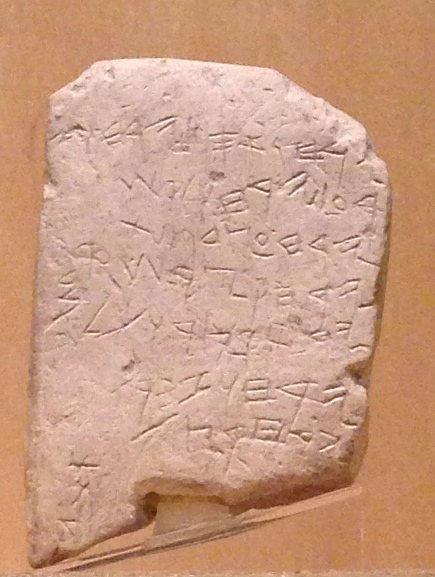
One of the earliest Hebrew texts is thought to be the Gezer calendar, a soft limestone tablet found in 1908 by the Irish archaeologist R. A. Stewart Macalister at Gezer, west of Jerusalem. It is usually dated to the 10th century BCE, but the date is uncertain because the excavation was not stratified. The language is disputed too: some see a northern dialect of Hebrew, others Phoenician. It is not a true calendar but a list of farming tasks by months and pairs of months: gathering, sowing, the barley harvest, vine pruning, summer fruit.
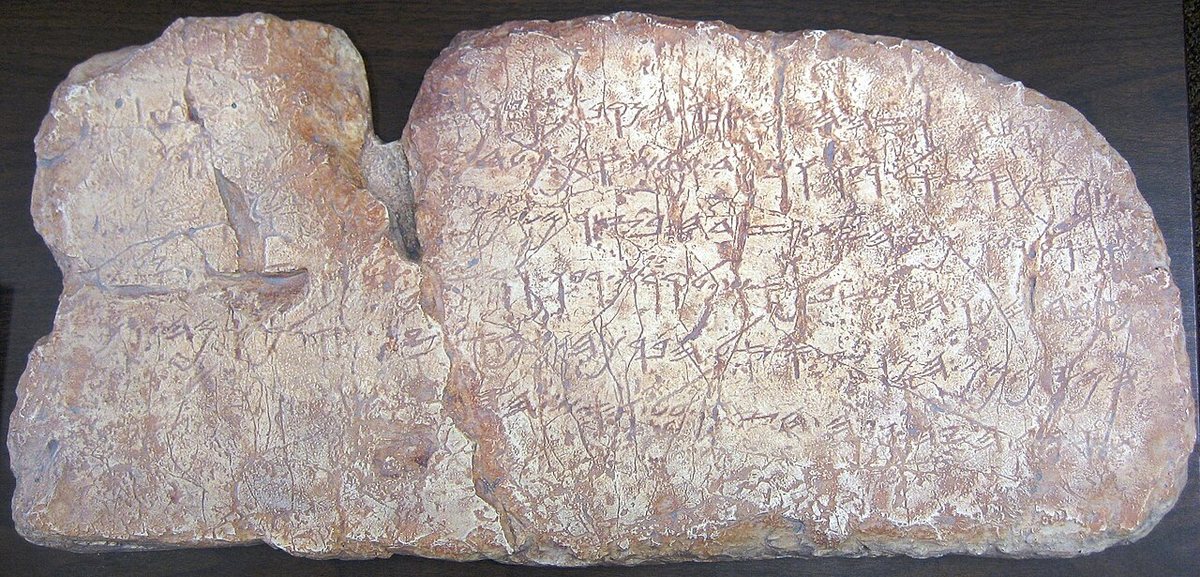
The Siloam inscription was carved into the rock of the tunnel that brings water in Jerusalem from the Gihon spring to the Pool of Siloam. It was discovered in 1880 by a sixteen-year-old pupil of the architect Conrad Schick. Its six lines describe how stonecutters dug the tunnel from both ends: with three cubits left they heard the other team’s voices, then met “axe against axe”, and the water then flowed for 1,200 cubits. On the basis of the letter forms it is dated to about 700 BCE. The tunnel is usually linked with King Hezekiah of Judah, but the inscription names no ruler. In 1890 it was cut out of the rock and broke into several pieces; it is now in the Istanbul Archaeology Museums.
Royal stones: Mesha and Tel Dan
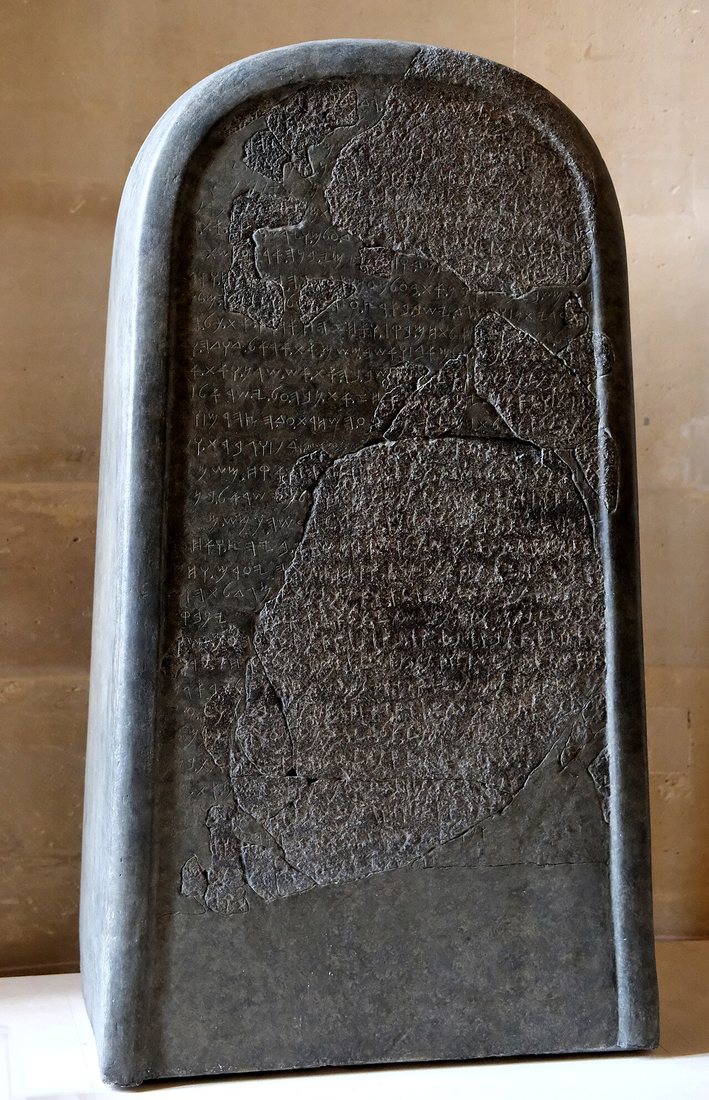
The stele of King Mesha of Moab, from about 840 BCE, is the longest Iron Age inscription found in the southern Levant: 34 lines on a basalt block about a metre tall. It is written in Moabite, a language very close to Hebrew, in a script close to Paleo-Hebrew. Mesha tells how Omri king of Israel and his son long oppressed Moab until the god Chemosh helped him throw off their rule; he also mentions the vessels of YHWH. The stele was found in 1868 at Dibon (now Dhiban in Jordan) by the missionary Frederick Klein. The next year local Bedouin smashed it; the archaeologist Charles Clermont-Ganneau later pieced the fragments together with the help of a paper impression (squeeze) taken just before. It has been in the Louvre since 1873.
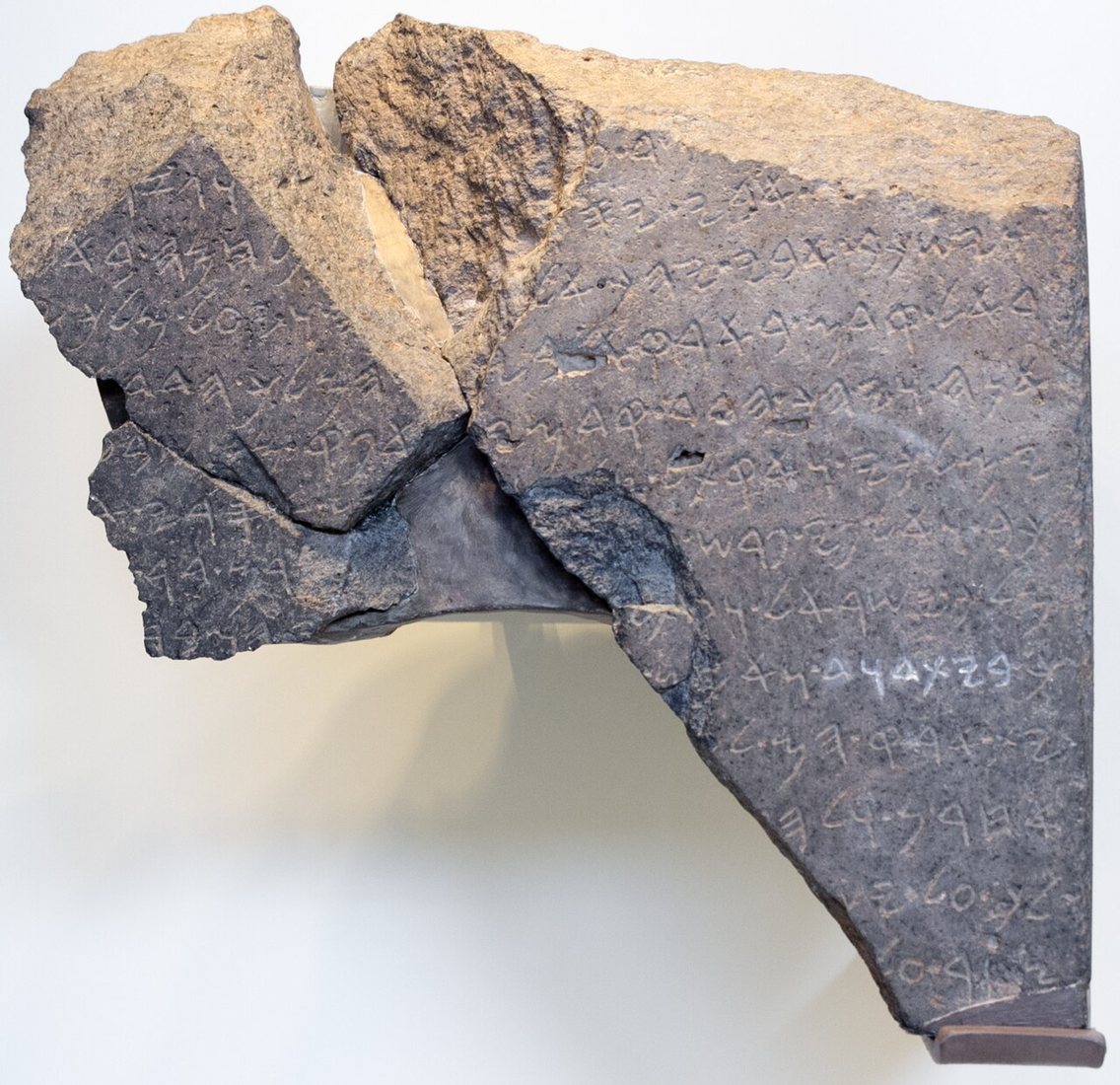
In 1993 and 1994 Avraham Biran’s team at Tel Dan in northern Israel found three fragments of a basalt stele with an Old Aramaic inscription in a Phoenician-type script. It was most probably set up by Hazael, king of Damascus, in the late 9th century BCE. The victor boasts of defeating the king of Israel and the king of the “House of David”, bytdwd (𐤁𐤉𐤕𐤃𐤅𐤃). Most scholars accept this reading and regard the inscription as the earliest widely accepted reference to the Davidic dynasty outside the Bible; a minority disputes it, because there is no word divider between byt “house” and dwd.
After the Tel Dan find, the French epigraphist André Lemaire proposed in 1994 that “House of David” should also be read in the damaged line 31 of the Mesha stele. This reading is disputed: an interpretation published in 2019 favours the name Balak instead.
Stelae of the 9th century BCE
From Phoenician shapes to the square script
In the 10th–6th centuries BCE the Israelites and Judeans wrote in the Paleo-Hebrew script, a local form of the Phoenician alphabet of 22 consonant letters. In the 6th and 5th centuries BCE, during the Babylonian exile and Persian rule, it was gradually replaced among the Judeans by the Aramaic script of the Persian chanceries. By about the 3rd century BCE this had developed into the Hebrew square script, in which Hebrew is still written. The Talmud (Sanh. 21b–22a) calls it ktav ashuri, “Assyrian script”, and records a tradition that it was brought from Assyria.
Yet the Paleo-Hebrew script did not vanish entirely. Among the Dead Sea Scrolls some books of the Torah are written in it, such as the Leviticus scroll from Cave 11, and the Bar Kokhba rebels struck coins with inscriptions in it. The Samaritans developed it into the Samaritan script, which they still use. Today’s Israeli one-shekel coin bears the word 𐤉𐤄𐤃, Yehud (Judea), in Paleo-Hebrew letters, after coins of the Persian period.
One alphabet in three forms
The same letters in the Paleo-Hebrew, Aramaic and Hebrew square scripts. Paleo-Hebrew is a local variety of the Phoenician script, so Unicode does not encode it separately: Paleo-Hebrew is written with the characters of the Phoenician block and rendered here in the Noto Sans Phoenician font. Letter shapes varied from place to place; the table shows only typical forms.
| Paleo-Hebrew (Phoenician) | Imperial Aramaic | Hebrew square script | letter |
|---|---|---|---|
| 𐤀 | 𐡀 | א | alef, ʾ |
| 𐤁 | 𐡁 | ב | bet, b |
| 𐤂 | 𐡂 | ג | gimel, g |
| 𐤃 | 𐡃 | ד | dalet, d |
| 𐤄 | 𐡄 | ה | he, h |
| 𐤅 | 𐡅 | ו | vav, w |
| 𐤉 | 𐡉 | י | yod, y |
| 𐤊 | 𐡊 | כ | kaf, k |
| 𐤌 | 𐡌 | מ | mem, m |
| 𐤏 | 𐡏 | ע | ayin, ʿ |
| 𐤓 | 𐡓 | ר | resh, r |
| 𐤔 | 𐡔 | ש | shin, š |
| 𐤕 | 𐡕 | ת | tav, t |
The Hebrew alphabet
- ʾalef
- bbet; today also v
- ggimel
- ddalet
- hhe
- wvav; today v
- zzayin
- ḥhet
- ṭtet
- yyod
- kkaf; today also kh
- llamed
- mmem
- nnun
- ssamekh
- ʿayin
- ppe; today also f
- ṣtsadi; today ts
- qqof
- rresh
- š, śshin and sin
- ttav
ʿbryt · ʿivrit“Hebrew (language)”; the letter yod marks the vowel i here, while the first i is not written at all
The Hebrew alphabet has 22 letters, all for consonants; it is written from right to left and has no upper and lower case. Five letters have a special form at the end of a word: ך (kaf), ם (mem), ן (nun), ף (pe), ץ (tsadi). The letters alef, he, vav and yod also indicate vowels (Latin matres lectionis). Below each letter are its scholarly transliteration and name; in today’s pronunciation bet, kaf and pe are read v, kh and f in some positions, usually after a vowel. The letters are rendered in the Noto Serif Hebrew font.
Aramaic, the language of empires
Aramaic spread far beyond the Aramean states. The Neo-Assyrian Empire, which subjugated them in the 9th and 8th centuries BCE, adopted it in its administration, and so the language of the conquered became the common language of the whole empire. The Neo-Babylonian Empire used it after them, and the Achaemenids administered their realm in it from Egypt to Bactria, as the page on Persia shows. Scholars call this uniform official form of the language Imperial Aramaic.
How Aramaic was becoming the language of diplomacy is shown by the biblical account of the Assyrian siege of Jerusalem in 701 BCE: the Judean officials ask the Assyrian envoy to speak to them in Aramaic, which they understand, and not in Judean, within earshot of the people on the wall (2 Kings 18:26). According to this account, ordinary people in Jerusalem did not then understand Aramaic.
In Jesus’ time most Jews in Judea and Galilee spoke Aramaic; Hebrew was the language of worship and learning and was still spoken in some circles. On the prevailing view Jesus spoke the Galilean dialect of Aramaic. The Gospels, written in Greek, preserve a few of his Aramaic words, such as talitha kum, “little girl, get up” (Mark 5:41); whether and how often he also used Hebrew or Greek is debated. Large parts of the Talmud and the targums, Aramaic translations of the Bible, are also written in Aramaic.
Aramaic has not died out. Neo-Aramaic languages are still spoken by Assyrian Christians, some Iraqi Jews and the Mandaeans, and in the Syrian town of Maaloula and two neighbouring villages by Muslims and Christians alike. The two largest, Suret (Assyrian Neo-Aramaic) and Turoyo (Surayt), have about a quarter of a million speakers each. All the Neo-Aramaic languages are endangered.
The Dead Sea Scrolls
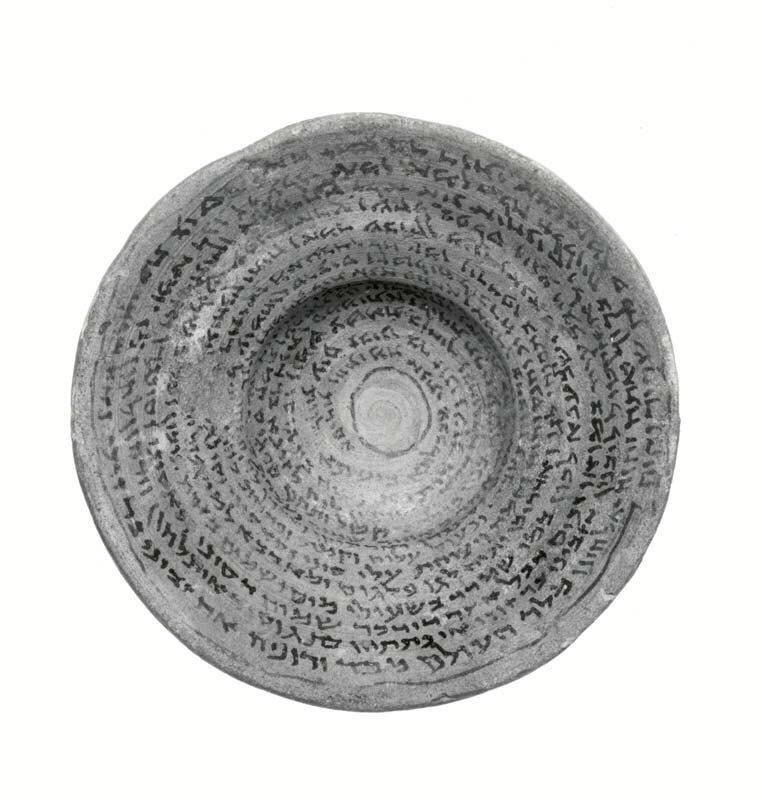
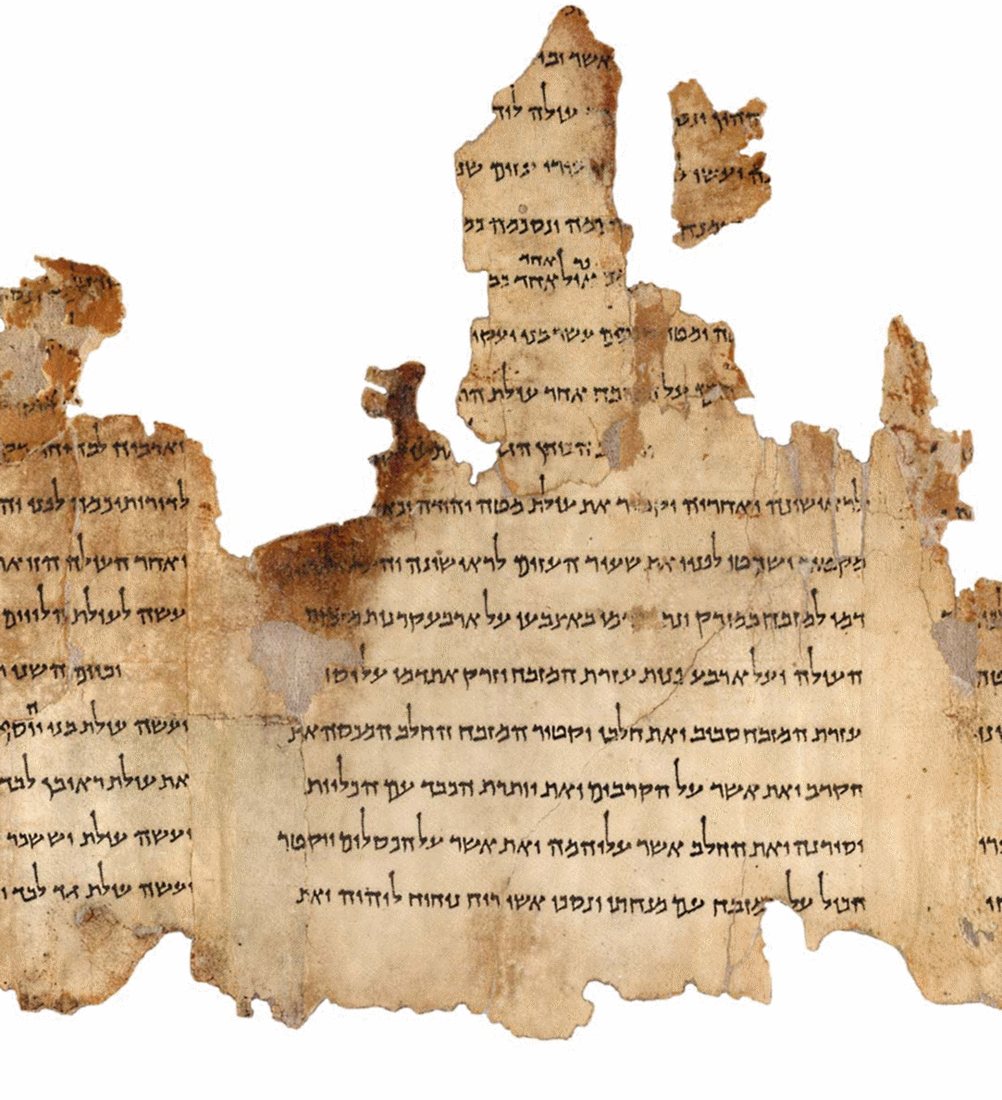
Between November 1946 and February 1947 Bedouin shepherds, among them Muhammed edh-Dhib, found jars containing scrolls in a cave near Qumran on the north-western shore of the Dead Sea. By 1956 Bedouin and archaeologists had explored eleven caves in the area, yielding the remains of 981 different manuscripts. Most are small scraps; fewer than a dozen scrolls are nearly complete.
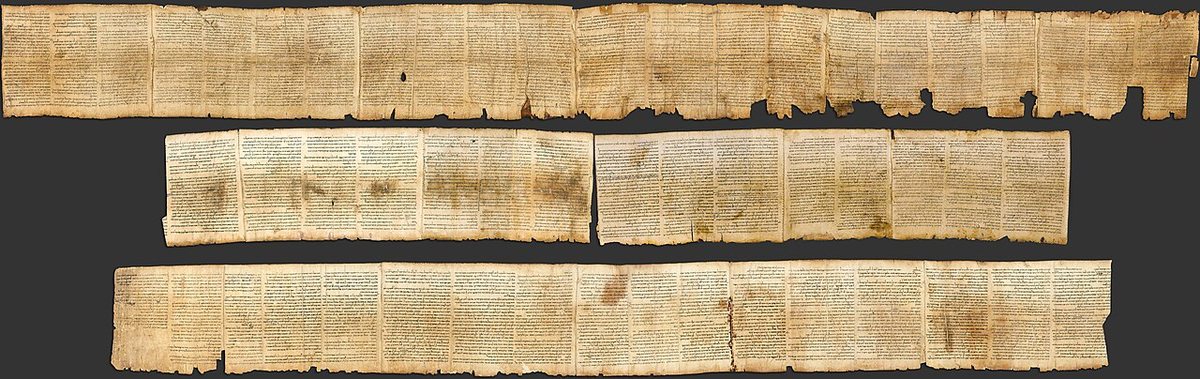
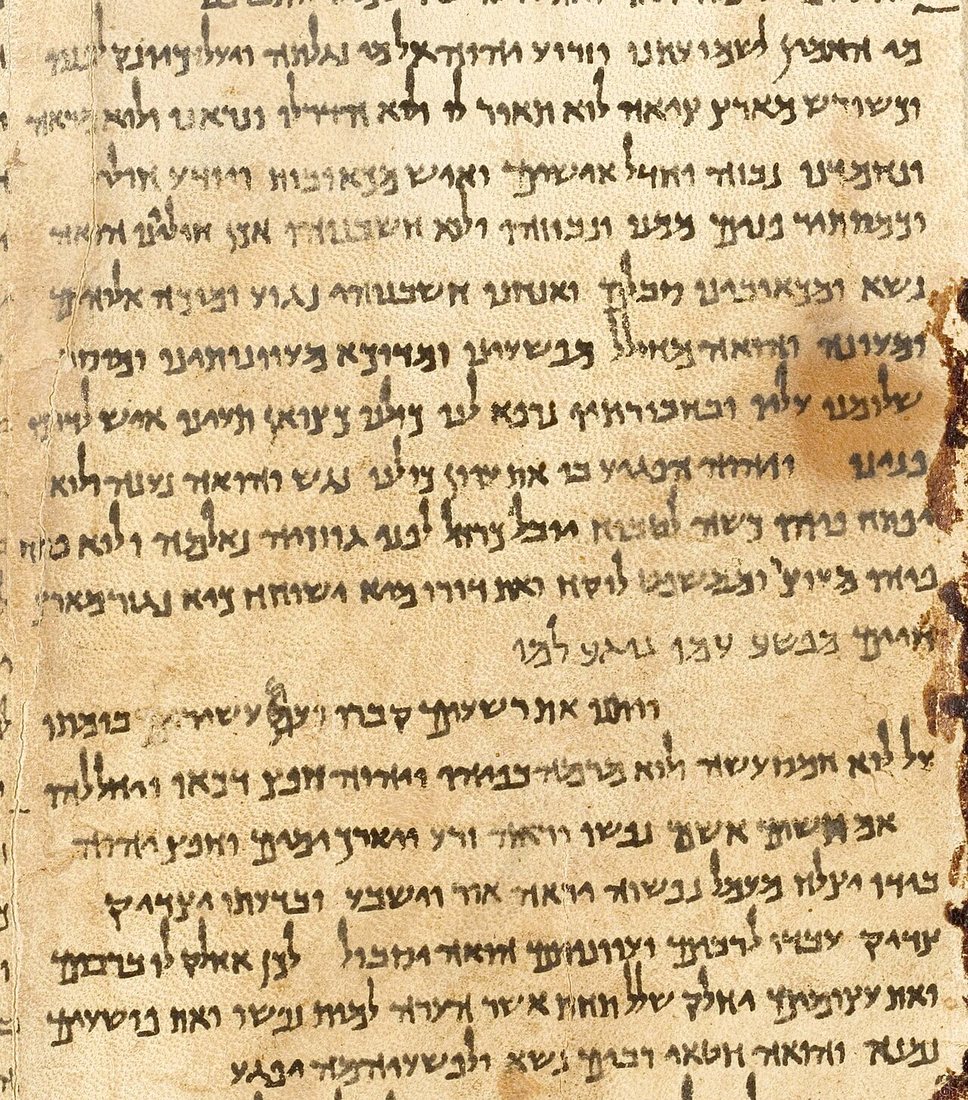
The scrolls date from the 3rd century BCE to the 1st century CE. About 40% are copies of books of the later Hebrew Bible, about 30% other Jewish writings of the time, and the rest texts of a particular religious group, on the prevailing view the Essenes. Most are written in Hebrew in the square script, some in Aramaic (the Genesis Apocryphon, for instance) and a few in Greek. Almost all are now in the Shrine of the Book of the Israel Museum in Jerusalem; a few, among them the Copper Scroll, are in the Jordan Museum in Amman.
The Great Isaiah Scroll
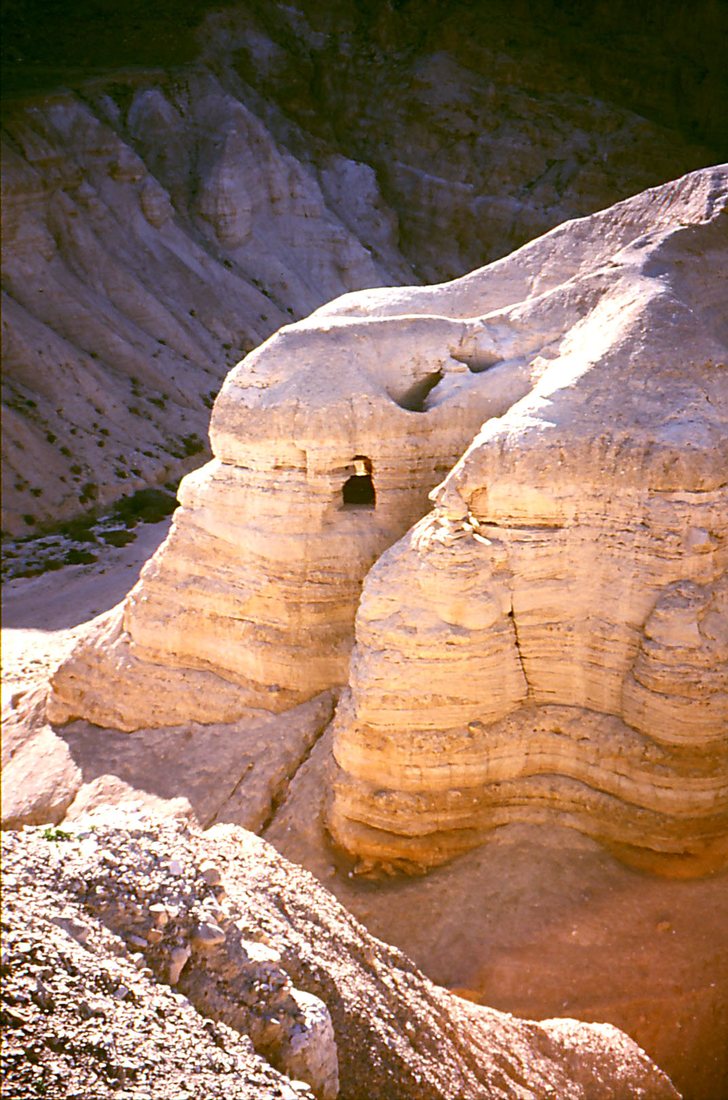
The best-known scroll is the Great Isaiah Scroll (1QIsaᵃ) from Cave 1: 17 sheets of parchment sewn into a strip about 7.34 m long, with 54 columns of text. It contains the whole Book of Isaiah, apart from small damaged parts, and on the evidence of the handwriting dates from about 125–100 BCE. That makes it roughly a thousand years older than the Hebrew manuscripts of Isaiah known before the discovery.
Its text broadly agrees with the later Masoretic Text, but differs from it in more than 2,600 places. Most are minor: spelling, word order, singular and plural. The scribe indicated vowels with the letters vav and yod more often than the Masoretic Text does. The scroll was bought for Israel in 1954 by the archaeologist Yigael Yadin.
From the Qumran scrolls
The Masoretes and the vowel points
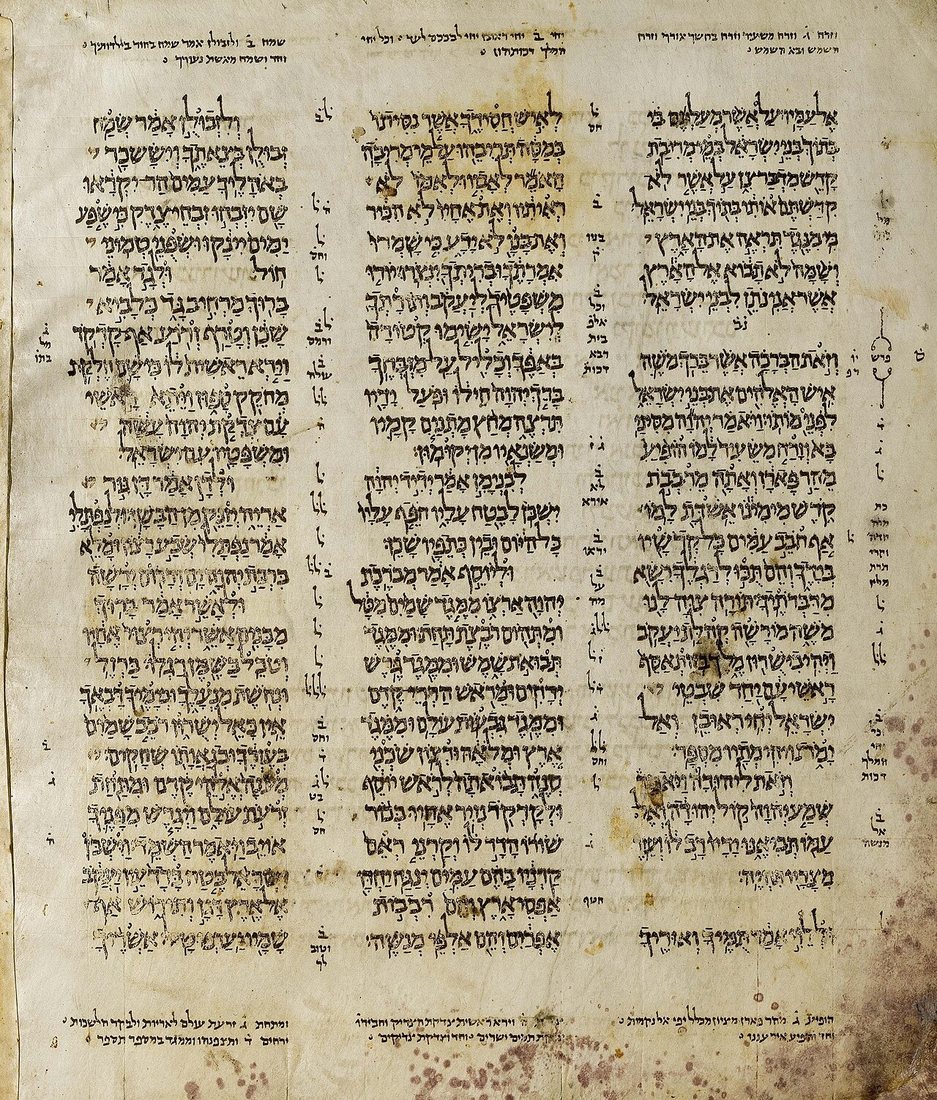
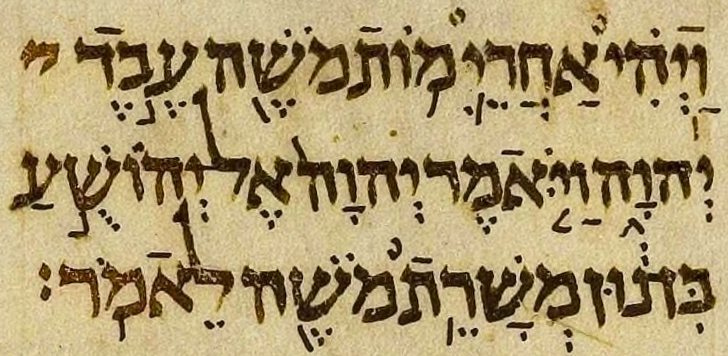
The Hebrew script recorded only consonants, indicating vowels at most with the letters alef, he, vav and yod. As long as Hebrew was a living language, that was enough. Once it was no longer a mother tongue, the correct reading of the sacred text had to be secured in another way. This was the work of the Masoretes, scholars and scribes active between the 7th and 11th centuries in Tiberias, Jerusalem and Mesopotamia. They introduced dots and strokes above and below the letters (niqqud) and accent marks, which add to the text without changing it, and wrote notes on spelling, the masorah, in the margins. Of several systems, the Tiberian one prevailed.
The model of the Tiberian tradition is the Aleppo Codex. Around 920 the scribe Shlomo ben Buya’a copied its consonantal text, and Aaron ben Moses ben Asher, the most eminent of the Tiberian Masoretes, added the vowel points, accents and masorah. Maimonides too accepted it as authoritative. For nearly six centuries the codex was kept in the Central Synagogue of Aleppo. The synagogue was set on fire in the anti-Jewish riots of 1947, and when the codex reached Israel in 1958 only 294 of an estimated 487 leaves remained; most of the Torah was missing. What happened to the missing leaves is unclear. The oldest complete manuscript of the Hebrew Bible is therefore the Leningrad Codex of the early 11th century.
bərēʾšît bārāʾ ʾĕlōhîm ʾēt haššāmayim wəʾēt hāʾāreṣ
- bərēʾšît
- in the beginning (bə- “in” + rēʾšît “beginning”, from rōʾš “head”)
- bārāʾ
- created
- ʾĕlōhîm
- God (plural in form, but the verb is singular)
- ʾēt
- marker of the definite object, not translated
- haššāmayim
- the heavens (ha- is the definite article)
- wəʾēt hāʾāreṣ
- and the earth (wə- “and”)
In the beginning God created the heavens and the earth.The first verse of the Bible (Gen 1:1) with the Tiberian vowel points, without the accent marks. The verb comes before the subject, as is usual in biblical narrative. The first word, bereshit, is also the Hebrew name of the Book of Genesis. Torah scrolls for use in worship are still written without the points, in consonants only: בראשית ברא אלהים את השמים ואת הארץ
The Aleppo Codex
The daughters of the Aramaic script
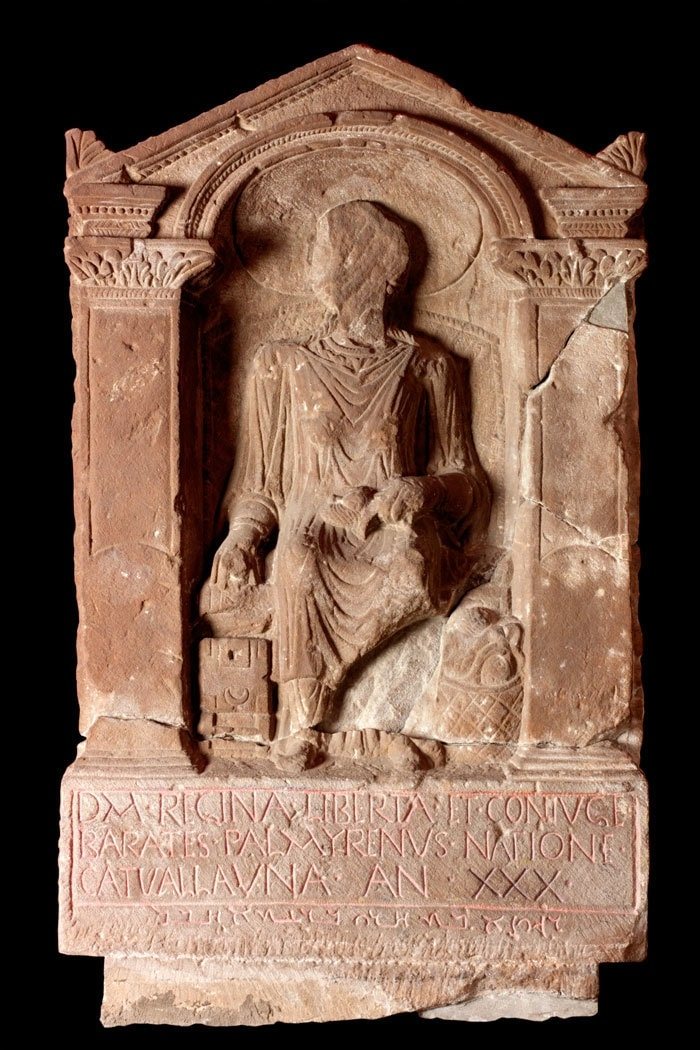
The Aramaic script spread along with the Aramaic language, and its local forms gave rise to a whole family of scripts. The Nabataeans, whose capital was Petra, wrote Aramaic in their own form of the script from the 2nd century BCE; their spoken language was, on the prevailing view, Arabic. From the cursive Nabataean hand the Arabic script developed from the 4th century CE. At Palmyra in the Syrian desert people wrote in the Palmyrene script; over 3,000 inscriptions are known, dating from 44 BCE to 274 CE.
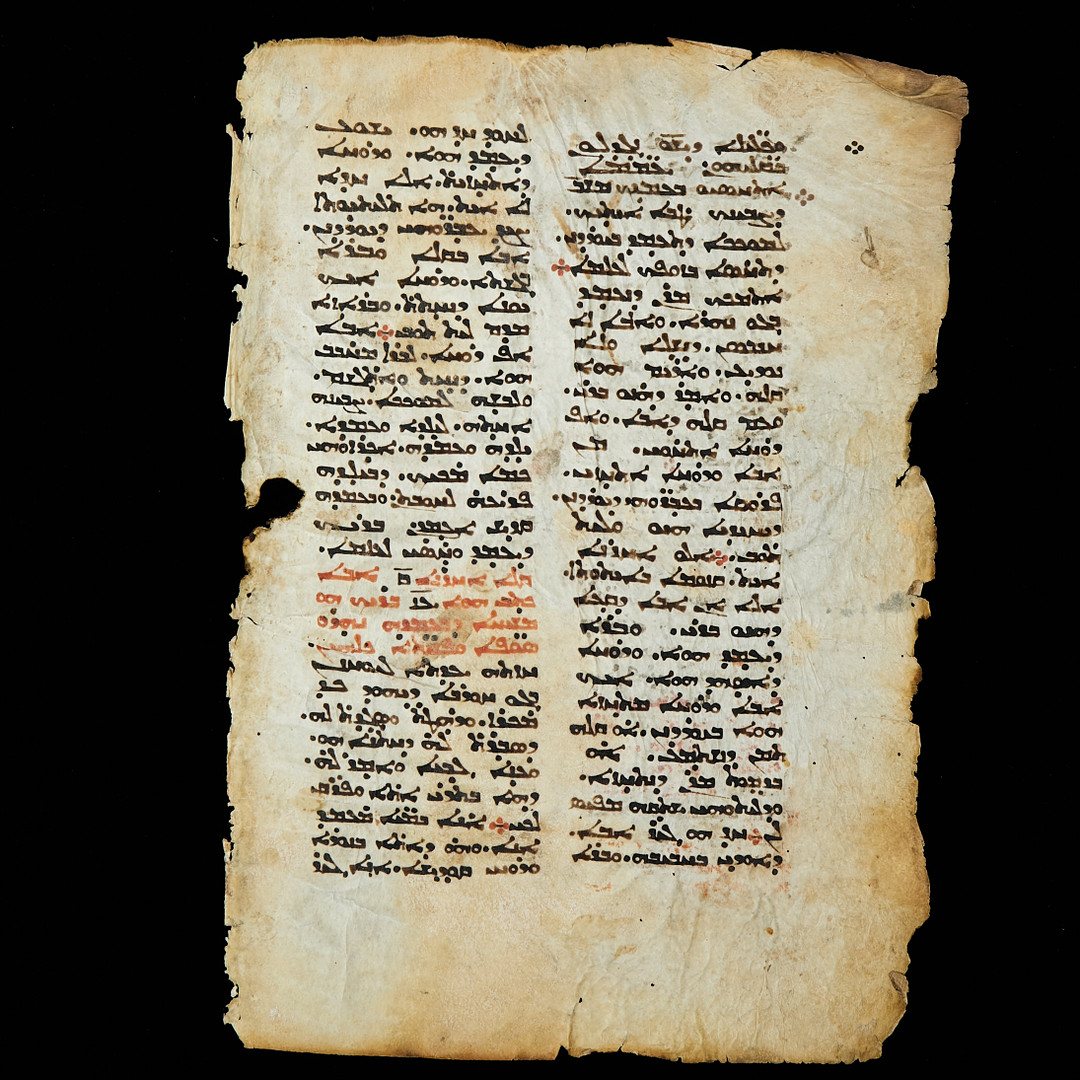
The most influential descendant was the Syriac script. Syriac, the Aramaic dialect of Edessa (today Şanlıurfa in Turkey), has been written in it since the 1st century CE and became the language of much of Eastern Christianity; its basic text is the Bible translation called the Peshitta, “the simple”. Christians of the Syriac tradition carried it as far as India and China. The Syriac script has three main forms (Estrangela, the western Serto and the eastern script) and marks vowels with dots or, in the west, with small Greek letters.
The Mandaic script also derives from Aramaic, and so, through Sogdian, do the Old Uyghur and Mongolian scripts. The Iranian Pahlavi scripts and the Indian Kharoshthi continue the Aramaic of the Persian chanceries, as the pages on Persia and India show; whether the Indian Brahmi script also derives from it is disputed.
One word in many scripts
The Semitic word mlk, “king”, in scripts descended from the Phoenician alphabet. All are written from right to left and record mainly consonants. The final -ā in Aramaic, written with the letter alef, is the ending of the definite form (“the king”).
| spelling | script | reading |
|---|---|---|
| 𐤌𐤋𐤊 | Phoenician and Paleo-Hebrew | mlk |
| ࠌࠋࠊ | Samaritan (from Paleo-Hebrew) | mlk |
| 𐡌𐡋𐡊𐡀 | Imperial Aramaic | malkā |
| מֶלֶךְ | Hebrew square script, with points | melekh |
| 𐡬𐡫𐡪𐡠 | Palmyrene | malkā |
| 𐢓𐢑𐢏𐢀 | Nabataean | malkā |
| ܡܠܟܐ | Syriac | malkā |
| ملك | Arabic (from Nabataean) | malik |
Palmyra and a Syriac book
Hebrew spoken again
Hebrew died out as a mother tongue in late antiquity, but it never stopped being written. For centuries Jews wrote prayers and religious poetry, legal and philosophical works and letters in it, and used it to communicate between communities with different native languages. In the 18th and 19th centuries the Jewish Enlightenment (Haskalah) took it up: its authors wanted to write modern literature in Biblical Hebrew but ran up against the lack of words for the contemporary world.
The revival of Hebrew as a spoken language is associated with Eliezer Ben-Yehuda (1858–1922). By tradition, while still in Paris he held the first modern conversation in Hebrew with friends, and in 1881 he moved to Jerusalem. He spoke only Hebrew at home; his son Itamar Ben-Avi (born 1882) is often called the first native speaker of Modern Hebrew. Ben-Yehuda published Hebrew newspapers, coined new words and began compiling a great dictionary of Hebrew.
The picture of one man reviving the language single-handedly is, however, simplified. By Ben-Yehuda’s own account, ten years after his arrival only four families in Jerusalem spoke Hebrew exclusively. What proved decisive were the schools of the immigrants’ farming settlements, where teaching was in Hebrew from the 1880s and where children took Hebrew as their own language. In 1913 the “War of the Languages” came to a head over whether the future technical college in Haifa would teach in German or Hebrew, and in 1922 Hebrew became one of the three official languages of British Mandatory Palestine. Its pronunciation was based on the Sephardic tradition. Today Hebrew is an official language of Israel, spoken by some nine million people, about five million of them as a mother tongue.
Words we know
A number of Hebrew and Aramaic words have reached English and other European languages through the Greek and Latin Bible, or through Yiddish:
| Hebrew / Aramaic | meaning | in English |
|---|---|---|
| אָמֵן ʾāmēn | surely, so be it | amen |
| הַלְלוּ־יָהּ halləlû-yāh | praise Yah (the Lord) | hallelujah |
| שַׁבָּת šabbāt | rest, the seventh day | sabbath |
| מָשִׁיחַ māšîaḥ | anointed (translated into Greek as christos) | messiah |
| שָׂטָן śāṭān | adversary, accuser | satan |
| רַבִּי rabbî | my master | rabbi |
| כָּשֵׁר kāšēr | fit, proper | kosher (via Yiddish) |
| גֹּלֶם gōlem | unformed substance, embryo (Ps 139:16) | golem (from the Prague legend) |
| אַבָּא ʾabbāʾ | Aramaic for father | abba; via Greek and Latin abbot |
| מָמוֹנָא māmônāʾ | Aramaic for wealth | mammon |
Timeline
- 10th c. BCE (?)The Gezer calendar; both its date and its language are disputed.
- c. 840 BCEThe stele of King Mesha of Moab.
- late 9th c. BCEThe Old Aramaic stele from Tel Dan.
- 732 BCEThe Assyrians take Damascus; Aramaic spreads as the language of Assyrian administration.
- 701 BCEThe Assyrian siege of Jerusalem; the Siloam inscription dates from about this time.
- 586 BCEThe Babylonians take Jerusalem; the Babylonian exile begins.
- 539–330 BCEJudea under Persian rule; Imperial Aramaic is the official language from Egypt to Bactria.
- c. 125–100 BCEThe Great Isaiah Scroll.
- 132–135The Bar Kokhba revolt; coins with Paleo-Hebrew lettering.
- 200–400 CEHebrew ceases to be an everyday spoken language.
- c. 920The Aleppo Codex, with Tiberian vowel points.
- 1526The illustrated Prague Haggadah is printed in Prague.
- 1881Eliezer Ben-Yehuda moves to Jerusalem.
- 1922Hebrew becomes an official language of Mandatory Palestine.
- 1946–1956The scrolls are discovered in eleven caves near Qumran.
- 1947The Aleppo synagogue is burned; when the codex surfaced in Israel in 1958, about two-fifths of its leaves were missing.
Languages on the globe
Tap a language to show it on the globe:
Sources and further reading
- Angel Sáenz-Badillos: A History of the Hebrew Language. Cambridge University Press 1993.
- Holger Gzella: A Cultural History of Aramaic: From the Beginnings to the Advent of Islam. Brill 2015.
- Joseph Naveh: Early History of the Alphabet. Magnes Press 1982.
- Emanuel Tov: Textual Criticism of the Hebrew Bible. Fortress Press, 3rd ed. 2012.
- James C. VanderKam: The Dead Sea Scrolls Today. Eerdmans, 2nd ed. 2010.
- Jacob Weingreen: A Practical Grammar for Classical Hebrew. Clarendon Press, 2nd ed. 1959.
- Glottolog 5 (languages and their classification).