Languages of antiquity
Ancient China
The Yellow River basin · from oracle bones to clerical script
Of the four writing systems most scholars regard as independent inventions (cuneiform, Egyptian hieroglyphs, Chinese characters and Maya script; for Egyptian hieroglyphs, stimulus from Mesopotamia has also been proposed), only Chinese characters have remained in continuous use, for more than three thousand years. Their oldest substantial records are the questions Shang kings put to cracking bones around 1200 BCE. From them an unbroken path leads through bronze inscriptions, bamboo books and the seal script of the unified empire to the clerical script of the Han dynasty, whose forms already come close to today's characters.
The last Shang capital
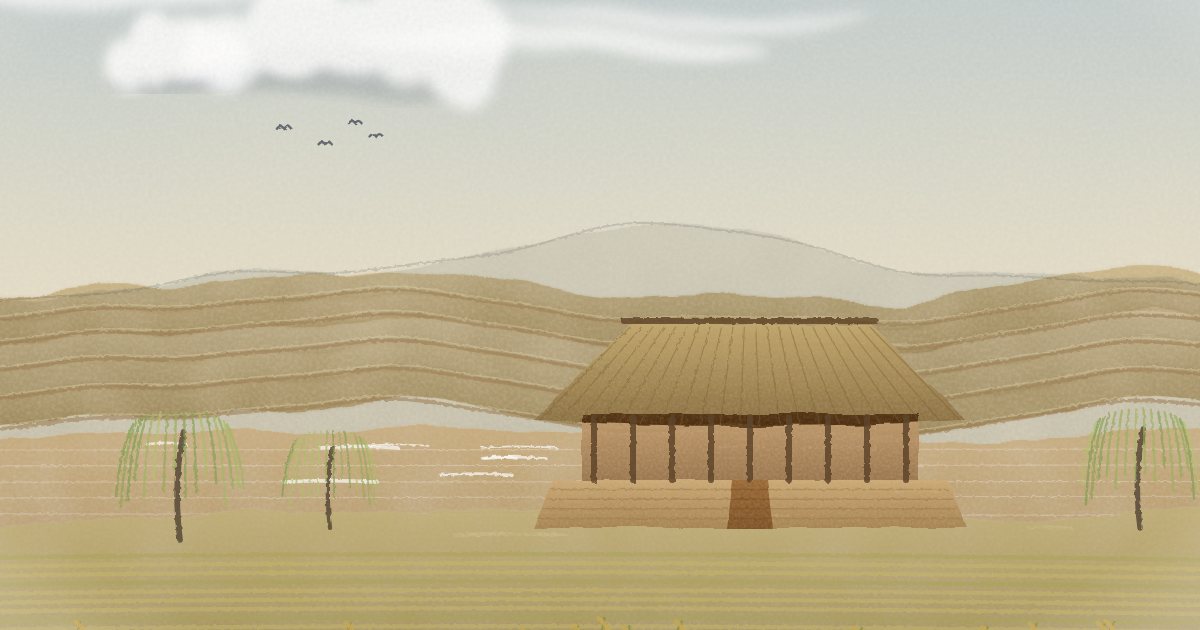
The earliest substantial evidence of Chinese writing comes from the Shang dynasty (商), which by the conventional modern dating ruled the Yellow River basin from about 1600 to 1046 BCE. Its last seat was the city whose remains are now called Yinxu (殷墟, 'Ruins of Yin'), near Anyang in Henan province. The Shang inscriptions themselves call the state Shang and its capital 'Great Settlement Shang' (大邑商); the name Yin was applied to them only under the following Zhou dynasty.
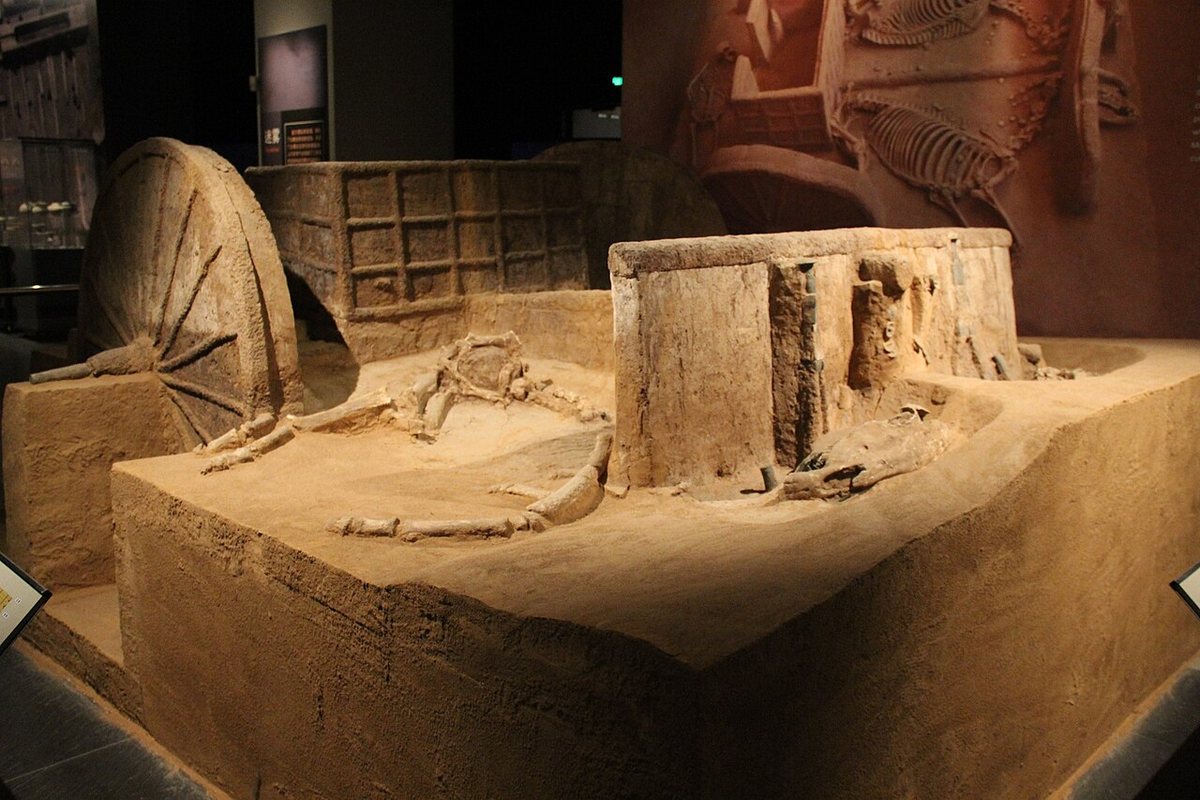
The city was the capital in the Late Shang period (c. 1250–1046 BCE), under twelve kings; by the reign of King Wu Ding at the latest it clearly held that role. Across some 30 km², archaeologists have uncovered the foundations of palaces and shrines, royal tombs, bronze and bone workshops, chariot burials and more than a hundred thousand oracle bones. The tomb of Fu Hao, a wife of Wu Ding and a military leader, found in 1976, is the only Shang royal-family tomb found unlooted. After the fall of the Shang, usually placed in 1046 BCE, the city fell into ruin. Yinxu has been a UNESCO World Heritage Site since 2006.
Divination by fire
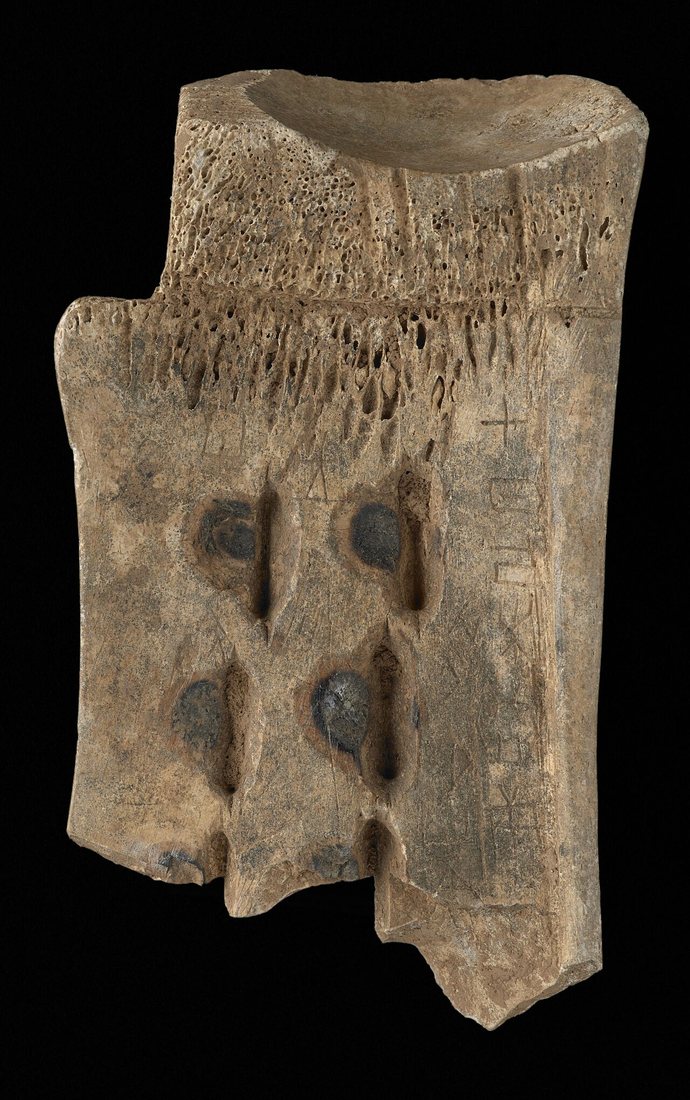
Oracle bones (Chinese jiagu 甲骨, 'shells and bones') are mostly turtle plastrons (the flat underside of the shell) and ox shoulder blades, which Shang diviners used for pyromancy, divination by fire. They drilled or chiselled a series of hollows into the smoothed bone or shell and applied an intense heat source until the front surface cracked, roughly in the shape of the character 卜 'to divine' (modern bǔ). The character probably depicts such a crack; its Old Chinese pronunciation, *pˤok according to Baxter and Sagart, may have imitated the sound of cracking.
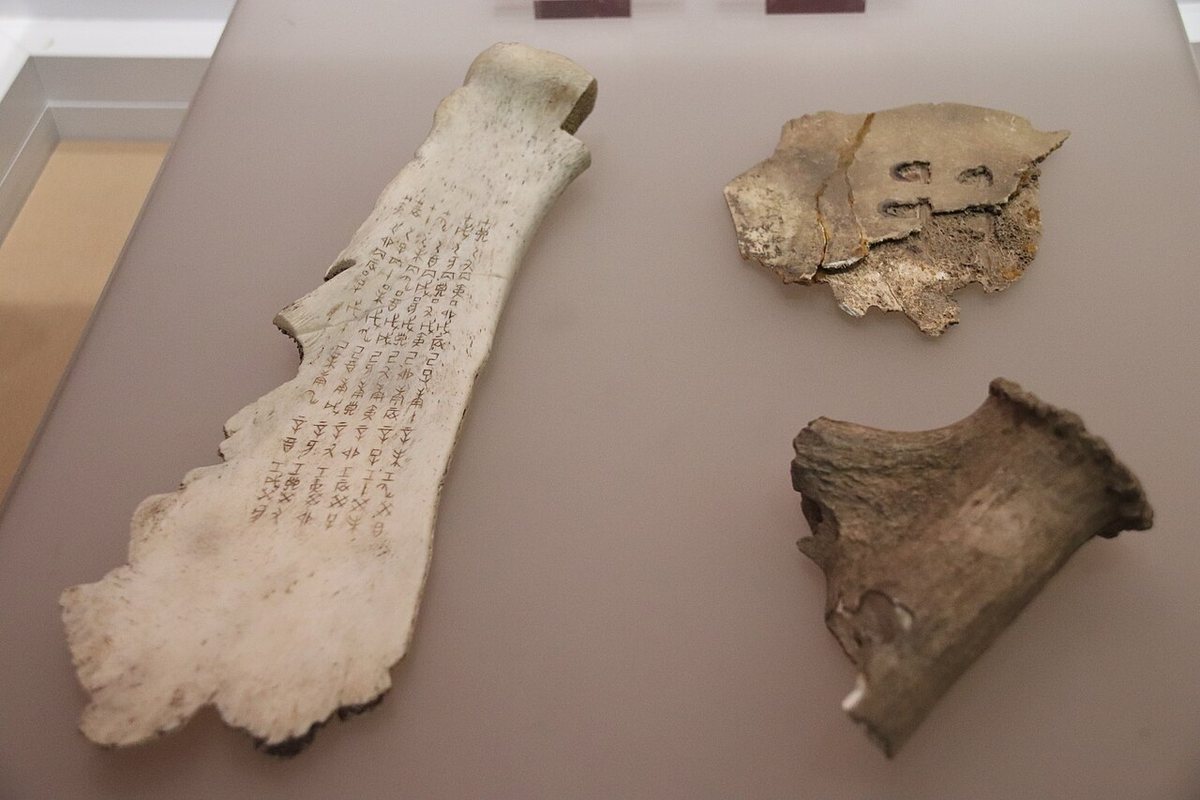
The diviners put questions to ancestors and deities about the weather, harvests, military campaigns, building settlements, births and illnesses in the royal family, or sacrifices. They carved the question into the bone, sometimes with the king's prognostication and, on rare occasions, the actual outcome. A complete record is rare: most inscriptions give only the date, the diviner's name and the topic. Days were counted in a sixty-day cycle combining ten 'heavenly stems' and twelve 'earthly branches'. Used bones were buried in pits, sometimes by the hundreds or thousands; a pit uncovered in 1936 held more than 17,000 pieces.
Estimates of the total vary: at least 160,000 pieces are cited, while a recent count found some 13,000 bones bearing a little over 130,000 inscriptions in collections in China and about fourteen other countries. The oldest inscriptions date from the reign of King Wu Ding. The length of his reign is disputed, but radiocarbon dating of 26 bones from his time gives 1254–1197 BCE. The beginning of connected Chinese texts is therefore usually placed around 1250 to 1200 BCE.
From medicine to history
Collectors' demand set off waves of illegal digging, and tens of thousands of pieces left the Anyang area. The source of the 'dragon bones' was traced to the village of Xiaotun outside Anyang, and in 1910 the scholar Luo Zhenyu identified it as the site of the last Shang capital; the Canadian missionary James Menzies reached the same conclusion. In 1917 Wang Guowei reconstructed the names of the Shang kings from the oracle inscriptions and showed that their sequence matched the list in Sima Qian's Records of the Grand Historian (Shiji). The Shang dynasty, whose historicity some scholars had then doubted, became documented history.
Systematic excavation at Yinxu was begun in 1928 by the Institute of History and Philology of the Academia Sinica; from 1929 to 1937 it was led by the archaeologist Li Ji, and since 1950 it has been continued by the Institute of Archaeology of the Chinese Academy of Social Sciences. Dong Zuobin divided the inscriptions by diviner into five periods, making it possible to date them. The American missionary Frank H. Chalfant coined the English phrase 'inscriptions upon bone and tortoise shell' in 1906; its Chinese translation, shortened to jiaguwen (甲骨文), became the usual name of the script.
Characters that have lasted three millennia
According to legend, writing was invented by Cangjie, historian to the mythical Yellow Emperor; he was said to have four eyes, and when he created the characters the gods and ghosts wept and the sky rained millet. The documented history of the script begins with the oracle bones. Their writing is already fully developed and records connected language, so it must have had a long development behind it, perhaps several centuries. No earlier evidence has been found, however: signs on Neolithic pottery and bone do not generally occur in strings, and no link to the Shang script has been demonstrated.
Chinese writing is logographic: a character writes a word, or more precisely a morpheme, which in Old Chinese was usually a single syllable. Already on the bones, pictographic characters stand alongside characters borrowed for similar-sounding words and compounds with a semantic and a phonetic part. One analysis of oracle-bone characters counts about 23% pictographs, 32% semantic compounds, 11% phonetic loans and 27% phono-semantic compounds. The script was not yet standardised: the same character could be reversed, turned through 90° or written with different components.
Some 4,000 to 5,000 distinct characters are distinguished on the bones. By various estimates between a quarter and a third, roughly 1,000–1,500, have been read, and several hundred more are under discussion. Yet the deciphered characters cover much of the core vocabulary of modern Chinese: the script that developed from them has been in continuous use ever since. The Shang also wrote with brush and ink, probably above all on bundles of bamboo slips, as the characters 冊 'bundle of slips' and 聿 'hand holding a brush' suggest, though no such bundles survive from the period. This is probably also where writing in columns from top to bottom comes from.
Pictographic origins of some characters
- personrén; a figure in profile
- womannǚ; a kneeling figure
- mouthkǒu
- eyemù; an eye stood on end
- sunrì; a circle with a dot or stroke
- moonyuè; a crescent
- mountainshān; three peaks
- watershuǐ; a flowing stream
- rainyǔ; drops falling from the sky
- treemù; a trunk with branches and roots
- horsemǎ; a horse stood on end
- chariotchē; a chariot seen from above
mù'to wash one's hair': the word sounded the same as, or very like, 木 mù 'tree', so it was written with that character plus the semantic element 氵 'water'. In the same way 淋 lín 'to pour' was formed from 林 lín 'woods'. Such phono-semantic compounds now make up the majority of characters.
The characters are shown in their modern traditional form, rendered with Noto Serif TC; readings are in modern Standard Chinese (pinyin). Unicode does not yet encode oracle-bone or bronze forms (seal script has been accepted for Unicode 18.0), so the photographs show what they looked like. Some characters, such as 目 and 馬, were probably turned through 90° to fit narrow bamboo slips and stayed that way.
Words from the oracle inscriptions
Many characters from the oracle bones are still written and read today, only in a later form. Readings are modern; an asterisk marks a reconstructed Old Chinese form.
| character | modern reading | meaning |
|---|---|---|
| 卜 | bǔ | to divine (Old Chinese *pˤok); perhaps a picture of a crack |
| 貞 | zhēn | in divinations 'to put a question' to the oracle; today 'chaste, loyal' |
| 王 | wáng | king |
| 雨 | yǔ | rain, to rain; a frequent topic of divination |
| 來 | lái | to come; originally a picture of a wheat plant (borrowed for a similar-sounding word) |
| 商 | shāng | Shang, the name of the state and its capital |
Oracle inscriptions
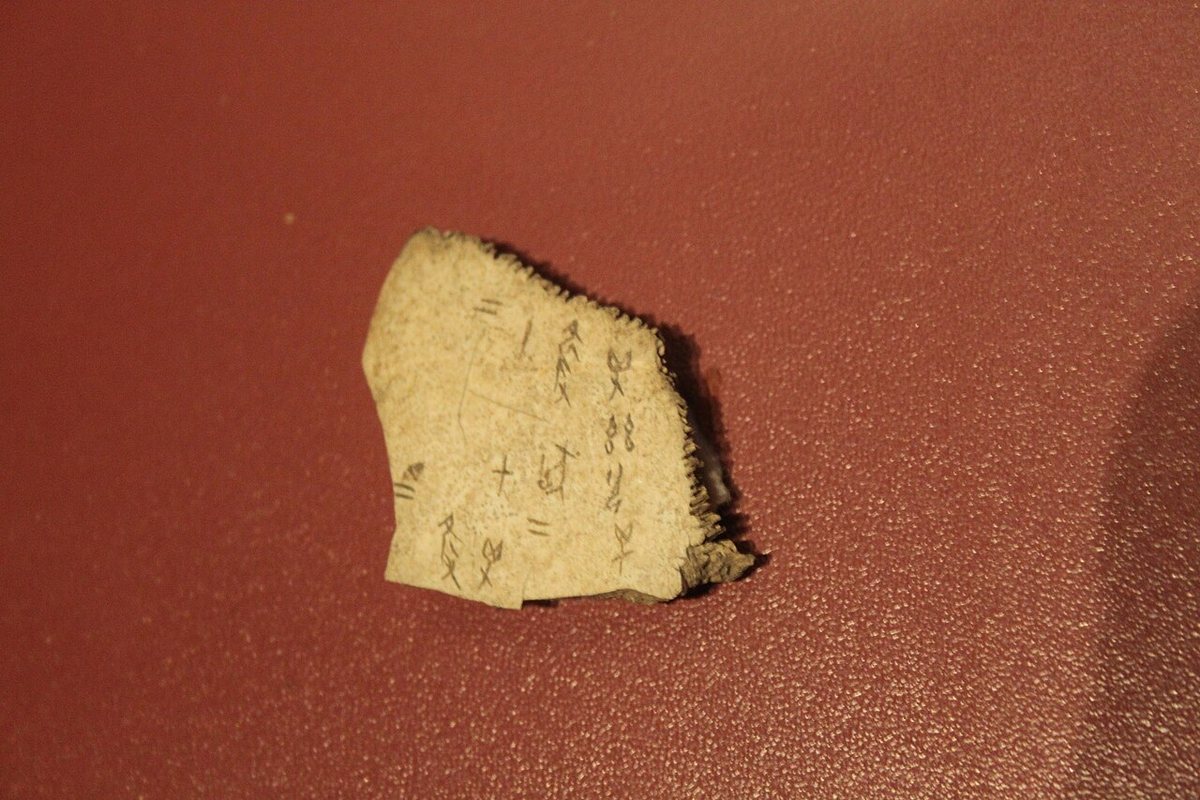
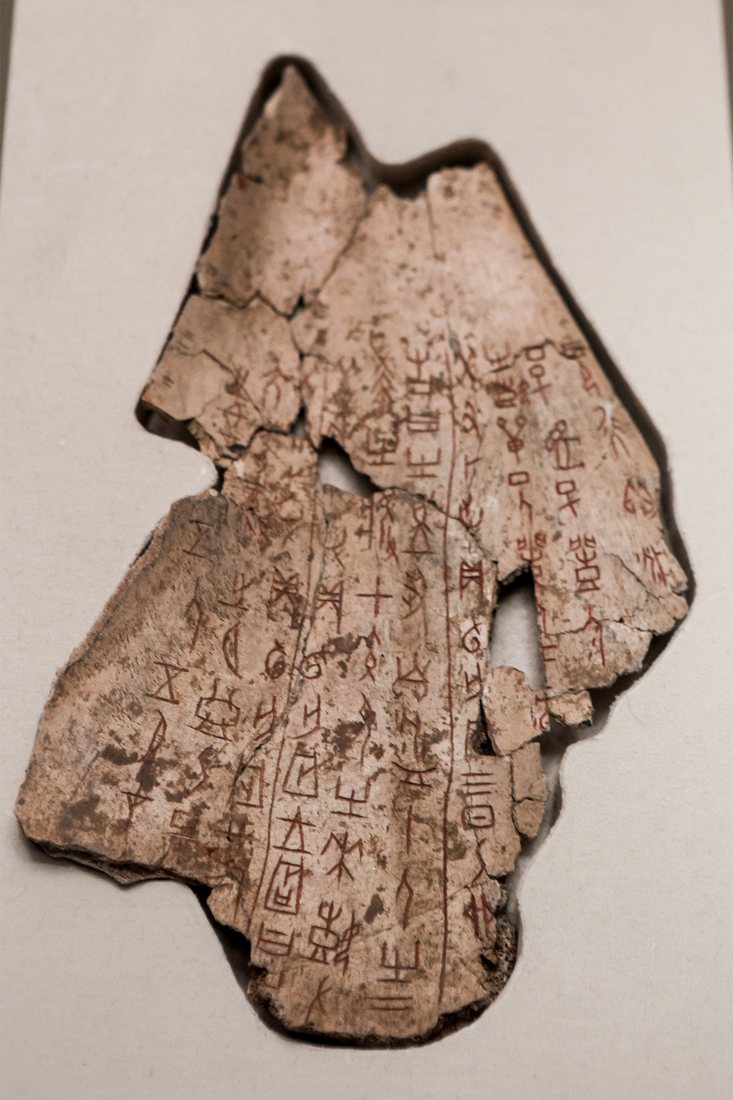
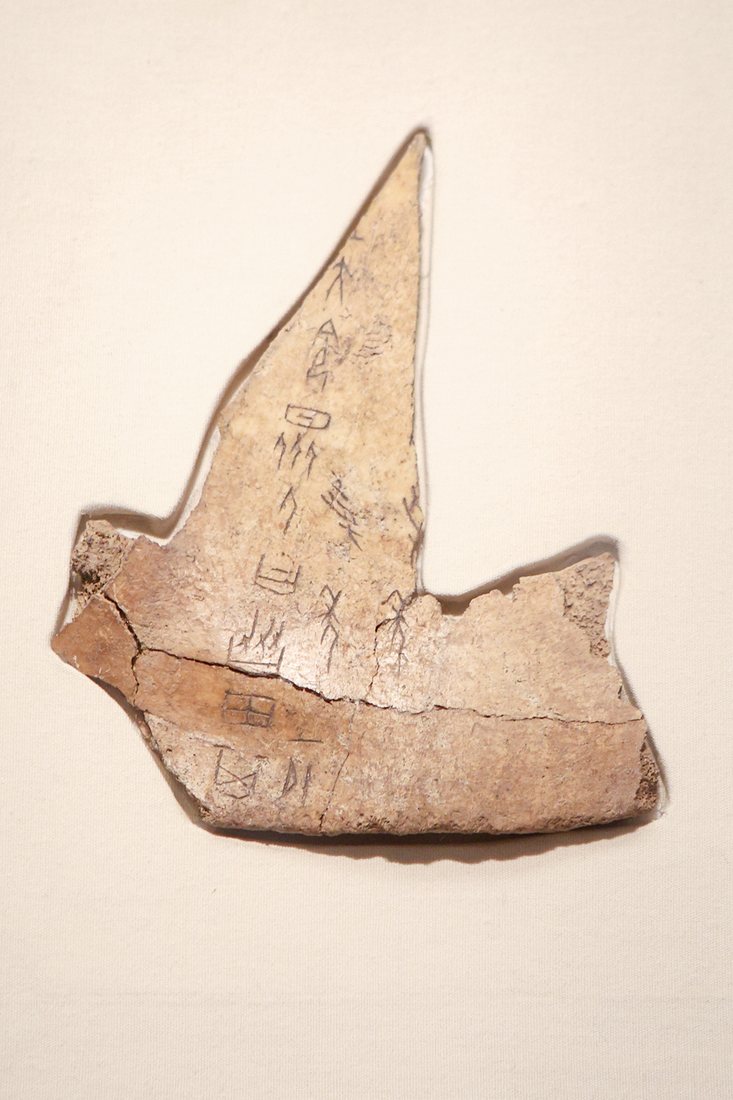
Inscriptions in bronze
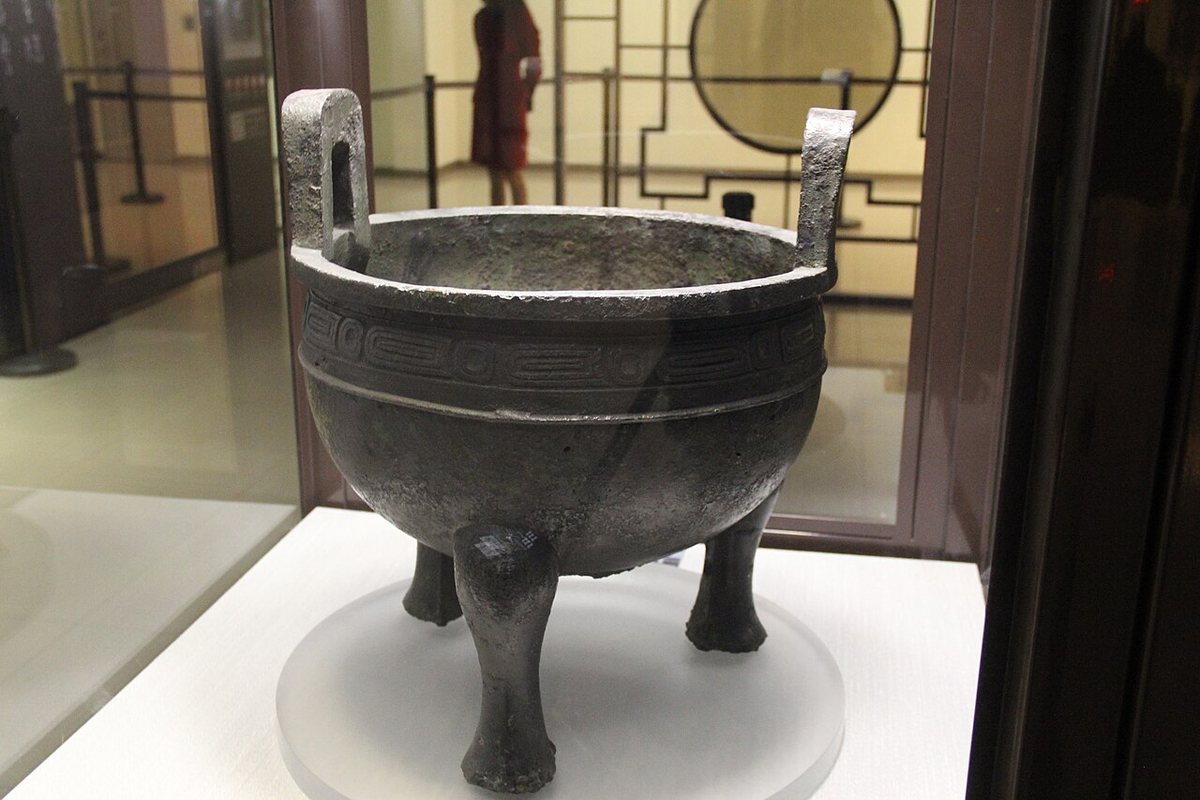
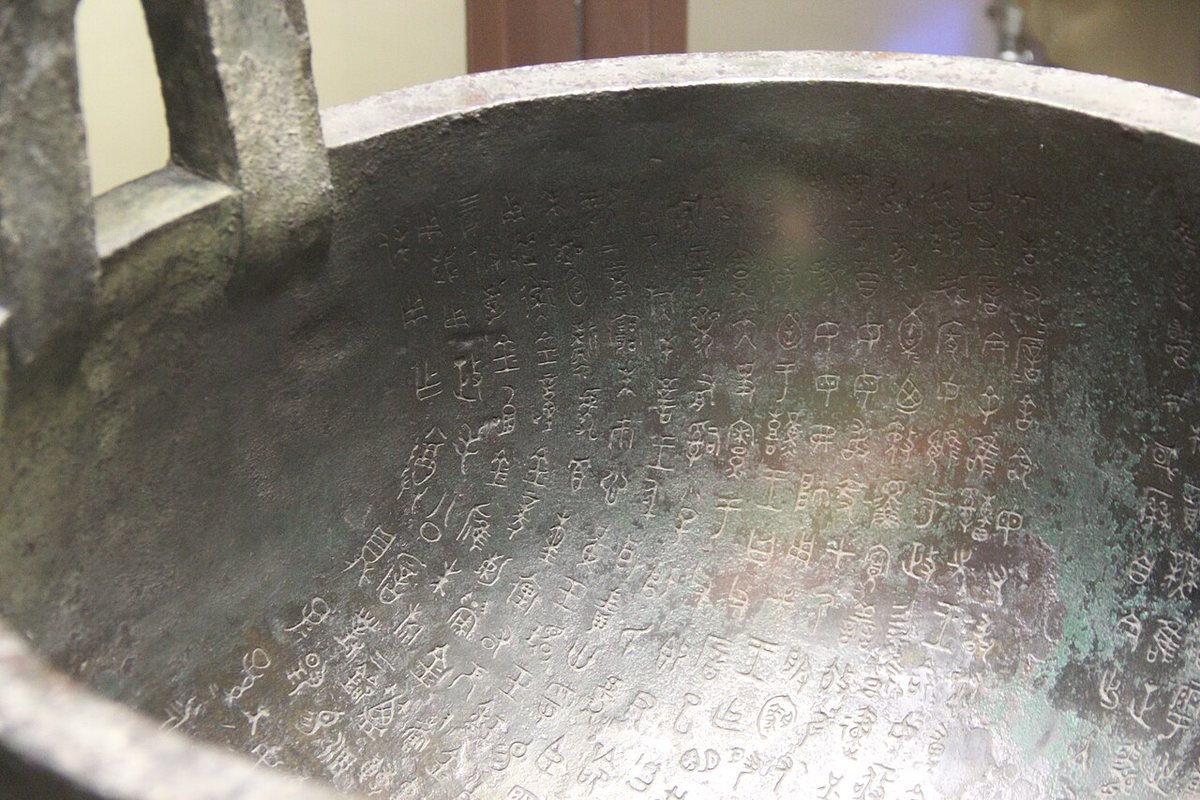
Besides the bones, the Shang and after them the Zhou left writing on ritual bronze vessels: ding cauldrons, bells and others. Bronze inscriptions (jinwen 金文, 'writing on metal') were at first incised into the clay mould and cast with the vessel; later they were also engraved into the finished bronze. About 12,000 surviving bronzes bear inscriptions. Shang inscriptions are short, from one to six characters and forty at most, and often give only the clan name and the ancestor to whom the vessel is dedicated. Under the Western Zhou (c. 1046–771 BCE) a hundred characters or more is common: they record appointments to office, gifts from the king and military campaigns. The character forms are more pictorial than on the bones, since soft clay was easier to write in than hard bone.
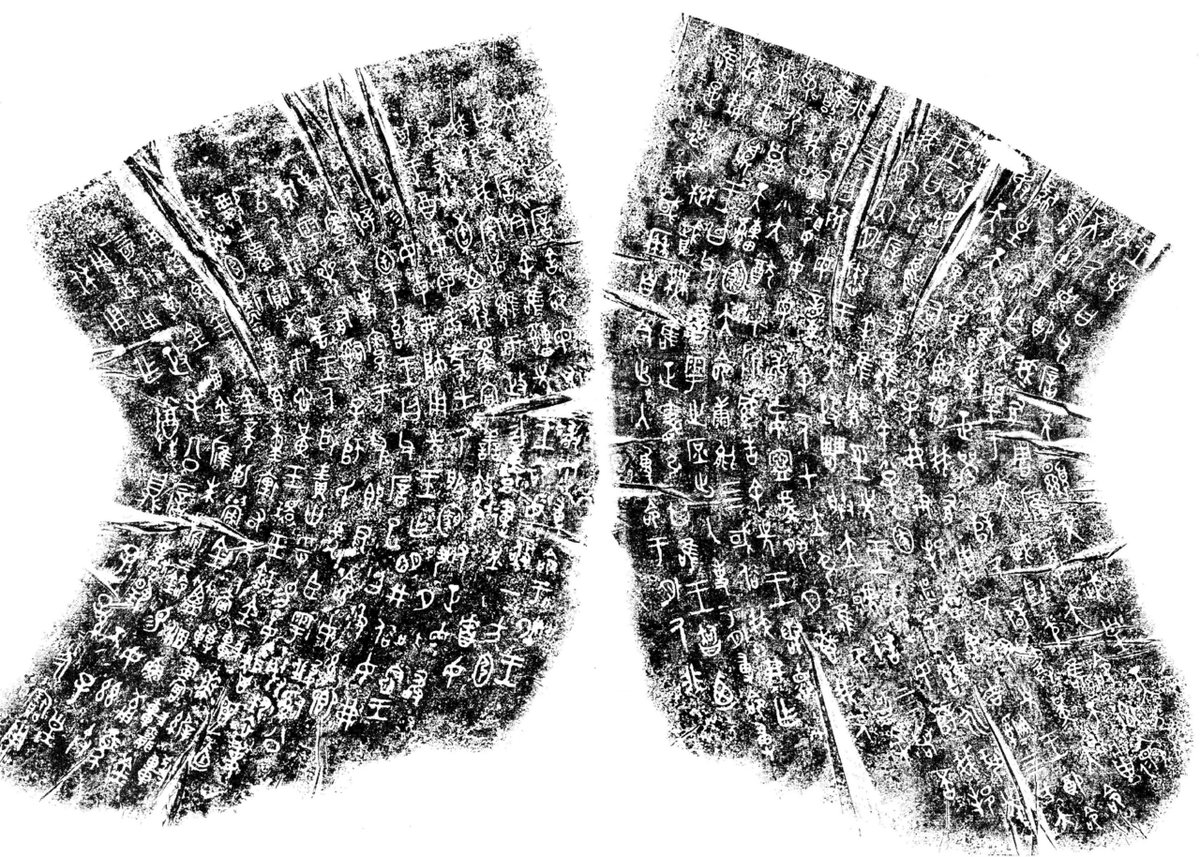
The longest known inscription is on the Mao Gong ding (毛公鼎) from the reign of King Xuan: 500 characters in 32 vertical lines according to the National Palace Museum (Qiu Xigui counts 498). In it the king charges the Duke of Mao with loyal service, recalls how the dynasty's founders, Wen and Wu, received the Mandate of Heaven, and lists generous gifts; the duke closes with his thanks and dedicates the cauldron to his descendants. It was found in 1843 in Qishan County, Shaanxi, passed through many hands, was taken to Taiwan in 1949 and is now in the National Palace Museum in Taipei.
From the Spring and Autumn period (8th–5th centuries BCE) the script developed differently in each state, so that by the Warring States period the forms used in Chu, in Qin and in the east differed markedly.
The Mao Gong ding
Books of bamboo
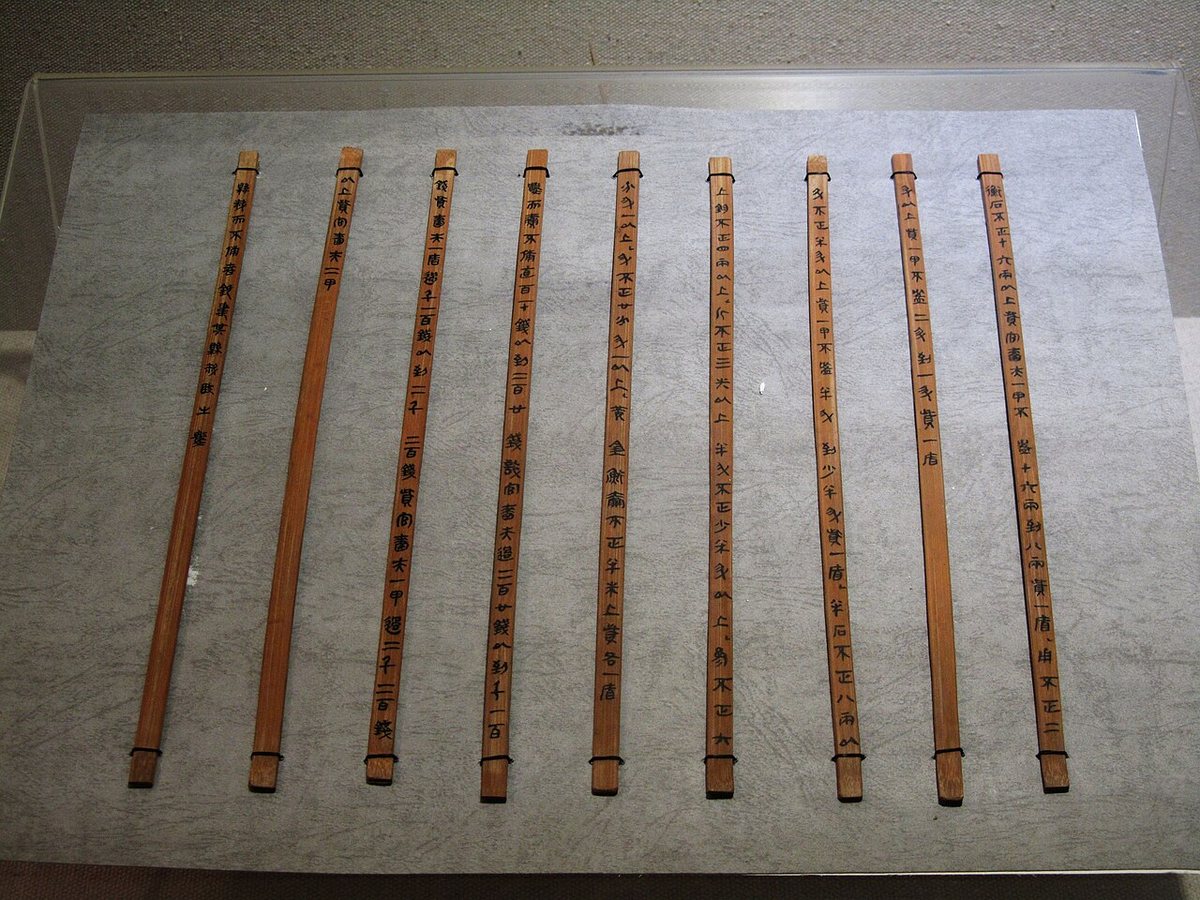
The main writing material of early China was narrow strips of bamboo or wood, written with a brush and tied together with cords. None survive from before the Warring States period (475–221 BCE); the oldest known come from tombs of that period.
In October 1993 some 800 bamboo slips were found in Tomb 1 at Guodian near Jingmen, Hubei province, not far from Ying, the capital of the state of Chu. The tomb is dated to around 300 BCE. The texts, written in the script of Chu, include the earliest known manuscripts of parts of the Daodejing and a number of previously unknown philosophical works.
In December 1975 Tomb 11 at Shuihudi in Yunmeng County yielded about 1,155 slips, deposited around 217 BCE. Written by a Qin scribe, they contain laws, administrative regulations and manuals of the Qin state. Their script is already more angular and straighter than seal script and is regarded as an early form of clerical script.
One empire, one script
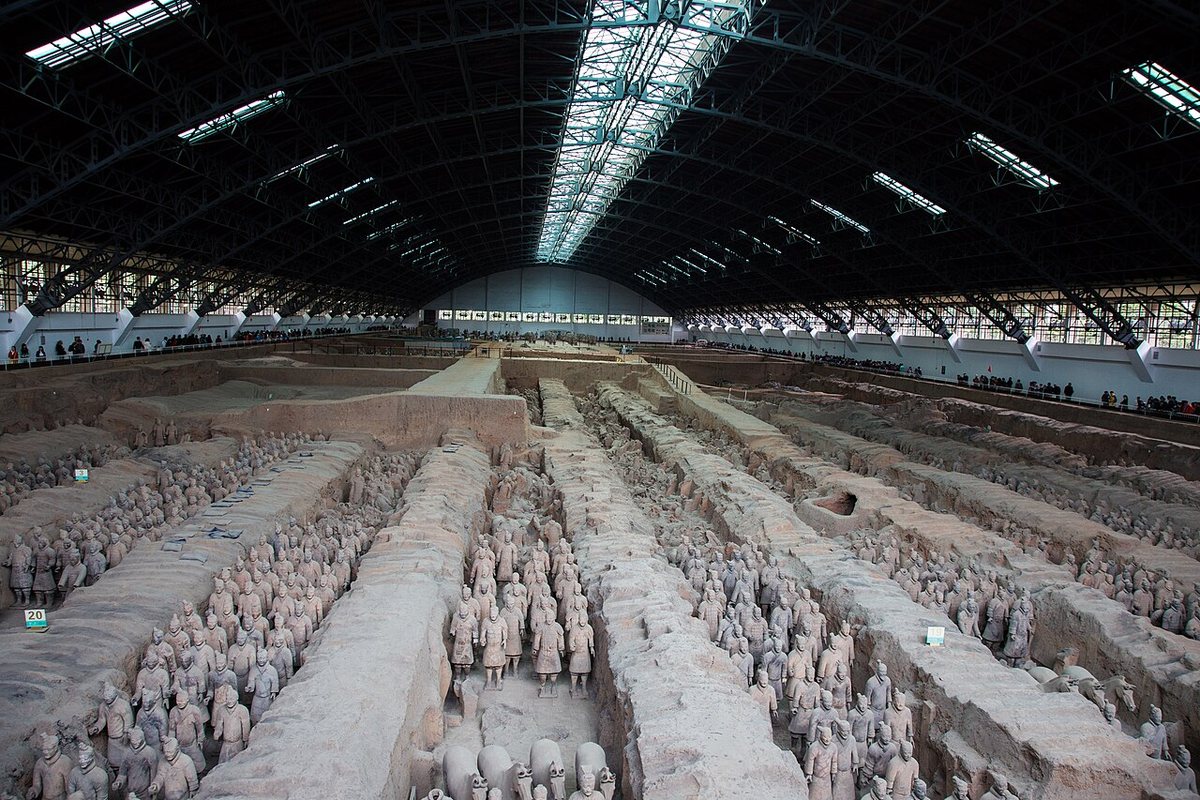
In 221 BCE the king of Qin conquered the last of the rival states and took the title First Emperor, Qin Shi Huang. With his chancellor Li Si he unified laws, weights and measures, the axle width of carts, coinage and writing. They proclaimed as the imperial standard the small seal script (xiaozhuan 小篆), which had developed in Qin from the script of the Zhou; Li Si removed most variant forms of characters and banned the local scripts of the conquered states. Some scholars argue that the trend towards standard forms was already under way, and that Li Si completed it. According to Chinese commentaries he also compiled a character primer, the Cangjiepian; in its Han form, merged with two other Qin primers, it had some 3,300 characters, and it survives only in part.
From 213 BCE, according to tradition, the emperor on Li Si's advice had most books burned, sparing works on astrology, agriculture, medicine, divination and the history of Qin. The empire itself ended in 206 BCE, but the unified script outlived it.
Clerical script
Alongside the official seal script, the state of Qin also wrote in more popular, more angular forms. From these developed clerical script (lishu 隸書): its rounded lines broke up into straight strokes and the pictorial quality of the characters faded. Han sources credited its invention to Qin clerks or to a prison official, Cheng Miao, but today it is thought to have developed gradually during the Warring States period; the Shuihudi slips show an early form. Under the Han dynasty (202 BCE – 220 CE) it became the main script, and by the end of the Eastern Han it had matured into the bafen style, with broad, squat characters and wave-like strokes that flick up at the end.
Clerical script later gave rise to semi-cursive and regular script (kaishu 楷書), which is still printed and written today. Clerical script thus obscured the pictorial origins of the characters, and its forms already come close to today's.
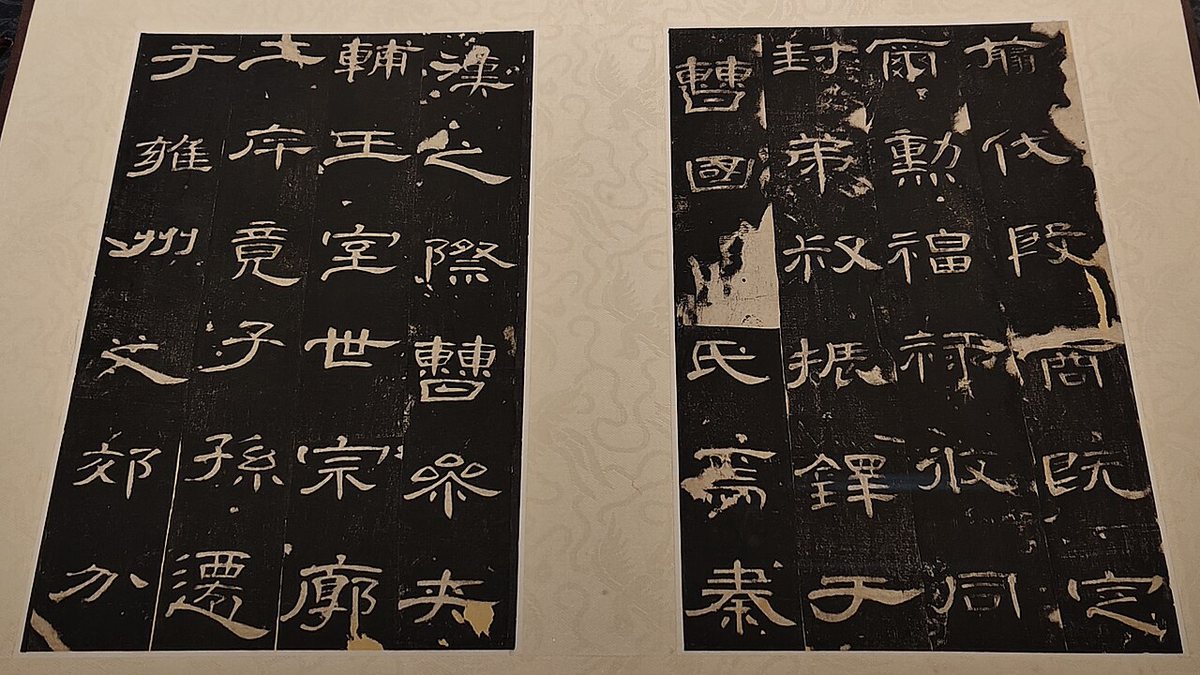
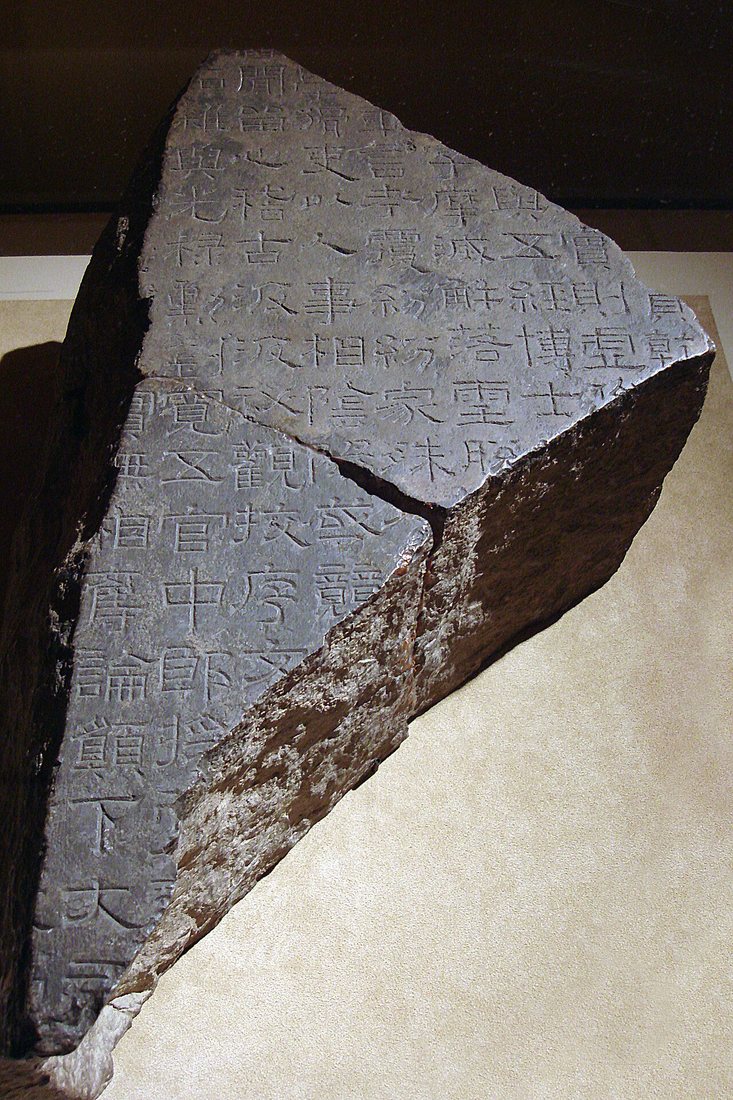
Between 175 and 183 CE, at the petition of the scholar Cai Yong and others, the court had the Confucian classics carved on 46 stone stelae set up at the Imperial Academy in Luoyang, so that the texts could no longer be altered. The stelae held some 200,000 characters, each stood about 2.5 m high and 1 m wide, and they carried the seven classics then recognised, among them the Book of Changes, the Book of Songs and the Analects. After the fall of the Han they were largely destroyed; only fragments survive.
Han script in stone
Six kinds of characters
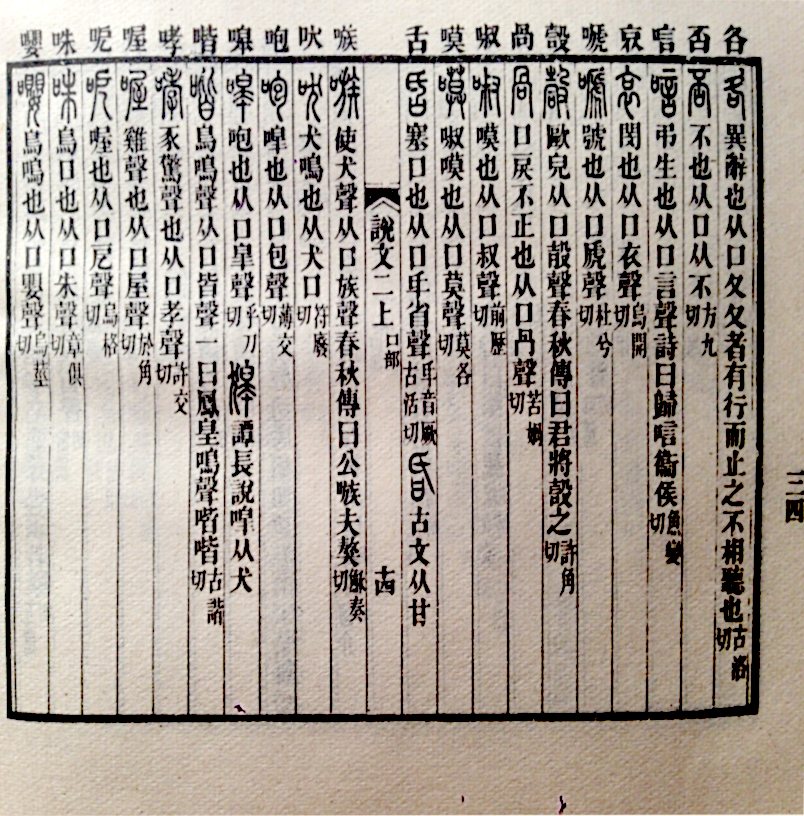
Around 100 CE the scholar Xu Shen completed the dictionary Shuowen Jiezi (說文解字, by the traditional interpretation 'explaining simple and analysing compound characters'); his son presented it to the court in 121. According to its postface it has 9,353 entries and 1,163 variants, and each entry is given in small seal script. It was the first dictionary to arrange characters in sections by a shared component, the so-called radicals; Xu Shen defined 540 of them, from 一 'one' to 亥 (the last of the earthly branches).
In the postface Xu Shen was the first to define and illustrate the 'six principles' (liushu 六書) by which tradition classifies characters: pictures of things (xiangxing 象形, such as 日 and 月), indicative signs for abstract ideas (zhishi 指事, such as numerals written as strokes, or 'above' and 'below' marked over and under a line), semantic compounds (huiyi 會意, such as 看 'to look', a hand above an eye), phono-semantic compounds (xingsheng 形聲), so-called derivative cognates (zhuanzhu 轉注, the least understood group) and loans (jiajie 假借). 來 is a loan: the picture of wheat came to be used for 'to come' because the words sounded alike, and a new character, 麥, was made for wheat.
Phono-semantic compounds have a semantic part that indicates the area of meaning and a phonetic part that sounded like the word being written; Xu Shen describes them with the formula 'from X, sound Y'. They make up the majority of characters: one analysis of 3,500 common characters in modern Chinese finds about 58% of them, whereas on the oracle bones they were about a quarter. Xu Shen knew neither the oracle bones nor most of the bronzes, and later scholarship has corrected many of his analyses. The edition most read today is Duan Yucai's annotated version of 1815.
Old Chinese and the classical language
The language of the inscriptions from Shang times to roughly the Han dynasty is called Old Chinese. The prevailing view places it in the Sino-Tibetan family, together with Tibetan, Burmese and many languages of the Himalayas and Southeast Asia. Words were mostly monosyllabic; William Baxter and Laurent Sagart propose that some had a short minor syllable before the full syllable, as in modern Khmer. Most recent reconstructions describe Old Chinese as having no tones: these arose later from consonants at the end of the syllable.
Because the characters do not record pronunciation directly, it has to be reconstructed. The starting point is the rhyme dictionary Qieyun of 601 CE, which reflects Middle Chinese; its categories are compared with the rhymes of the Book of Songs (Shijing, early 1st millennium BCE) and with the phonetic components of characters. Reconstructions differ in detail and remain hypotheses; they are marked with an asterisk, as in 來 *mə.rˤək 'to come' and 麥 *mˤrˤək 'wheat' in Baxter and Sagart (2014).
From the language of late Zhou and Han texts grew Classical Chinese (wenyan 文言). It was written for two thousand years, even as spoken Chinese drifted ever further from it. From the 2nd century CE it spread to Vietnam, Korea, Japan and the Ryukyu Islands, where for a long time it was the only written language; its position is often compared with that of Latin in medieval Europe. Each country read it with its own pronunciation, the Japanese for example through the kanbun method. In China it was replaced by written vernacular Chinese after the literary revolution associated with the May Fourth Movement of 1919. Because many once distinct words now sound the same, a classical text read aloud is hard to follow: in the 1930s the linguist Yuen Ren Chao demonstrated this with a poem in which every syllable is now pronounced shi, differing only in tone.
Zǐ yuē: xué ér shí xí zhī, bù yì yuè hū?
- 子 zǐ
- the Master (Confucius)
- 曰 yuē
- said
- 學 xué
- to learn
- 而 ér
- and (conjunction)
- 時 shí
- at the proper time
- 習 xí
- to rehearse, practise
- 之 zhī
- it (pronoun)
- 不亦…乎 bù yì … hū
- is it not …? (rhetorical question)
- 說 yuè
- joy (later written 悅)
'The Master said: To learn and at the proper time rehearse what one has learned – is that not a joy?'The opening line of the Analects (Lunyu), a collection of sayings of Confucius and his disciples, shows how compact the classical language is: nearly every character is a word of its own, and grammar is carried by word order and particles. The character 說, otherwise 'to speak, explain', is read yuè here and stands for the word 'to rejoice', later written 悅. The Analects were also among the classics carved on the Xiping stelae.
Timeline
- c. 1250–1200 BCEUnder King Wu Ding the oldest oracle-bone inscriptions are made at Yinxu.
- c. 1046 BCEThe Zhou defeat the Shang (conventional date).
- c. 800 BCEThe Mao Gong ding, with the longest known bronze inscription.
- c. 300 BCEThe Guodian bamboo texts, the earliest known manuscripts of parts of the Daodejing.
- 221 BCEQin unifies China; small seal script becomes the imperial standard.
- c. 217 BCESlips with the laws of Qin are buried in a tomb at Shuihudi.
- 213 BCEAccording to tradition, the burning of the books begins.
- 202 BCE – 220 CEHan dynasty; clerical script becomes the main script.
- c. 100 CEXu Shen completes the Shuowen Jiezi dictionary.
- 175–183The Xiping Stone Classics in Luoyang.
- 1899Wang Yirong recognises ancient writing on 'dragon bones'.
- 1917Wang Guowei reconstructs the Shang royal genealogy from the inscriptions.
- 1928Systematic excavations begin at Yinxu.
- 1975Discovery of the Shuihudi bamboo slips.
- 1993Discovery of the Guodian bamboo texts.
- 2006Yinxu is inscribed on the UNESCO World Heritage List.
Chinese on the globe
Tap a language to show it on the globe:
Sources and further reading
- Qiu Xigui: Chinese Writing. Trans. Gilbert L. Mattos and Jerry Norman. Society for the Study of Early China, Berkeley 2000.
- David N. Keightley: Sources of Shang History. The Oracle-Bone Inscriptions of Bronze Age China. University of California Press 1978.
- William G. Boltz: The Origin and Early Development of the Chinese Writing System. American Oriental Society, New Haven 1994.
- William H. Baxter, Laurent Sagart: Old Chinese. A New Reconstruction. Oxford University Press 2014.
- Jerry Norman: Chinese. Cambridge University Press 1988.
- Glottolog 5 (languages and their classification).