Language stories
From Latin to the Romance languages
Spoken Latin · the break-up of the Empire · the first texts in the vernacular
French, Spanish, Italian, Portuguese, Romanian and the other Romance languages do not descend from the literary Latin of Cicero and Virgil but from the Latin people spoke every day in the Roman provinces. Nobody ever stopped speaking it; it simply changed differently in each region until speakers from distant areas no longer understood one another. How that happened can be read from mistakes in inscriptions, school lists of “right and wrong”, glossaries of words that had become obscure, and the first texts to put the spoken language in writing.
A language that never stopped
Latin did not die out the way Etruscan did, whose speakers gradually shifted to another language. People in Italy, Gaul, Iberia and along the Danube passed their speech on to their children without a break; it simply changed from one generation to the next. No one could have lived through the day on which they stopped speaking Latin and started speaking French or Spanish. The line between “Latin” and “the Romance languages” is drawn in hindsight, at the point where the changes had piled up far enough for people to notice them and write them down.
The Romance languages continue spoken Latin, not the standard written form known from literature. The two existed side by side throughout: written Latin changed slowly and was upheld by the schools, while speech changed faster. Yet they were not two languages. The Hungarian Latinist József Herman, like most scholars today, stresses that there was never an unbridgeable gap between written and spoken Latin, or between the speech of the educated and of ordinary people; it was a continuous range of registers, as in any language.
How we know how people spoke
Spoken Latin was not deliberately written down, so we know it only indirectly. It shows through in mistakes in inscriptions, such as those on the walls of Pompeii or on lead curse tablets; in private letters and accounts; in technical works on medicine or veterinary care that paid little attention to style; in early Christian texts; in the pronunciation of Latin words borrowed into neighbouring languages such as Basque, Albanian or Welsh; and finally in the Romance languages themselves, whose comparison shows what their common source must have sounded like.
The complaints of grammarians are especially valuable. The best known is the so-called Appendix Probi, “Probus’ Appendix”: a list of 227 words in the form “right, not wrong”, such as speculum non speclum. It owes its name to the fact that it survives attached to a treatise bearing the name of the 1st-century grammarian Marcus Valerius Probus, though Probus almost certainly did not write it. It was probably compiled in Rome, according to the prevailing view in the 3rd or 4th century; the exact date is disputed. It is known only from a single water-damaged copy of the 7th or 8th century, probably made at the monastery of Bobbio and now kept in Naples. The author meant to stamp out mistakes – and in doing so recorded how people actually spoke.
Appendix Probi: “right, not wrong”
A selection from the list. The forms the author condemned are often exactly the ones the Romance words grew from.
| right | not | what the mistake reveals | Romance outcome |
|---|---|---|---|
| speculum | speclum | loss of an unstressed vowel (syncope) | It. specchio, Sp. espejo, Pt. espelho |
| oculus | oclus | syncope | It. occhio, Sp. ojo, Fr. œil |
| calida | calda | syncope | It. calda, Fr. chaude (“warm”, fem.) |
| vetulus | veclus | syncope; the cluster tl becomes cl | It. vecchio, Sp. viejo, Fr. vieux |
| auris | oricla | a diminutive (auricula) replacing the basic word; au pronounced as o | It. orecchio, Fr. oreille, Rom. ureche |
| mensa | mesa | loss of n before s | Sp. and Pt. mesa, Rom. masă |
| columna | colomna | short u pronounced as o | It. colonna |
| olim | oli | loss of final -m | final -m survived nowhere in words of more than one syllable; in monosyllables it remained as n (rem > Fr. rien) |
| aqua | acqua | a doubled consonant | It. acqua – the “wrong” form is standard today |
The Empire breaks up, and so does the language
As long as the Roman Empire lasted, administration, the army, trade, travel and schooling held Latin together; changes that began in one place spread elsewhere. According to Herman and others, written Latin still looks remarkably uniform in the 5th century, and regional differences only emerge from detailed statistical analysis of inscriptions. In the course of the 5th century the western half of the Empire broke up into Germanic kingdoms, and in 476 the last Western Roman emperor was deposed. The ties that had kept the language unified weakened.
What mattered, though, was not a single year but the centuries that followed. In the 7th and 8th centuries the Arabs conquered North Africa and most of the Iberian Peninsula, and contact between the Romance-speaking regions around the Mediterranean was broken further; it is from the 7th century onwards that regional variation multiplies in Latin documents. The languages of the new rulers left traces too – French, Italian and Spanish, for example, took their word for war (guerre, guerra) from Germanic – as did those of earlier inhabitants. How far they shaped pronunciation and grammar, however, has to be judged case by case and often remains disputed.
Latin did not survive everywhere. In Britain, North Africa and the Moselle valley other languages replaced it during the Middle Ages. In the Balkans it was largely displaced by Slavic languages; it lives on in Romanian and its relatives Aromanian, Megleno-Romanian and Istro-Romanian, and it survived on the Adriatic coast as Dalmatian, whose last known speaker, Tuone Udaina of the island of Krk, died in 1898.
Regular sound changes
Sounds did not change at random but regularly: a given change affected, in a given region and period, every word in which the sound stood in the same position. This is what makes it possible to match Romance words reliably to their Latin sources. Some changes are shared by all or nearly all Romance languages: by the 5th century the distinction between long and short vowels had disappeared, and h and the final -m of longer words were lost. Others took place in only part of the territory.
Classical Latin always pronounced c as k. Before e and i, however, the k gradually changed, so that caelum, “sky”, became Italian cielo with ch, French ciel and Portuguese céu with s, Spanish cielo with [θ] (as in English th) in most of Spain, and Romanian cer with ch. Only languages on the fringes escaped the change: Logudorese Sardinian (chenàre, “to dine”, from Latin cenare) still keeps the k, as did the now extinct Dalmatian (kenúr).
The cluster ct developed differently in each region: Latin noctem became Italian notte, Spanish noche, Portuguese noite, French nuit and Romanian noapte. In the west, voiceless consonants between vowels weakened (vitam, “life”, gave Spanish and Portuguese vida and French vie, but Italian vita); the boundary is a bundle of dialect differences running across Italy roughly from La Spezia to Rimini, known as the La Spezia–Rimini Line. The western Romance languages also added a vowel before word-initial s plus consonant (scribere > Sp. escribir, Fr. écrire, but It. scrivere, Rom. scrie), and Spanish turned initial f into h, which was then lost (farina > harina, filius > hijo).
One word in five languages
Inherited words changed in each language according to its own rules. The Romance forms usually continue the accusative without its final -m, as in noctem or civitatem.
| Latin | Italian | Spanish | Portuguese | French | Romanian | meaning |
|---|---|---|---|---|---|---|
| oculus | occhio | ojo | olho | œil | ochi | eye |
| vetulus | vecchio | viejo | velho | vieux | vechi | old (originally a diminutive of vetus) |
| clavis | chiave | llave | chave | clé | cheie | key |
| caelum | cielo | cielo | céu | ciel | cer | sky, heaven |
| nox, acc. noctem | notte | noche | noite | nuit | noapte | night |
| factum | fatto | hecho | feito | fait | fapt | done; deed, fact |
| civitas, acc. civitatem | città | ciudad | cidade | cité | cetate | originally “citizenry”, then “city”; Rom. “fortress” |
Cases, articles and new tenses
Latin expressed relations within the sentence mainly through the endings of six cases. Once final -m had gone and some vowels had merged, many endings sounded alike and the case system collapsed; prepositions and a more fixed word order took over its work. Instead of Classical Marcus patri librum dat, “Marcus gives his father the book”, Italian says Marco dà il libro al padre, literally “Marcus gives the book to the father”. Old French and Old Occitan still distinguished two cases, subject and oblique, and Romanian still has a special form shared by the genitive and dative: casa, “the house”, but casei, “of the house, to the house”.
Latin had no articles. The Romance languages created them: the definite article from the demonstrative ille, illa, “that” (It. il, la, Sp. el, la, Pt. o, a, Fr. le, la), the indefinite from the numeral unus, una, “one”. Romanian attaches the definite article to the end of the word, as neighbouring Bulgarian and Albanian also do: lupul, “the wolf”, from lupum illum. Sardinian built its article from the pronoun ipse (su, sa). The Oaths of Strasbourg of 842 still lack an article even where later French would require one: pro christian poblo, “for the Christian people”.
New verb forms were built from phrases as well. The Classical future of the cantabo type, “I shall sing”, died out and was replaced by the infinitive combined with habere, “to have”: cantare habeo, “I have to sing”, became Italian canterò, Spanish cantaré, Portuguese cantarei and French chanterai. In the Oaths of Strasbourg this form is already complete: salvarai, “I shall protect”, prindrai, “I shall take, enter into”. Romanian forms its future differently, with an auxiliary from Latin volo, “I want” (voi cânta). The neuter gender mostly merged with the masculine but left traces: Italian plurals such as le uova, “eggs”, or le braccia, “arms”, continue the Latin neuter -a (ova, bracchia).
Bible glosses and the Council of Tours
In the 8th century, probably in northern Gaul, someone compiled a glossary to the Latin Bible now called the Reichenau Glosses, after the monastery of Reichenau on Lake Constance where the manuscript was later kept. It explains more than a thousand words and forms from Jerome’s Vulgate that readers might no longer know, using expressions close to the speech of the day: semel, “once”, is glossed una vice, pulchra, “beautiful”, bella, in ore, “in the mouth”, in bucca, hiems, “winter”, hibernus. The glosses are written in Latin, but they are the forerunners of Romance words – compare French une fois, belle, bouche, hiver.
At the end of the 8th century Charlemagne and his scholars, foremost among them Alcuin of York, pushed through a reform of learning and a more correct Latin based on older models. This showed how far speech had drifted from writing. In 813 a council of bishops at Tours ordered that sermons (homilies) be translated “in rusticam Romanam linguam aut Thiotiscam” – into the rustic Romance tongue or into German – so that everyone could understand them. It is one of the first explicit admissions that Romance speech was no longer the same as Latin.
In 1982 the British Romanist Roger Wright put forward an influential but not universally accepted hypothesis: until the Carolingian reform, he argues, Latin texts were read aloud with local pronunciation, so that to contemporaries written Latin and spoken Romance were one language with a traditional spelling. Only the reform, which introduced a pronunciation “by the letter”, turned Latin into a separate learned language – and created the need to write the vernacular in a different way.
Everyday words instead of classical ones
Many ordinary words of Classical Latin were replaced in speech by others – colloquial, expressive or diminutive ones. The Classical word is given in brackets.
| Latin | Italian | Spanish | Portuguese | French | Romanian | note |
|---|---|---|---|---|---|---|
| caballus (Classical equus) | cavallo | caballo | cavalo | cheval | cal | horse; caballus was a colloquial word. Classical equa, “mare”, survives in Sp. yegua, Pt. égua and Rom. iapă |
| casa (Classical domus) | casa | casa | casa | maison (from mansio); chez, “at the home of”, from casa | casă | house; casa meant “hut” |
| comedere, manducare (Classical edere) | mangiare (via Old French) | comer | comer | manger | mânca | to eat; comedere “to eat up”, manducare originally “to chew” |
| bucca (Classical os) | bocca | boca | boca | bouche | gură (from gula, “throat”) | mouth; bucca meant “cheek” |
| formosus, bellus (Classical pulcher) | bello | hermoso | formoso | beau | frumos | beautiful; formosus “shapely”, bellus “pretty, nice” |
| auricula (Classical auris) | orecchio | oreja | orelha | oreille | ureche | ear; auricula is a diminutive, “little ear” |
| hibernum (Classical hiems) | inverno | invierno | inverno | hiver | iarnă | winter; from hibernum tempus, “wintry season” |
The first texts in the vernacular
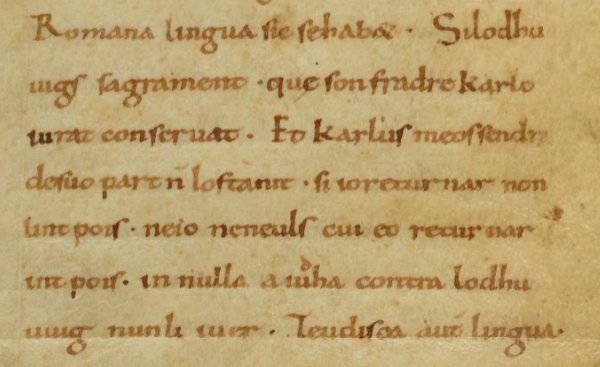
The oldest continuous text deliberately written in an early Romance language of France is the Oaths of Strasbourg of 14 February 842, preserved in the Latin Histories of Nithard, a grandson of Charlemagne (more on them on the page about Rome). Nithard introduces the soldiers’ oath with the Latin sentence Romana lingua sic se habet, “in the Romance tongue it runs thus”, and the corresponding oath of Louis the German’s army with Teudisca autem lingua, “and in German”. Some forty years younger is the Sequence of Saint Eulalia (around 880), the oldest surviving poem in French.
In Italy the earliest precisely dated evidence is the Placiti cassinesi, sworn statements from 960–963 in disputes over land belonging to the monastery of Monte Cassino. In March 960 a witness before the court at Capua declared: Sao ko kelle terre, per kelle fini que ki contene, trenta anni le possette parte sancti Benedicti – “I know that those lands, within the boundaries described here, were held for thirty years by the party of Saint Benedict”, that is, the monastery. The Latin court record kept this sentence in the vernacular, on the usual interpretation so that everyone present would understand it. The older Veronese Riddle (late 8th or early 9th century) stands on the border between Latin and Romance, and how to classify it is disputed.
In the Iberian Peninsula the earliest evidence includes the Glosas Emilianenses, notes written between the lines and in the margins of a Latin manuscript from the monastery of San Millán de la Cogolla in La Rioja. They date from the 10th or 11th century; the exact date is disputed. Besides the Romance notes they contain two short glosses in Basque, usually cited as the oldest written sentences in that language. Among the oldest dated texts in Portuguese is the will of King Afonso II of 1214. Romanian is attested last of all: the oldest surviving Romanian text that can be dated precisely is a letter sent in 1521 by Neacșu of Câmpulung to Brașov. It is written in Cyrillic; the Latin alphabet prevailed in Romanian only in the 19th century (officially in 1860–1862).
Proto-Romance: what can be reconstructed
For historical linguistics the Romance languages are a special case: their ancestor is known from texts. The comparative method, otherwise used to reconstruct Proto-Indo-European or Proto-Slavic, can derive the common ancestor of the Romance languages, Proto-Romance, from its descendants, and the result can be checked against real Latin. Forms that are not attested anywhere and exist only as reconstructions are marked with an asterisk.
The comparison shows that reconstruction reliably captures the spoken form of the language that written sources conceal: nine vowels without length distinctions instead of the ten Classical ones (five short and five long), which most Romance languages further merged into seven, the accusative without -m, colloquial words, and even words that never appear in Latin texts. An example is *captiare, “to hunt”, derived from captare, “to catch”: it gave Italian cacciare, French chasser, Spanish cazar and Portuguese caçar. The international Dictionnaire Étymologique Roman project (DÉRom), launched in 2008, systematically reconstructs the core Proto-Romance vocabulary in this way.
Reconstruction has its limits, however. Whatever vanished from every daughter language cannot be recovered from them: no one could tell from the Romance languages that Latin had a future of the cantabo type, a passive formed with endings (amatur, “is loved”) or most of its cases. Nor does reconstruction give exact dates; it smooths over differences between regions and social groups, and it captures the state of things just before the languages parted rather than the Latin of the Classical age. Proto-Romance is therefore not the same thing as “Vulgar Latin”; it is a model that approaches spoken Latin from the opposite side to the written sources.
Timeline
- 3rd–4th c.Appendix Probi, a list of mistakes in pronunciation and forms; the date is disputed.
- 476The last Western Roman emperor is deposed; end of the Western Roman Empire.
- 8th c.The Reichenau Glosses explain words of the Vulgate with expressions close to speech.
- late 8th or early 9th c.The Veronese Riddle, a text on the border between Latin and early Romance; its classification is disputed.
- 813The Council of Tours orders sermons to be translated into the “rustica Romana lingua”.
- 14 Feb 842The Oaths of Strasbourg, the oldest continuous text in an early Romance language of France.
- c. 880The Sequence of Saint Eulalia, the oldest surviving French poem.
- 960A witness’s statement before the court at Capua, the first of the Placiti cassinesi.
- 10th/11th c.The Glosas Emilianenses at the monastery of San Millán de la Cogolla.
- 1214The will of King Afonso II of Portugal, one of the oldest dated Portuguese texts.
- c. 1303–1305In De vulgari eloquentia Dante distinguishes the Romance languages by their word for “yes”: oc, oïl and sì.
- 1521Neacșu’s letter, the oldest surviving Romanian text that can be dated precisely.
- 1898Death of Tuone Udaina, the last known speaker of Dalmatian.
Latin and its descendants on the globe
Click to show a language on the globe:
Sources and further reading
- József Herman: Vulgar Latin. Trans. Roger Wright. Pennsylvania State University Press, 2000.
- Roger Wright: Late Latin and Early Romance in Spain and Carolingian France. Francis Cairns, 1982.
- J. N. Adams: The Regional Diversification of Latin, 200 BC – AD 600. Cambridge University Press, 2007.
- Ti Alkire, Carol Rosen: Romance Languages: A Historical Introduction. Cambridge University Press, 2010.
- Martin Maiden, John Charles Smith, Adam Ledgeway (eds): The Cambridge History of the Romance Languages. 2 vols. Cambridge University Press, 2011–2013.
- Glottolog 5 (languages and their classification).