Language stories
Languages coming back
Language revitalisation · Wales, New Zealand, the Isle of Man and Israel
Languages rarely disappear overnight. A community gradually shifts to another language, and parents stop passing the old one on to their children. Revitalisation tries to restore that transmission – through preschools and schools taught in the endangered language, legislation, media and adult classes. Welsh, Māori and Manx show three different starting points and three different outcomes. Hebrew is the only generally recognised case of a language without native speakers becoming the mother tongue of millions again.
How languages recede
Most of the languages in decline today are not disappearing because their speakers are dying out, but because communities are gradually switching to another language with more prestige or practical value. Linguists call this language shift. The decisive moment comes when parents stop speaking the language to their children. A break in intergenerational transmission shows up with a delay: the language may live on among adults and the elderly for decades, but it has no young speakers to pass it on.
The degree of endangerment is most often described with UNESCO's six-point scale: safe, vulnerable, definitely endangered, severely endangered, critically endangered and extinct. In 2003 a group of experts commissioned by UNESCO proposed nine factors of language vitality. First among them is intergenerational transmission; others include the number of speakers and their proportion of the population, the domains in which the language is used, and the attitudes of the community and the state. This atlas takes its vitality grades from Glottolog, which maps onto the UNESCO scale, and also marks awakening languages: those with no native speakers that are being learned and used again.
Revitalisation is a deliberate effort to halt or reverse this process. The American sociolinguist Joshua Fishman argued in Reversing Language Shift (1991) that schools, government offices and media are not enough unless the language becomes the language of homes and neighbourhoods again. The three main cases on this page – Welsh, Māori and Manx – started from very different positions.
Key terms
Terms used in the study of endangered languages and on this page:
- Language shift
- A community's gradual move from one language to another, usually a majority language. It passes through a period of bilingualism in which the original language retreats from government, schools and eventually families.Māori who moved to the cities after the Second World War shifted to English, and their children often no longer spoke Māori.
- Intergenerational transmission
- Parents and grandparents passing a language on to children as their mother tongue. In the UNESCO framework (2003) it is the first and most widely used vitality factor; a small language that is still transmitted at home may be more stable than a large one that is no longer passed on.On the Isle of Man, parents in the 19th century stopped speaking Manx to their children because they considered English more useful.
- UNESCO scale
- Six grades from safe to extinct, as used in the Atlas of the World's Languages in Danger (Moseley 2010). A vulnerable language is still spoken by children, but only in some areas of life; children no longer learn a definitely endangered language at home; in a critically endangered one the youngest speakers are grandparents and older, and they speak it only partially and rarely.In this atlas (after Glottolog) Welsh is vulnerable, Māori definitely endangered, Manx awakening and Modern Hebrew safe.
- Awakening language
- A language that has lost its native speakers but is being learned and used again, usually from written sources and recordings. A closely related term is sleeping language; many authors avoid the word "dead" because a language can be woken up again. This atlas shows awakening languages as a separate grade; on Glottolog's scale, as mapped onto the UNESCO scale, they count as extinct. UNESCO itself sometimes classifies such languages differently.Manx and Cornish: awakening in this atlas, listed by UNESCO today as critically endangered.
- Language nest
- A preschool in which older speakers talk to young children all day exclusively in the endangered language. It relies on small children acquiring a language naturally if they hear it often enough.The Māori kōhanga reo (literally "language nest"), since 1982; the Hawaiian Pūnana Leo were modelled on them.
- Immersion school
- A school in which all or nearly all subjects are taught in the endangered language, not just the language itself.Māori kura kaupapa Māori, the Manx Bunscoill Ghaelgagh, Welsh-medium schools in Wales.
- New speakers
- People who learned a language outside the family – at school, in classes or on their own – and actively use it. In revitalised languages they are often the majority, and their speech may differ from that of the last native speakers in pronunciation and vocabulary.Almost all present-day speakers of Manx; also many young speakers of Welsh and Māori who learned the language at school.
Welsh: a minority in its own country
Welsh (Cymraeg) is a Celtic language of the Brittonic branch, related to Breton and Cornish, and has been spoken in Wales continuously since the early Middle Ages. The Acts of 1535 and 1542, however, brought Wales into the English legal system, and the first of them reserved public office for those who used English. Welsh writing nonetheless carried on; in the prevailing view, William Morgan's translation of the Bible of 1588, which became the model for the literary language, played a major part in this.
In the 19th century Welsh became a language that schools did not allow for. A government report on education in Wales published in 1847 disparaged the Welsh language and the morals of the Welsh, and became known in Wales as the Treachery of the Blue Books (Brad y Llyfrau Gleision). Teaching was in English even where pupils barely understood it, and some schools used the Welsh Not, a piece of wood hung on a child caught speaking Welsh. Many parents supported English-language teaching themselves, seeing it as the way to get on in life.
The census records the decline. In 1891, 54% of the population of Wales aged three and over spoke Welsh (910,289 people); by 1981 the figure was only 19% (503,532), the lowest absolute number in the census series. Yet Welsh never stopped being the first language of some children, especially in the north and west of the country.
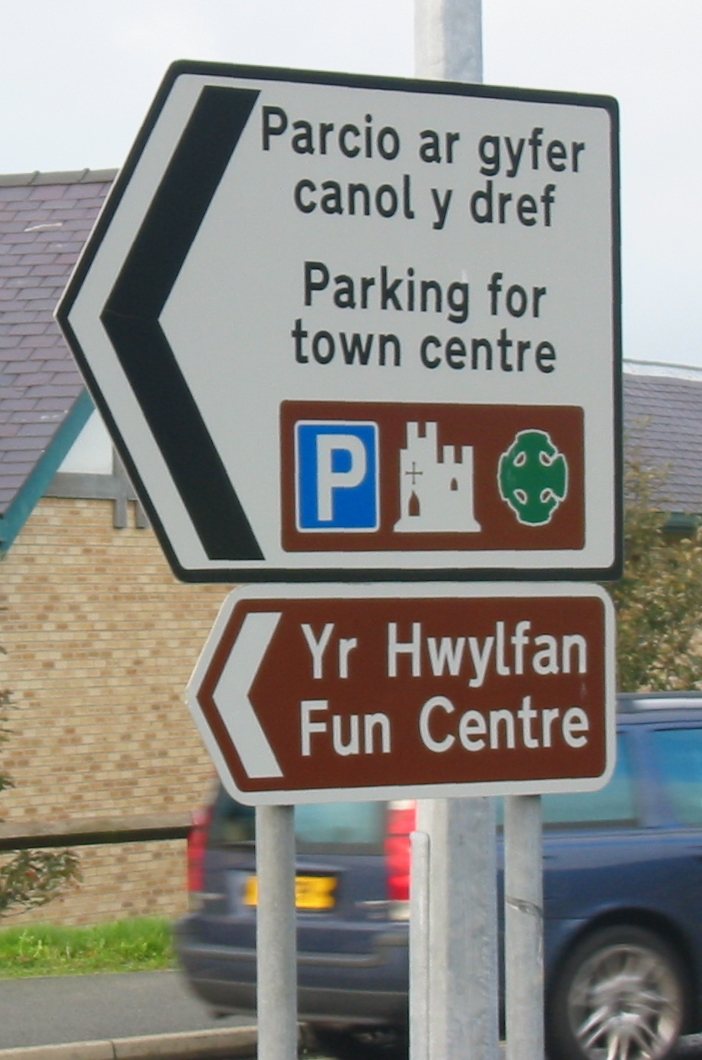
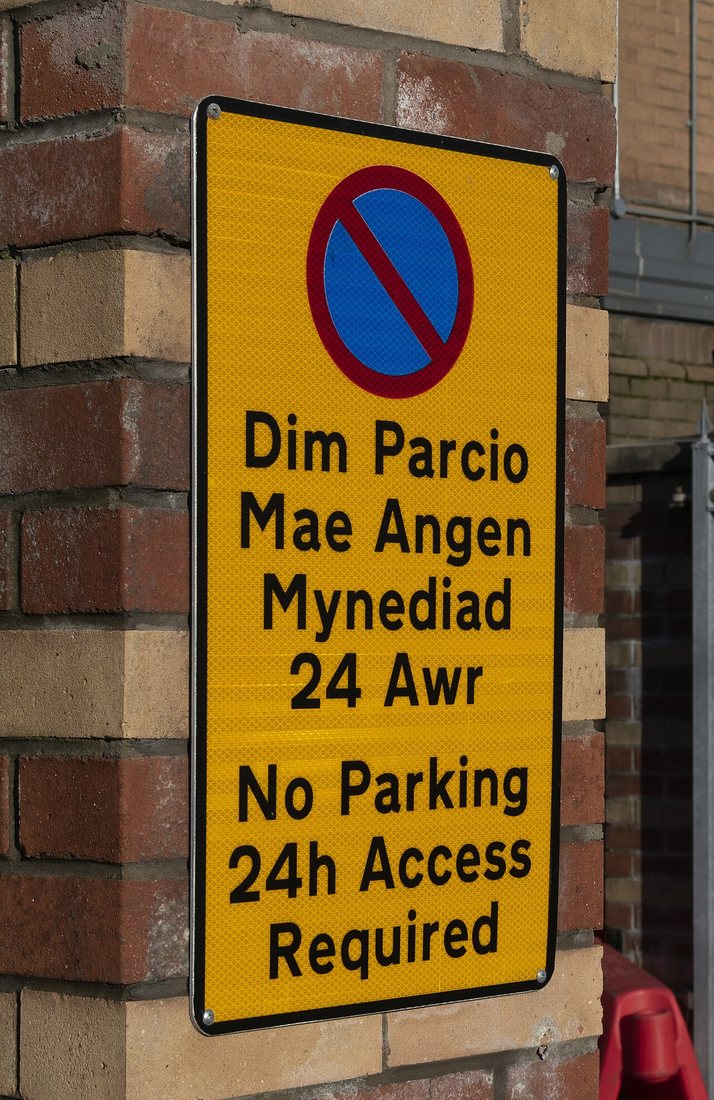
Bilingual signs in Wales
Welsh: schools, television and legislation
The revival began in education. In 1939 Ifan ab Owen Edwards founded the first Welsh-medium primary school in Aberystwyth (Ysgol Gymraeg Aberystwyth), and in 1956 the first Welsh-medium secondary school opened in Rhyl (Ysgol Glan Clwyd). The Welsh Language Society (Cymdeithas yr Iaith Gymraeg), founded in 1962, campaigned – including through civil disobedience – for Welsh in public administration, on road signs and in broadcasting. The Welsh-language television channel S4C began broadcasting in 1982.
Legislation followed. The Welsh Language Act 1967 guaranteed the right to speak Welsh in legal proceedings in Wales. The Welsh Language Act 1993 established the principle that in public business and the administration of justice in Wales, Welsh and English should be treated on a basis of equality, as far as reasonable and practicable; it set up the Welsh Language Board and required public bodies to draw up Welsh language schemes. The Welsh Language (Wales) Measure 2011, passed by what was then the National Assembly for Wales, gave Welsh explicit official status and replaced the Board with a Welsh Language Commissioner with powers to enforce the duties of public bodies and some companies.
In the 2021 census, 538,300 residents of Wales aged three and over, or 17.8%, said they could speak Welsh. That is more than in 1981 or 1991, but the lowest proportion in the history of the census, and down from 20.8% in 2001. Sample surveys such as the Annual Population Survey consistently give higher figures, largely because they ask the question differently and people rate their own ability differently. In its Cymraeg 2050 strategy the Welsh Government set a target of one million speakers by 2050.
Māori: from majority language to minority
Māori (te reo Māori) is the Eastern Polynesian language of the indigenous people of New Zealand and the southernmost member of the Austronesian family. In the 19th century most Māori spoke it, and in rural areas some settler children knew it too. School policy, however, promoted English: the Education Ordinance of 1847 made it the main language of schools, and in the early 20th century Māori pupils were punished, often physically, for speaking Māori in the classroom or the playground. Many parents accepted this because they wanted their children to succeed in an English-speaking society.
Until the Second World War Māori remained the first language of most Māori. The decline accelerated after the war, when Māori moved to the cities in large numbers and children grew up far from the grandparents who had traditionally played a large part in family life. By the 1980s fewer than 20% of Māori spoke the language at the level of a native speaker, and many of them no longer used it at home. Already in the 1970s groups of young Māori, among them Ngā Tamatoa, campaigned for Māori to be taught in schools; in 1972 a petition with tens of thousands of signatures was presented to Parliament. Māori Language Week (Te Wiki o te Reo Māori) has been held every year since 1975.
Nests, schools and official status
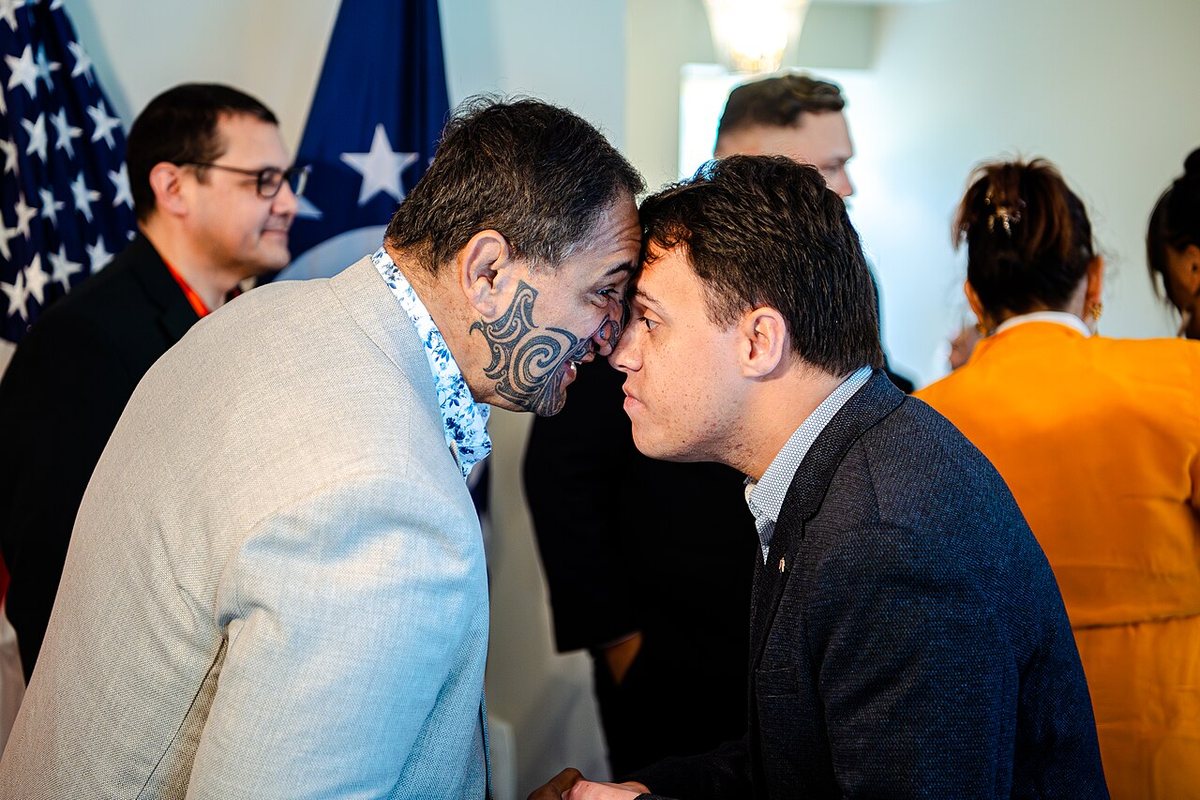
The best-known instrument of the Māori revival is the kōhanga reo, literally "language nest". The first opened in 1982 in Wainuiomata near Wellington, and three years later there were more than 300. They are preschools for children up to six in which only Māori is spoken, run by the families (whānau) themselves with the involvement of respected elders (kaumātua). They were followed by kura kaupapa Māori, schools taught through Māori – the first in 1985 – whose status was set out in the Education Act 1989. Other communities adopted the idea of language nests, among them the Hawaiians (Pūnana Leo).
In 1986 the Waitangi Tribunal, which hears Māori claims under the Treaty of Waitangi (1840), found that the Māori language is a taonga, a treasure protected by the Treaty. Parliament then passed the Māori Language Act 1987, which made Māori an official language, guaranteed the right to use it in court and established the Māori Language Commission (now Te Taura Whiri i te Reo Māori). In 2016 it was replaced by Te Ture mō Te Reo Māori.
In the 2023 census, 213,849 residents of New Zealand (4.3%) said they could hold a conversation about everyday things in Māori, up from 148,395 in 2013. Among people of Māori ethnicity the figure was 20.5%. The proficiency of these speakers varies widely, and only a minority use Māori as their main language at home. In 2011 the Waitangi Tribunal warned that after a genuine revival in the 1980s and early to mid-1990s the language was weakening again, partly because of the loss of the older native speakers who had led the revival.
Manx: the language that did not disappear
Manx (Gaelg) is the Goidelic Celtic language of the Isle of Man in the Irish Sea, closely related to Irish and Scottish Gaelic. Henry Jenner estimated in 1874 that about 30% of the island's population still spoke it. Parents, however, stopped passing it on to their children, considering English more useful, and in the 1961 census only 165 people reported knowing Manx.
The Manx Language Society (Yn Çheshaght Ghailckagh) was founded in 1899. By the mid-20th century only a few elderly native speakers remained; in 1948, at the instigation of Éamon de Valera, the Irish Folklore Commission recorded them, and the recordings later helped the revival. Ned Maddrell, who died on 27 December 1974, is often described as the last native speaker of Manx – more precisely, as the last person to have grown up in a community where Manx was the everyday language. "Last speaker" is always something of a simplification with dying languages, because the line between native speakers, people who only heard the language as children, and those who learned it later tends to be blurred.
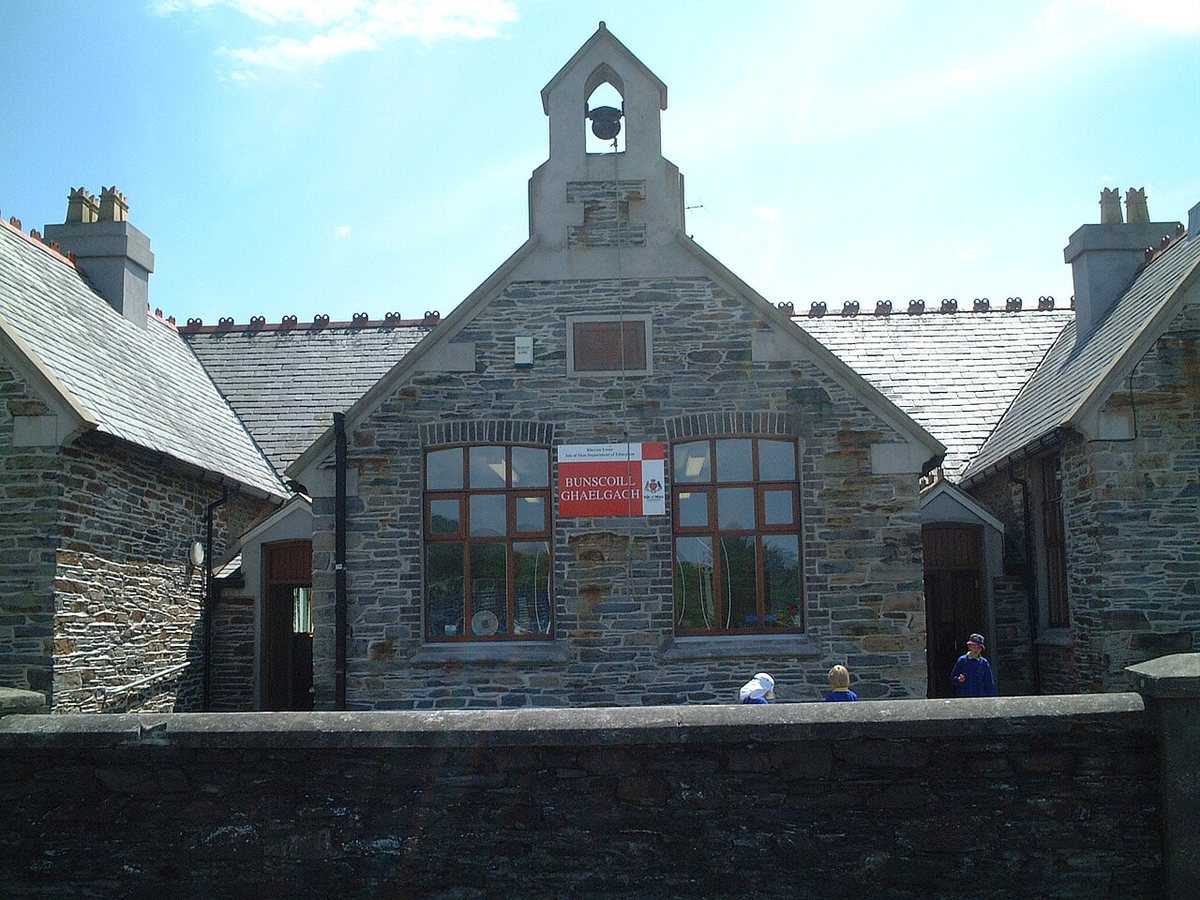
Manx never fell entirely out of use. Enthusiasts learned it from the last speakers and from written sources, including the Manx translation of the Bible, first published complete in a single volume in 1775. A Manx language unit headed by Brian Stowell was set up in 1992, and today Manx is taught as an optional subject in all the island's primary and secondary schools. The Bunscoill Ghaelgagh, a primary school in St John's, provides nearly all its teaching in Manx (it had 67 pupils in 2016), and the Mooinjer Veggey playgroups introduce the language to even younger children. The first novel in Manx appeared in 2006.
In the 2021 census over 2,000 residents of the island reported some knowledge of Manx, nearly all as a second language; whether children raised in Manx from birth count as new native speakers is a matter of debate. In 2009 UNESCO's Atlas of the World's Languages in Danger listed Manx as extinct, although hundreds of people on the island spoke it; UNESCO later changed the classification to critically endangered. This atlas, following Glottolog (source: ElCat), lists Manx as an awakening language.
Hebrew: an exceptional case
Hebrew (עברית, ivrit) is the only generally recognised case of a language that had no native speakers for centuries becoming the mother tongue of a whole community again – today of millions of people. It ceased to be a mother tongue in late antiquity, but it never stopped being written and read: it served for prayer, scholarship and literature, and as a means of communication between Jewish communities with different mother tongues. The revival therefore did not start from nothing. What was missing were words for the modern world and, above all, families to pass the language on to their children.
The revival is most often associated with Eliezer Ben-Yehuda (1858–1922), who settled in Jerusalem in 1881, spoke only Hebrew at home, published Hebrew newspapers, coined new words and began compiling a large dictionary. His son Itamar Ben-Avi (born 1882) is often described as the first native speaker of Modern Hebrew. In the prevailing view, however, Ben-Yehuda's role was chiefly that of an initiator and a symbol. What proved decisive were the Hebrew schools in the agricultural settlements of immigrants – in Rishon LeZion, for example, teaching was entirely in Hebrew from 1886 – and the children who adopted Hebrew as their own language. The Hebrew Language Committee, forerunner of the Academy of the Hebrew Language (1953), was founded in 1890; in 1922 Hebrew became one of the official languages of British Mandatory Palestine, and since 1948 it has been an official language of Israel. The page on the Hebrews and the Arameans tells the story in more detail.
Why it succeeded here is usually explained by a combination of circumstances that are hard to repeat elsewhere: immigrants with different mother tongues needed a common language, Hebrew had a rich written tradition, and for the new community it was a symbol of national renewal. How far the revived language differs from the old one is disputed. The linguist Ghil'ad Zuckermann argues that present-day Israeli Hebrew is a hybrid language with a strong Yiddish and wider European component; other scholars stress its continuity with earlier Hebrew in grammar and vocabulary.
Four languages in figures
Census figures reflect what people say about themselves, and each country asks the question differently, so the languages cannot be compared directly. Endangerment grades are those used in this atlas (Glottolog).
| language | then | measures | now |
|---|---|---|---|
| Welsh | 1891: 54% of the population of Wales (910,289 people); 1981: 19% (503,532) | Welsh-medium schools from 1939; S4C television (1982); Acts of 1967, 1993 and 2011 | 2021: 538,300 people, 17.8% (census); vulnerable |
| Māori | first language of most Māori until the Second World War; by the 1980s fewer than 20% of Māori at native-speaker level | kōhanga reo (1982), kura kaupapa Māori (1985), official language (1987) | 2023: 213,849 people, 4.3% of the population, can hold a conversation (census); definitely endangered |
| Manx | 1874: about 30% of the island's population (estimate by H. Jenner); 1961: 165 people (census) | Yn Çheshaght Ghailckagh (1899); recordings of the last speakers (1948); systematic teaching in schools from 1992; Bunscoill Ghaelgagh | 2021: over 2,000 people with some knowledge (census); awakening, critically endangered according to UNESCO |
| Hebrew | no native speakers from late antiquity (c. 200–400 CE); a language of worship and writing | Hebrew schools in the settlements (from the 1880s); official language of Mandatory Palestine (1922) and Israel (1948) | about 9 million speakers, around 5 million of them native (Ethnologue 2018); safe |
Timeline
- 1535 and 1542Acts bring Wales into the English legal system; the first reserves public office for those who use English.
- 1847The report on education in Wales known as the Treachery of the Blue Books; in New Zealand the Education Ordinance promotes English.
- 1899The Manx Language Society (Yn Çheshaght Ghailckagh) is founded.
- 1922Hebrew becomes one of the official languages of Mandatory Palestine.
- 1939The first Welsh-medium primary school opens in Aberystwyth.
- 1948The Irish Folklore Commission records the last native speakers of Manx.
- 1962The Welsh Language Society (Cymdeithas yr Iaith Gymraeg) is founded.
- 27 Dec 1974Death of Ned Maddrell, usually described as the last native speaker of Manx.
- 1975The first Māori Language Week (Te Wiki o te Reo Māori).
- 1982The first kōhanga reo opens in Wainuiomata; the Welsh-language channel S4C begins broadcasting.
- 1987The Māori Language Act makes Māori an official language of New Zealand.
- 1993The Welsh Language Act: Welsh and English to be treated equally in public business in Wales.
- 2009UNESCO lists Manx as extinct; the classification is later changed to critically endangered.
- 2011Welsh gains official status in Wales (Welsh Language (Wales) Measure 2011).
Languages on the globe
Tap a language to show it on the globe:
Sources and further reading
- Joshua A. Fishman: Reversing Language Shift. Theoretical and Empirical Foundations of Assistance to Threatened Languages. Multilingual Matters 1991.
- David Crystal: Language Death. Cambridge University Press 2000.
- Leanne Hinton, Ken Hale (eds.): The Green Book of Language Revitalization in Practice. Academic Press 2001.
- Lenore A. Grenoble, Lindsay J. Whaley: Saving Languages. An Introduction to Language Revitalization. Cambridge University Press 2006.
- Christopher Moseley (ed.): Atlas of the World's Languages in Danger. 3rd ed., UNESCO Publishing 2010.
- Ghil'ad Zuckermann: Revivalistics. From the Genesis of Israeli to Language Reclamation in Australia and Beyond. Oxford University Press 2020.